Pearl Jewelry suite consisting of a necklace, a pair of pendent earrings and a ring
Open FREE Unlimited Store Join Our Newsletter
Origin of Name :-
The name refers to a natural pearl jewelry suite, composed of a single-row pearl necklace, a pair of drop-shaped pearl ear-pendants and a pearl ring designated as Lot No. 159, at the Christie's Contemporary Jewelry and Watches Sale, No. 7664, held on April 29, 2008, at Jumeirah Emirates Towers Hotel, Dubai. United Arab Emirates. The jewelry suite was sold for $73,000, much above the pre-sale estimate of $35,000 to $45,000. Seven out of the 15 lots sold at this auction, registered prices above the upper pre-sale estimate, indicative of the strong auction demand for natural pearls.

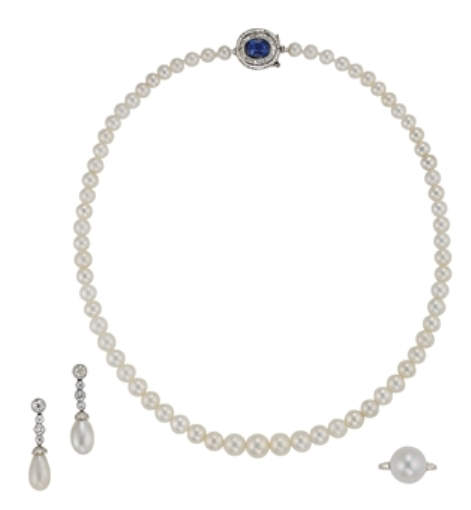
Pearl jewelry suite consisting of a necklace, pair of pendent earrings and a ring
Please click here for an enlarged image (External Link)
Characteristics of the pearl jewelry suite
Characteristics of the necklace
The necklace is a choker under the modern system of classification of pearl necklaces
The necklace is a single-row pearl necklace, made up of 68 graduated pearls, with a range in size of 4.5 mm to 7.9 mm. The length of the necklace is 39.5 cm (15.5 inches), which under the modern system of classification of pearl necklaces is a "choker," which includes pearl strands of 14-16 inches.
The size and shape of the pearls in the necklace
The single-strand of graduated pearls vary in size from 4.5 mm to 7.9 mm. The largest pearls are situated in the front lower part of the necklace. The pearls gradually decrease in size, and the smallest pearls are found towards the rear of the necklace. The shape of the pearls appear to be spherical, but closer examination shows that strand includes spherical, near-spherical and button-shaped pearls. This is in keeping with the natural provenance of the pearls, as finding 68 pearls, all of which are perfectly spherical, among natural pearls would be an extremely difficult task.
The color and overtone of the pearls in the necklace
The color of the pearls are white, the most sought-after color in pearls. On zooming the pearls actually appear silvery-white. Thus, while the body color of the pearls are white, silver is an overtone color. The white body color is associated with the lack of any pigments in the conchiolin part of the nacre, which being transparent allows the white color of aragonite to show through. The silver overtone color is an optical effect caused by light passing through successive layers of aragonite.
The luster and orient of the pearls in the necklace
The luster and orient of the pearls are also exceptional, being pearls of saltwater origin. Luster is caused by reflection of light from the surface and just below the surface of the nacre, and is greater for saltwater pearls than freshwater pearls. Orient is caused by refraction that scatters light into its component colors, as it passes through successive layers of aragonite platelets. Luster, orient and overtones are all dependant on the thickness of the nacre; properties which are optimum for natural pearls, being composed entirely of nacre. This explains why such optical properties had remained unchanged in many natural pearls, some of which are over 400 to 500 years old, such as the La Peregrina, the Mancini Pearls and the Barbara Hutton Pearls. It is a matter of debate whether modern-day cultured pearls would be able to retain such optical properties for very long periods of time as their natural counterparts.
The clasp of the necklace
The clasp of the necklace is composed of a single blue sapphire and baguette-cut diamonds. The blue sapphire is cushion-shaped and occupies the center of the clasp. The two diamond surrounds encircling the blue sapphire are oval shaped and set with baguette cut diamonds.
Characteristics of the pair of pearl ear-pendants
The pair of ear-pendants are made up of two drop-shaped pearls, which are almost identical in size, shape, color and other optical properties. One of the drop-shaped pearls has an almost perfect drop-shape, while the other slightly bulges in the center, and is slightly shorter than the first pearl. The dimensions of the drop-shaped pearls are approximately 13.5 mm and 7.5 mm, respectively the greatest length and width of the pearls. Each of the ear-pendants are approximately 3.0 cm long. The color of the drop-shaped pearls are silvery-white, matching with the color of the pearls in the necklace and the ring. The luster and orient of the drop-shaped pearls also match with that of the pearls in the necklace. This points to the common origin of these pearls, from the same saltwater oyster species, and perhaps from the same environment.
The drop-shaped pearls are suspended by a diamond line surmount, attached to the pearl by a bell cap arrangement, also mounted with diamonds. The line surmount is mounted with four diamonds, that look like old-European cut diamonds, the forerunner of the modern brilliant-cut diamonds. The metal used on the bell cap and surmount appears to be silver or platinum. The topmost part of the line surmount, which is circular and mounted with a diamond of similar shape, carries the screw-pin that secures the ear-pendant to the lobes of the ear.
Characteristics of the pearl ring
The largest pearl in the suite a button-shaped pearl with a long and short diameter of 12.01 and 10.0 mm and weighing 10.21 carats (40.84 grains) is incorporated in the ring. Even though the pearl is described as a button, it is in fact a near-spherical pearl, as the variation in diameter between the long and short diameters is less than 20%. The variation in diameter is given by (1-short diameter/long diameter) x 100% = (1 - 10/12.01) x 100 = (1 - 0.83) x 100 = 0.17 x 100 = 17%. A pearl with a variation in diameter between 0% to 2% is defined as a perfectly spherical pearl. When the variation in diameter is between 2% to 20%, the pearl is said to be near-spherical. When the variation in diameter is greater than 20% the pearl is known as button-shaped. The near-spherical pearl is also silvery-white in color, matching the color of the pearls in the necklace and ear-pendants. It also has the same luster and orient as the pearls in the necklace and the ear-pendants. Each of the shoulders of the ring is set with a single baguette cut diamond.
History of the pearl jewelry suite
Nothing is known of the historical provenance of this pearl jewelry suite. The identity of the owner who put up the suite for sale was also withheld. The suite appears to be of 19th-century origin, according to certain features in the jewelry, such as the diamond cuts and design features in the ear-pendants and the clasp. The features of the pearls such as its range in size from 4.5 mm to 7.9 mm and the silvery-white color, shows that the pearls originated in the most prolific pearl producing oyster species in the world, Pinctada radiata, the main source of pearls for the world since very ancient times. Thus the possible sources of these pearls can be the Persian Gulf, the Red Sea or the Gulf of Mannar, the hub of the international pearl industry since very ancient times. An alternative source of the pearls could be Venezuela, the source of the Atlantic pearls, also produced by Pinctada radiata ( previously Pinctada imbricata), during the 16th to 17th centuries.
Lab Reports from the Gem Testing Laboratory of Great Britain
All three pieces of jewelry in the suite, the necklace, the ear-pendants and the ring are supported by Lab Reports issued by the Gem Testing Laboratory of Great Britain, certifying that the pearls incorporated in the pieces are all natural pearls.
Report No. 0127828 dated January 16, 2008, authenticates the natural provenance of the pearls comprising the necklace. Report No.0127723 dated November 27, 2007, covers the natural authenticity of the pearls in the pair of ear-pendants. Report No. 0127729 dated November 28, 2007, certifies that the single button-shaped pearl incorporated in the ring is also natural.
Sale of the pearl jewelry suite at the auctions
The pearl jewelry suite was Lot No. 159 at the Christie's Contemporary Jewelry and Watches Sale, No. 7664, held at the Jumeirah Emirates Towers Hotel in Dubai, the United Arab Emirates. A presale estimate of $35,000 to $45,000 was placed on the suite. However, after a keenly contested bid, the pearl jewelry suite, eventually sold for $73,000, higher than the upper pre-sale estimate by $28,000. This is in keeping with the current strong auction demand for natural pearls and jewelry incorporated with such pearls, a trend that began with the onset of the new millennium, in a market that was dominated by cultured pearls for over half-a-century. Out of the 15 lots of natural pearl jewelry that appeared at this auctions, seven lots registered prices much higher than the pre-sale estimate, in keeping with this trend. The highest prices recorded at the sale was Lot No. 178, A superb four-row natural pearl and diamond necklace, that realized $1, 743,400 and Lot No. 147, the Umm Kulthum's nine-row satlada necklace, that realized $1,385,000. See table below.
Table of the 15 lots of pearl jewelry that appeared at the Christie's auction in Dubai on April 29, 2008, giving the pre-sale estimates and final prices realized
| S/N | Lot No. | Lot Description |
Pre-Sale Estimate | Price Realized |
| 1 | 147 |
An imposing antique Indian natural pearl nine-row necklace that belonged to Umm Kulthum, the legendary Egyptian singer | $80,000-$120,000 | $1,385,000 |
| 2 | 148 | A fine pair of natural pearl and diamond ear pendants | $60,000-$80,000 | $157,000 |
| 3 | 149 | An attractive natural black pearl ring | $50,000-$70,000 | $43,000 |
| 4 | 154 | An attractive antique natural pearl and diamond pendent brooch | $60,000-$80,000 | $97,000 |
| 5 | 155 | A natural pearl and diamond pendent necklace | $25,000-$35,000 | $43,000 |
| 6 | 156 | A natural pearl and diamond necklace | $150,000-$180,000 | $205,000 |
| 7 | 158 | A pair of natural pearl earrings | $20,000-$30,000 | $29,800 |
| 8 | 159 | A pretty group of natural pearl and diamond jewelry | $35,000-$45,000 | $73,000 |
| 9 | 160 | An attractive pair of antique natural pearl and diamond ear pendants | $180,000-$250,000 | $217,000 |
| 10 | 162 | A natural pearl, diamond and ruby pendent necklace | $45,000-$50,000 | $94,600 |
| 11 | 163 | A four-row natural pearl necklace | $50,000-$80,000 | $61,000 |
| 12 | 166 | A highly important orange natural pearl | $600,000-$800,000 | $713,000 |
| 13 | 172 | An important pearl and diamond suite, by Gerard | $400,000-$600,000 | $481,000 |
| 14 | 174 | An exceptional belle époque natural grey/brown pearl pendant necklace | $700,000-$1,000,000 | $769,000 |
| 15 | 178 | A superb four-row natural pearl and diamond necklace | $1,800,000 -$2,200,000 | $1,743,400 |
You are welcome to discuss this post/related topics with Dr Shihaan and other experts from around the world in our FORUMS (forums.internetstones.com)
Related :-
1) Superb Four-Row Natural Pearl and Diamond Necklace
2) Four-Row Natural Pearl Necklace
External Links :-
 Home
Security & Guarantee
How it Works
Technology Partners
Updated Tables
Famous Diamonds
More Famous Diamonds
Famous Pearls
Famous Gemstones
Contact Dr Shihaan Larif
Contact Senior Editor
Famous Jewelry
Reference Database
Forums
Learning Center
Gemstone Gallery
e-mail Notifications
Advertise
Press Release
About Us
Privacy Policy
Contact Us
FAQ'S
Site Map
Staff Mail Login
Staff Documents
Birthstones
History
Minerals
Shows
Live Metal Prices
Jewellery Gallery
News
Marketplace
Marketplace Support
Open Store
Online Auctions
Join Us & Contribute
Directory
Classifieds
List your products
Wholesale Trading
Post Buy Request
Go Green Policy
Site Updates
Upcoming-ToDo List
Latest News
Latest Articles
Latest Blog Updates
Chat Rooms
Job Board
User Gallery
Videos
New Newsletter Archive
Old Newsletter Archive
Jewelry & Mineral Blog
User Blogs & Social Network
Search
Answers (Q & A)
Valuation
Help me find a diamond/jewelry
pin.internetstones.com- Social Pinboard- Sart yours & connect with millions
Invite Friends From Yahoo, Gmail etc-One Click
Home
Security & Guarantee
How it Works
Technology Partners
Updated Tables
Famous Diamonds
More Famous Diamonds
Famous Pearls
Famous Gemstones
Contact Dr Shihaan Larif
Contact Senior Editor
Famous Jewelry
Reference Database
Forums
Learning Center
Gemstone Gallery
e-mail Notifications
Advertise
Press Release
About Us
Privacy Policy
Contact Us
FAQ'S
Site Map
Staff Mail Login
Staff Documents
Birthstones
History
Minerals
Shows
Live Metal Prices
Jewellery Gallery
News
Marketplace
Marketplace Support
Open Store
Online Auctions
Join Us & Contribute
Directory
Classifieds
List your products
Wholesale Trading
Post Buy Request
Go Green Policy
Site Updates
Upcoming-ToDo List
Latest News
Latest Articles
Latest Blog Updates
Chat Rooms
Job Board
User Gallery
Videos
New Newsletter Archive
Old Newsletter Archive
Jewelry & Mineral Blog
User Blogs & Social Network
Search
Answers (Q & A)
Valuation
Help me find a diamond/jewelry
pin.internetstones.com- Social Pinboard- Sart yours & connect with millions
Invite Friends From Yahoo, Gmail etc-One Click




Our Global Jewelry Industry Job Network


Buy & Sell in our Marketplace

Subscribe to our Newsletter

List in our Classifieds

List in our Directory

User Uploaded Gallery

Powered by Ultra Secure
Amazon (USA) Cloud Network

Founder Internet Stones.COM
Register in our Forums

| Featured In
|
|
|
|
|
|
|
|







Blog & Education Feed
Articles Feed
 |
 |
 |

Copyright © .Internet Stones.COM. All rights reserved.