Pearl of Asia
Open FREE Unlimited Store Join Our Newsletter
Origin of name
The "Pearl of Asia" believed to be the largest natural pearl in the world, with a weight of 600 carats, equivalent to 2,400 grains, has a history dating back to the early 17th century. The pearl as the name suggests was of Asian origin, discovered in the ancient and historic pearl fishing grounds of the Persian Gulf, somewhere between the late 16th and early 17th centuries. The pearl eventually entered the court of the Moghul Emperors of India, at the time of Emperor Shah Jahan (1628-1658), and subsequently passed through the hands of the King of Persia, Nadir Shah and later the Emperor of China, Qianlong, and reached the west only in the early 20th century. Thus during the course of the pearl's almost 400-year old history, it had passed through the courts of three of the greatest empires of Asia, the Moghul Empire, the Persian Empire and the Chinese Empire, lasting a period of over 300 years, and hence the name "Pearl of Asia" is indeed a true reflection of the origin and colorful history of the pearl.
Characteristics of the "Pearl of Asia"
The largest nacreous natural pearl in the world
The "Pearl of Asia" is an exceptionally large nacreous saltwater pearl, with dimensions of 76 x 50 x 28 mm, and a weight of 2,400 grains, equivalent to 600 carats or 120 grams. The pearl is reputed to be the largest nacreous natural pearl in the world, excluding the extraordinarily large "Pearl of Allah" which is non-nacreous.
The shape of the pearl
The pearl has a unique shape resembling the shape of a garden-egg or bringal (Solanum melongena). It is not certain where the pearl fits in under the eight basic shapes in which pearls are normally found in nature :- round, semi-round, button, drop, pear, oval, baroque and ringed. Perhaps the pearl may be described as a modified drop shape, or a garden-egg shaped baroque pearl, but certainly it does not fall under the category of a regular shaped pearl, such as round, drop, pear or oval. Thus if we consider the "Pearl of Asia" as a baroque pearl, it undoubtedly becomes the largest nacreous baroque pearl in the world.
The body color, overtones and orient of the pearl
The "Pearl of Asia" can be characterized as a white pearl with a silvery overtone. Given the white color of the pearl, with silvery overtones, and the shimmering iridescence, that had been maintained for over 400 years, the thickness of the nacre must be considerable, as body color and overtones of a pearl are mainly determined by the thickness and number of layers of nacre. The shimmering iridescent colors of the pearl, known as the "orient" of the pearl, is caused by the reflection and scattering of light as it passes through the layers of nacre on the surface.
The present setting of the "Pearl of Asia"
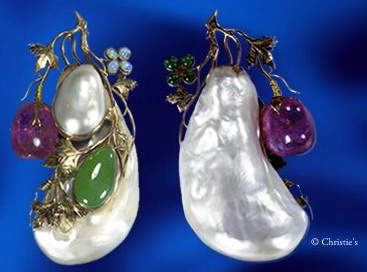
The settings of the pearl, when it was part of the crown jewels of the Moghul Empire, the Persian Empire or the Chinese Empire are not known. But, after the pearl reached the west, during the early years of the 20th century, the pearl was set in its present setting, resembling a bunch of fruits, with golden branches and leaves. The garden-egg shaped, Pearl of Asia, is the largest fruit on this bunch. There are three other large fruits on this bunch, represented by a smaller oval-shaped white pearl, and two other oval-shaped, cabochon-cut gemstones, made of jade and purple (pink) quartz. There are a few other smaller spherical-shaped fruits in the bunch, made up of an unknown variety of gemstones. The twigs and leaves of this bunch are made out of gold.
© Christie's
Two different lateral views of the "bunch-of-fruits" setting of the Pearl of Asia
This natural setting representing a bunch of fruits, is in keeping with the designs for baroque pearls that was prevalent in the west, during the 16th and 17th centuries. The designer of the piece of jewelry used his imagination, to integrate the curious shapes of baroque pearls into the composite design he had already visualized for the pearl. Other examples of such creations include, the swan pendant, exhibited in the State Hermitage Museum in St. Petersburg, and the pendant setting for the "Hope Pearl." The incorporation of the "Pearl of Asia" into this composite "bunch-of-fruits" setting, is in conformity with the 16th and 17th century designs, even though the design was executed in the early 20th century. The designers of this unique piece of jewelry are however not known.
History of the Pearl of Asia
Source of the pearl
The Persian Gulf, one of the most ancient sources of pearls in he world
The "Pearl of Asia" was reported to have been discovered in the ancient and historic pearl fishing grounds of the Persian Gulf, between the late 16th and early 17th centuries. The Persian Gulf, the Red Sea and the Gulf of Mannar in Sri Lanka, had been the hub of the international pearl trade for over 4,000 years. The Persian Gulf region had produced some of the world's finest natural pearls since ancient times. The Greek Historian Pliny in his book Historia Naturalis, referred to the high quality of the Persian Gulf pearls in the following terms :- "But the most perfect and exquisite pearls of all others, be they, that are gotten about Arabia, within the Persian Gulf."
Countries with a coastline on the Persian Gulf
The Persian Gulf is an inland sea, originating from the Indian ocean, and situated in West Asia between Iran and the Arabian Peninsula. The area of the Gulf is around 251,000 km², with a length of 989 km and width of around 160 km. The width of the Gulf at its narrowest point in the Strait of Hormuz, is about 56 km. Overall the Gulf is considered a shallow sea, with an average depth of 50 meters, and a maximum depth of around 90 meters. The Strait of Hormuz in the east, connects the Persian Gulf to the Gulf of Oman. The western end of the Gulf is occupied by the Shatt-al-Arab, a major river delta, into which flows the waters of the Euphrates and Tigris. Countries with a coastline on the Persian Gulf are Iran, Oman, United Arab Emirates, Saudi Arabia, Qatar, Bahrain, Kuwait and Iraq. Most of the northern coastline of the Gulf is occupied by Iran and likewise most of the southern coastline is occupied by Saudi Arabia.
The main pearl fishing areas in the Gulf
Oyster beds or oyster reefs are found in underwater geological formations known as the pearl banks. The pearl banks extend from a few hundred meters to around 96 km from the shore, at depths ranging from 2 to 18 fathoms (3.6 to 32.4 meters). The banks stretch on the Arabian side of the Persian Gulf, from Kuwait and the Island of Bahrain in the west, to Oman on the tip of the Arabian peninsula, including the Strait of Hormuz, and extending up to the Kish island on the Persian side of the Gulf. The oyster reefs are in greatest abundance on the Arab side of the Gulf, especially in the vicinity of the Bahrain Islands. Thus most of the pearl fishing seem to have been concentrated around the islands of Bahrain, since ancient times, and Ptolemy, the 2nd century AD geographer and astronomer refers to the pearl fisheries that existed from time immemorial at Tylos, the Roman name for the present Island of Bahrain. Other important pearling areas in the Gulf, were the areas near the Island of Dalmah off Abu Dhabi, Abu Musa, Hormuz, and the Lavan-Kish Island group.
Colonization of the main pearl fishing areas in the Persian Gulf
The rich pearl banks of the Persian Gulf, and the renowned quality and size of the pearls produced, attracted the attention of the colonialists, starting from the early 16th century, when in 1504, the Portuguese took control of all the main pearling port cities of the Persian Gulf, such as Kuwait, Hormuz and Bahrain. After the expulsion of the Portuguese in 1620, by the Persians with the help of the British, most of the islands in the Gulf came under the control of different colonial masters, such as the Dutch, British and the French and also the regional powers such as the Persian and Ottoman empires.
From what species of Pinctada was the "Pearl of Asia" discovered ?
The two common species of pearl oysters found in the Persian Gulf are the Pinctada radiata (Gulf-pearl oyster) and Pinctada margaritifera (Black-lip oyster). However, given the size of the Pearl of Asia (7.6 x 5.0 x 2.8 cm) it is doubtful whether the pearl could have developed in any one of these species, as the maximum size attained by Pinctada radiata is 7 to 8 cm, and Pinctada margaritifera, the Black-lip oyster produces mainly black pearls, even though it can grow to a maximum size of 15 to 20 cm. Pinctada radiata mainly produces seed pearls and some pearls of medium size. The species Pinctada maxima (White-lip oyster) can grow up to a maximum of 30 cm (12 ins.) in diameter. Such a large pearl oyster could have easily accommodated a pearl as big as the "Pearl of Asia." But the natural habitat of this pearl is the South Sea, that lies between the southern coast of China and the northern coast of Australia. Pinctada maxima is also found in Australia, Fiji and Tahiti in the South Pacific, besides the South Sea, the Philippines and Myanmar in Asia. Even though the common species of Oysters, that were found in the Persian Gulf were Pinctada radiata and Pinctada margaritifera, it was quite possible that the species Pinctada maxima could also have co-existed with these two species, though to a lesser extent. This may perhaps explain the discovery of this large saltwater pearl in the Persian Gulf.
The "Pearl of Asia" enters Emperor Shah Jahan's court
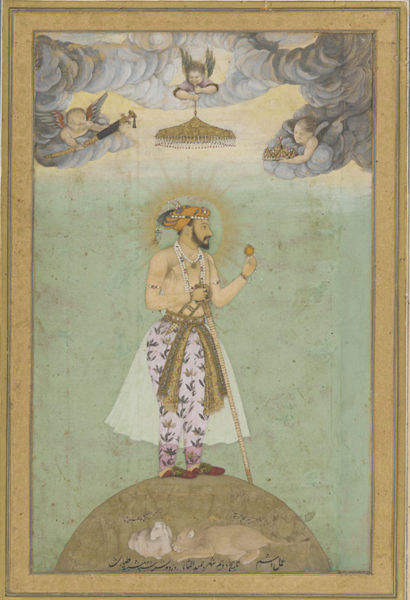
The "Pearl of Asia" was discovered in the late 16th or early 17th centuries in the Persian Gulf. The pearls that were discovered in the Gulf, during this period, were eventually exported to the outside world, mainly through two commercial centers in the region, Baghdad and Bombay. The "Pearl of Asia" that reached Bombay during the time of Emperor Shah Jahan, were eventually purchased by agents of the Emperor, who were astonished not only by the enormous size of the pearl, being the biggest pearl ever discovered at that time, but also by its silvery white color, luster and brilliance. The decision to purchase the pearl for the Emperor, by the agents, would have been influenced by their awareness of the Emperor's great and selective tastes that always gave priority to the highest quality in acquiring gemstones and diamonds.
Emperor Shah Jahan
Shah Jahan's court was renowned for its extravagance and great pomp and pageantry. Shah Jahan also believed that jewels belonging to the crown, were not to be hidden and stacked away in an underground vault, but used in everyway possible way in the court, in order to enhance the brilliance of the court and the status of the sovereign, while also giving an opportunity to the subjects to appreciate the beauty of the crown jewels. It was in line with this thinking that Shah Jahan, got the court artisans and jewelers, to design and construct the most splendorous throne ever constructed in human history, covered entirely with gold and encrusted with the most expensive of diamonds, pearls, emeralds, rubies and sapphires, that came to be known as the "Peacock Throne." According to a conservative estimation made by jewelry historians, the value of the "Peacock Throne" in terms of current market values, adds up to a staggering one billion dollars !!!
It is not known whether "The Pearl of Asia" was one of the valuable jewels that bedecked the legendary "Peacock Throne" like the renowned "Koh-i-Noor Diamond," "Darya-i-Noor Diamond," "Noor-ul-Ain Diamond" "Akbar Shah Diamond," "Shah Diamond," "Golconda-D Diamond" etc. But according to jewelry historians, Emperor Shah Jahan gifted the "Pearl of Asia" to his favorite Queen Mumtaz Mahal, in whose memory subsequently he constructed the internationally renowned mausoleum "The Taj Mahal", to immortalize his love for her, after her death in childbirth in 1631.
The "Pearl of Asia" is carried away as part of an enormous booty by Emperor Nadir Shah of Iran
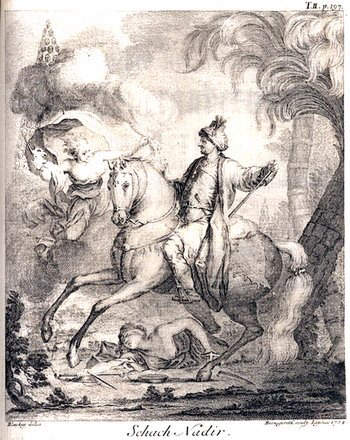
After Shah Jahan, the "Pearl of Asia" and other crown jewels including the "Peacock Throne" was inherited by his son, the mighty Aurangzeb (1658-1707), the last of the great Moghul emperors of India, under whom the Moghul empire reached its greatest extent. The "Pearl of India" then passed through a series of lesser Moghul emperors, that included Bahadur Shah (1707-1712), Jahandar Shah (1712-1713), Farrukh-siyar (1713-1719), and Muhammad Shah (1719-1748). It was during the reign of Muhammad Shah, that the greatest calamity befell the Moghul Empire, when the mighty Nadir Shah, the Emperor of neighboring Persia, decided to invade the capital cities of the Moghul Empire, Delhi and Agra, with a view of plundering its enormous wealth. In February 1739, Nadir defeated the Moghul army at Karnal and took Emperor Muhammad Shah prisoner. His forces then marched into Delhi and Agra, and took into their custody most of the crown jewels stored in the royal treasury, as well as jewels in the possession of members of the royal family and other aristocrats. He also took into his possession the renowned "Peacock Throne" of Shah Jahan, and got his unwilling host Muhammad Shah, to turn out a duplicate "Peacock Throne" using jewels from the Moghul treasury. Eventually, when Nadir Shah left Delhi in May 1739, he had carried with him a booty estimated at 70 crores or 700 million rupees. Besides the two "Peacock Thrones" the booty included several famous diamonds, like the Koh-i-Noor, the Darya-i-Noor, the Noor-ul-Ain, etc, several famous rubies, spinels, emeralds and pearls, including the "Pearl of Asia," and chest loads of emeralds, rubies, sapphires, pearls etc. The plunder of the Moghul wealth boosted the finances of Iran to such an extent that Nadir Shah was able to exempt all Iranians from taxes for the next three years.
Emperor Nadir Shah sends the "Pearl of Asia" as gift to Emperor Ch'ien-lung of China
As it was the tradition during this period, Emperor Nadir Shah sent gifts from the plundered loot to several of the sovereigns of neighboring countries. He sent the duplicate "Peacock Throne" as gift to Sultan Mahmud, the Ottoman Emperor, and this throne is preserved and displayed in the Topkapi Museum, in Istanbul, today. Other sovereigns who received gifts from Nadir Shah were Empress Elizabeth of Russia, and the ruler of Bukhara in Uzbekistan, Abul Faiz Khan. Among the valuable gifts he sent to the Emperor of China, Ch'ien-lung (Qian-long, 1735-1796), was the largest pearl ever discovered in the world, the "Pearl of Asia."
Emperor Ch'ien-lung of China
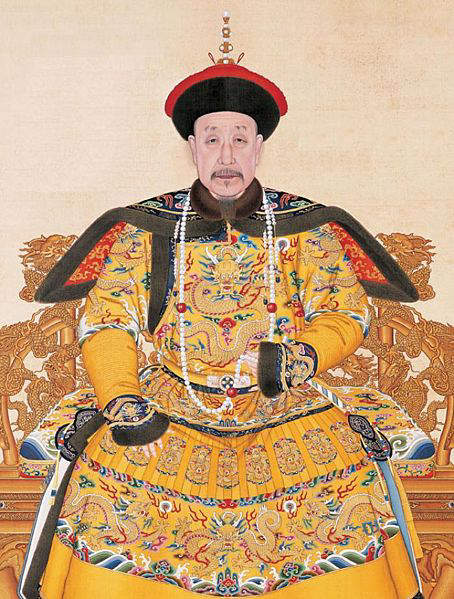
Ch'ien-lung the fourth emperor of the Ch'ing dynasty, ascended the throne of China, on October 18, 1735, at the age of 24, after the death of his father, Yung-cheng. He was the eldest surviving son of Emperor Yung-cheng, and since childhood was given a well planned education, including teachings of eminent scholar Fu-min, in anticipation of his future role as the Emperor of China. Ch'ien-ling had some distinctive physical characteristics that was very favorable for his role as the absolute monarch of the Chinese nation. These were his extraordinary height of almost 6 feet, his slender build and upright posture, which he maintained even in old age. He married his first wife at the age of 16 years, in 1727, to whom he was deeply attached and by whom he had a son in 1730, who died in his childhood in 1738. Subsequently he took a second wife, and several concubines, by whom he had 17 sons and 10 daughters.
Ch'ien-lung the fourth emperor of the Ch'ing dynasty of China
Under Ch'ien-lung the Ch'ing dynasty achieved its highest degree of power, and China reached its greatest expansion. Ch'ien-lung conducted a series of successful military campaigns, that eliminated the Turkish and Mongolian threats to northwestern China, and created the new province of Sinkiang (Hsin-chiang), that enlarged the extent of the empire. He also tightened his grip on Tibet, transferring political power from the Dalai Lama to two Chinese agents of the Emperor. He also subdued the Gurkhas of Nepal, the rebels of Yunnan province in southwest China, and the Burmese. In 1787, he suppressed a rebellion in Taiwan, and later exerted sufficient pressure on Vietnam in order to convert it into a tributary state.
Ch'ien-lung ruled for 60 years, one of the longest in the history of China, and second only to his grandfather K'ang-hsi, whose reign lasted for 61 years. However, despite his great achievements in the first 40 years of his rule, the last two decades of his rule, encountered many problems due to bad management, the cost of never ending military campaigns, compounded by corruption and nepotism, attributed to one of his favorite officers, Ho-shen, whose son married the Emperor's favorite daughter, and who was given a responsible position and became the most powerful person in the empire after the Emperor. Ch'ien-lung was also a great patron of the arts, and extended his patronage and protection to the artists of China. Under his rule, architecture, painting, porcelain, jade and ivory work flourished, the products finding a ready export market. However, his greatest contribution to the arts, was perhaps, his sponsorship of a compilation of Chinese classics. Ch'ien-lung abdicated his throne on February 9, 1796, after 60 years of rule, in favor of his fifth son, Yung-yen, who ascended the throne under the title of Chia-ch'ing.
The "Pearl of Asia" entombed with Emperor Ch'ien-lung's remains in 1799
Ch'ien-lung died on February 7, 1799, and was buried in a tomb, situated to the northeast of Beijing, called Yu-ling. The "Pearl of Asia" gifted by Nadir Shah, remained a valuable possession of Emperor Ch'ien-lung throughout his long reign of 60 years. The Emperor as well as his subjects believed that the rare and valuable pearl brought happiness and good fortune. Thus, when the Emperor died in 1799, the lucky pearl was placed in his tomb, in order to pay his debt on his arrival to Hades (Lord of the dead), as believed by the Chinese.
The "Pearl of Asia" is stolen by grave diggers in 1900
One year after the burial of the remains of Emperor Ch'ien-lung in the tomb known as Yu-ling in the northeast of Beijing, grave robbers looking for buried treasures desecrated his tomb. They dug up his grave and escaped with the valuable "Pearl of Asia," once the proud possession of Emperor Ch'ien-lung. The pearl then disappeared for sometime, until it re-surfaced again in Hong-Kong.
The "Pearl of Asia" is sold in Paris to a private collector
The "Pearl of Asia" that resurfaced in Hong Kong, was later taken to Paris, where the renowned pearl was sold to an anonymous private collector from Europe. It appears that the pearl was set in its present "bunch-of-fruits" setting only after its arrival in Europe. However, the exact time of designing the setting, and the designers involved in the setting are not known. Since its arrival in Europe, the pearl has passed through several hands, before becoming the property of its current owner.
The "Pearl of Asia" is displayed at the "Allure of Pearls" exhibition held at the Harry Winston Gallery of the NMNH of the Smithsonian Institution.
The "Pearl of Asia" was one of the twelve rarest pearls in the world, that went of public display for the first time, in the "Allure of Pearls" exhibition, held at the Harry Winston Gallery of the Janet Annenberg Hooker Hall of Geology, Gems and Minerals, of the NMNH of the Smithsonian Institution, from March 18, to September 5, 2005. The exhibition that was co-sponsored by Paspaley Pearls Pty. Ltd., Iridesse pearls and the Gemological Institute of America, was a tremendous success, and led to an awareness and appreciation of these marvels of nature, created by a group of living organisms called mollusks. The "Pearl of Asia" was loaned by Christie's to the NMNH of the Smithsonian Institution for the exhibition, who in turn appeared to have borrowed it from the present anonymous owner of the historic pearl. The same anonymous collector from England, had also loaned another famous and historic pearl for the occasion, the Hope Pearl. According to Jeffrey Post, curator of the museum's National Gem Collection, neither of these two famous pearls has been on public display for more than 40 years. In fact the display of the "Pearl of Asia" laid to rest many wild speculations about the whereabouts of this important and historic pearl, including a suggestion that the pearl was hidden in a Chinese museum or an European bank.
Related :-
2) Pearl of Allah/ Pearl of Lao Tzu
External Link :-
Allure of Pearls Exhibition-Smithsonian Institute
References
1.Pearl History Timeline - Pearl-Guide.com
2.Bahrain Pearling in Historic Times - karipearls.com
3.Persian Gulf & Red Sea Pearl Fisheries - Pearls and Pearling Life - Streeter
4.Persian Gulf - From Wikipedia, the free encyclopedia
5.The Jewel of the Deep - Richard Boyle
6.Pearl Oyster -From Wikipedia, the free encyclopedia
7.Book of the Pearl - Kunz &Stevenson
8.Mineral Sciences Exhibitions - Department of Mineral Sciences, www.mnh.si.edu/exhibits/pearls

 Home
Security & Guarantee
How it Works
Technology Partners
Updated Tables
Famous Diamonds
More Famous Diamonds
Famous Pearls
Famous Gemstones
Contact Dr Shihaan Larif
Contact Senior Editor
Famous Jewelry
Reference Database
Forums
Learning Center
Gemstone Gallery
e-mail Notifications
Advertise
Press Release
About Us
Privacy Policy
Contact Us
FAQ'S
Site Map
Staff Mail Login
Staff Documents
Birthstones
History
Minerals
Shows
Live Metal Prices
Jewellery Gallery
News
Marketplace
Marketplace Support
Open Store
Online Auctions
Join Us & Contribute
Directory
Classifieds
List your products
Wholesale Trading
Post Buy Request
Go Green Policy
Site Updates
Upcoming-ToDo List
Latest News
Latest Articles
Latest Blog Updates
Chat Rooms
Job Board
User Gallery
Videos
New Newsletter Archive
Old Newsletter Archive
Jewelry & Mineral Blog
User Blogs & Social Network
Search
Answers (Q & A)
Valuation
Help me find a diamond/jewelry
pin.internetstones.com- Social Pinboard- Sart yours & connect with millions
Invite Friends From Yahoo, Gmail etc-One Click
Home
Security & Guarantee
How it Works
Technology Partners
Updated Tables
Famous Diamonds
More Famous Diamonds
Famous Pearls
Famous Gemstones
Contact Dr Shihaan Larif
Contact Senior Editor
Famous Jewelry
Reference Database
Forums
Learning Center
Gemstone Gallery
e-mail Notifications
Advertise
Press Release
About Us
Privacy Policy
Contact Us
FAQ'S
Site Map
Staff Mail Login
Staff Documents
Birthstones
History
Minerals
Shows
Live Metal Prices
Jewellery Gallery
News
Marketplace
Marketplace Support
Open Store
Online Auctions
Join Us & Contribute
Directory
Classifieds
List your products
Wholesale Trading
Post Buy Request
Go Green Policy
Site Updates
Upcoming-ToDo List
Latest News
Latest Articles
Latest Blog Updates
Chat Rooms
Job Board
User Gallery
Videos
New Newsletter Archive
Old Newsletter Archive
Jewelry & Mineral Blog
User Blogs & Social Network
Search
Answers (Q & A)
Valuation
Help me find a diamond/jewelry
pin.internetstones.com- Social Pinboard- Sart yours & connect with millions
Invite Friends From Yahoo, Gmail etc-One Click




Our Global Jewelry Industry Job Network


Buy & Sell in our Marketplace

Subscribe to our Newsletter

List in our Classifieds

List in our Directory

User Uploaded Gallery

Powered by Ultra Secure
Amazon (USA) Cloud Network

Founder Internet Stones.COM
Register in our Forums

| Featured In
|
|
|
|
|
|
|
|







Blog & Education Feed
Articles Feed
 |
 |
 |

Copyright © .Internet Stones.COM. All rights reserved.