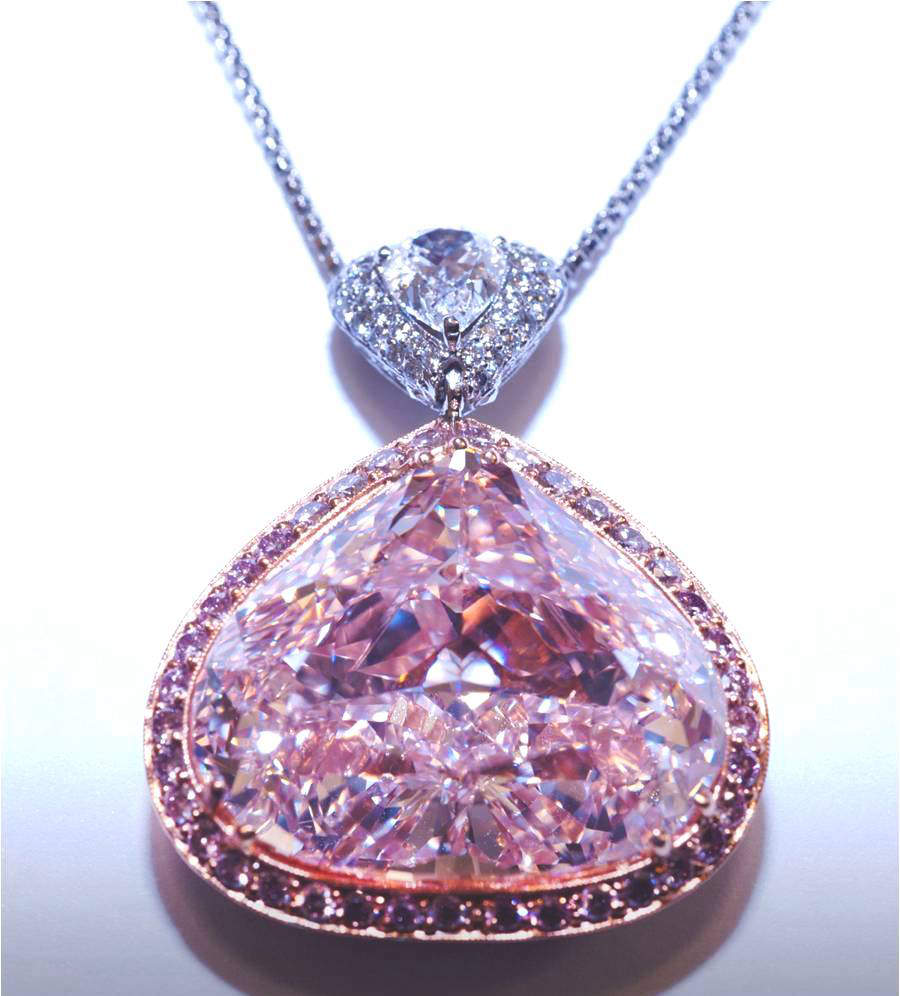
Pink Sunrise Diamond
Open FREE Unlimited Store Join Our Newsletter
Origin of name
The origin of the name "Pink Sunrise"is unknown as are other important details of this rare and unique diamond which first made it's appearance at the beginning of the 21st century. Perhaps, the name seems to reflect the unique color of this diamond, which is reminiscent of the shades of pink and red colors associated with the sun's appearance in the early morning eastern skies.

Characteristics of the diamond
The "Pink Sunrise"is a 29.79-carat, fancy pink, internally flawless (IF), diamond, with a modified heart shape, reminiscent of the renowned 273.85-carat, D-color, De Beers "Centenary Diamond", which had an identical shape.
The "Pink Sunrise"is a type IIa diamond. The important features of this class of diamonds are :-
1. They are Nitrogen free or contain undetectable quantities of Nitrogen.
2. The crystals are plastically deformed, which imparts the pink color to the diamonds.
3. They are very rare in occurrence, perhaps much less than 0.1 % of all naturally occurring diamonds.
History
Besides the color, cut, clarity and weight of the diamond, nothing else is known about the early history of the "Pink Sunrise", such as the date of discovery, the country of origin, the mine of origin, the original owners of the diamond, the circumstances of the discovery etc. The only fact we know for certain about the diamond is that it was cut by the world renowned master cutter Gabi Tolkowsky, perhaps in Antwerp, Belgium, and the finished stone was unveiled to the world at the beginning of the 21st century.
A casual inspection of the photographs of the "Pink Sunrise"and the "Centenary"diamonds immediately reveals a striking similarity in their shapes. This similarity is not a matter of coincidence, but caused by deliberate design, as the two stones were cut by the same world renowned master cutter Gabi Tolkowsky, who lives in Antwerp, Belgium, and hails from a family of diamond cutters, with five new diamond cuts to his credit. Gabi Tolkowsky has also earned the rare distinction of cutting the world's largest faceted diamond, the 545.67-carat, fancy yellow brown, IF clarity, cushion shaped diamond, the "Golden Jubilee", which was presented to the King of Thailand, by his subjects in 1997, to mark the Golden Jubilee of his Coronation. Tolkowsky referred to the cushion-cut employed on the "Golden Jubilee"as a "fire rose cushion-cut."
According to Gabi Tolkowsky, the "Pink Sunrise"was the first rare and unique historical diamond, that was ready to appear at the beginning of the 21st century. The cutting and polishing of the "Pink Sunrise"into a modified heart shape took more than an year, in spite of the smaller size and carat weight of the rough stone. Even though the shape of the two diamonds were strikingly similar, the "Pink Sunrise"had it's own individual beauty, with it's own pattern of facets and design.
Gabi Tolkowsky is reported to have said that the inspiration which he gets to select an appropriate design for a rough stone, from a range of available cuts, result from an imposed fact. According to him, "every diamond large or small is a unique individual. None is similar to another. The shape, volume, hue and purity in the rough appearance have a combined effect on the mind. All what happens is the fact of revolving the rough stone between two or three finger and peering onto and into it, with the small folding hand loupe."The greatest challenge to the cutter is to reveal the hidden potential and beauty of the rough stone by selecting the appropriate cut.
Perhaps being a new discovery, the stone doesn't have any legend or history associated with it, but without any doubt it has the potential of becoming a famous diamond, and building it's own legends as it passes down from generation to generation.
Occurrence of pink diamonds
Pink diamonds are extremely rare in occurrence. There are only about ten notable and famous pink diamonds in the world today, and almost all of them are less than 100 carats in weight. Even the smaller pink diamonds such as the ones produced in the Argyle Mines in Australia, are also extremely rare. A statistical estimate at the Argyle Mines in western Australia has shown that only a single carat of pink diamond is produced for every 1,000,000 carats of rough diamonds. This woks out to an astonishingly low percentage of 0.0001 %.
The earliest known source of pink diamonds in the world was the Kollur mines near Golconda, in Southern India. The Darya-i Nur, Nur-ul-Ain, Hortensia, and the Conde Pink might have originated in these mines. The next known source of pink diamonds were the diamond mines of Southern Africa. The Steinmetz Pink, Mouawad Lilac and the Mouawad Pink might have originated in these mines. Today the Argyle mines of western Australia have become a consistent source of pink diamond even though they are much smaller in size and have an average weight of about one carat. In spite of their smaller size the Argyle pink diamonds are noted for their intense pink colors which are superior to the lighter shades of pink, of diamonds from other traditional sources. At a Christie's auction in New York in 1989, a 3.14-carat Argyle pink diamond was sold for $ 1,510,000. This works out to about $ 480,000 per carat. But, privately Argyle had sold pink diamonds for up to $ 1,000,000 a carat.
List of famous and notable pink diamonds arranged in descending order of weights
S/N | Name | Carat Weight | Shape/Cut | Color |
| 1 | Darya-i-Nur | 186.00 | table | light pink |
| 2 | Nur-ul-Ain | 60.00 | oval | light pink |
| 3 | Steinmetz Pink | 59.60 | cushion | fancy vivid pink |
| 4 | Shah Jahan | 56.71 | table | light pink |
| 5 | Agra | 32.34 | cushion | fancy light pink |
| 6 | Pink Sunrise | 29.79 | mod. heart | fancy pink |
| 7 | Mouawad Lilac | 24.44 | emerald | fancy pink |
| 8 | Graff Pink Orchid | 22.84 | marquise | fancy purplish pink |
| 9 | Mouawad Pink | 21.06 | radiant | fancy pink |
| 10 | Hortensia | 20.00 | pentagonal | light orangish pink |
| 11 | Graff Pink Supreme | 10.83 | fancy pink | pear |
| 12 | Conde Pink | 9.01 | light pink | pear |
Back to Famous Diamonds,Gemstones and Pearls
 Home
Security & Guarantee
How it Works
Technology Partners
Updated Tables
Famous Diamonds
More Famous Diamonds
Famous Pearls
Famous Gemstones
Contact Dr Shihaan Larif
Contact Senior Editor
Famous Jewelry
Reference Database
Forums
Learning Center
Gemstone Gallery
e-mail Notifications
Advertise
Press Release
About Us
Privacy Policy
Contact Us
FAQ'S
Site Map
Staff Mail Login
Staff Documents
Birthstones
History
Minerals
Shows
Live Metal Prices
Jewellery Gallery
News
Marketplace
Marketplace Support
Open Store
Online Auctions
Join Us & Contribute
Directory
Classifieds
List your products
Wholesale Trading
Post Buy Request
Go Green Policy
Site Updates
Upcoming-ToDo List
Latest News
Latest Articles
Latest Blog Updates
Chat Rooms
Job Board
User Gallery
Videos
New Newsletter Archive
Old Newsletter Archive
Jewelry & Mineral Blog
User Blogs & Social Network
Search
Answers (Q & A)
Valuation
Help me find a diamond/jewelry
pin.internetstones.com- Social Pinboard- Sart yours & connect with millions
Invite Friends From Yahoo, Gmail etc-One Click
Home
Security & Guarantee
How it Works
Technology Partners
Updated Tables
Famous Diamonds
More Famous Diamonds
Famous Pearls
Famous Gemstones
Contact Dr Shihaan Larif
Contact Senior Editor
Famous Jewelry
Reference Database
Forums
Learning Center
Gemstone Gallery
e-mail Notifications
Advertise
Press Release
About Us
Privacy Policy
Contact Us
FAQ'S
Site Map
Staff Mail Login
Staff Documents
Birthstones
History
Minerals
Shows
Live Metal Prices
Jewellery Gallery
News
Marketplace
Marketplace Support
Open Store
Online Auctions
Join Us & Contribute
Directory
Classifieds
List your products
Wholesale Trading
Post Buy Request
Go Green Policy
Site Updates
Upcoming-ToDo List
Latest News
Latest Articles
Latest Blog Updates
Chat Rooms
Job Board
User Gallery
Videos
New Newsletter Archive
Old Newsletter Archive
Jewelry & Mineral Blog
User Blogs & Social Network
Search
Answers (Q & A)
Valuation
Help me find a diamond/jewelry
pin.internetstones.com- Social Pinboard- Sart yours & connect with millions
Invite Friends From Yahoo, Gmail etc-One Click




Our Global Jewelry Industry Job Network


Buy & Sell in our Marketplace

Subscribe to our Newsletter

List in our Classifieds

List in our Directory

User Uploaded Gallery

Powered by Ultra Secure
Amazon (USA) Cloud Network

Founder Internet Stones.COM
Register in our Forums

| Featured In
|
|
|
|
|
|
|
|







Blog & Education Feed
Articles Feed
 |
 |
 |

Copyright © .Internet Stones.COM. All rights reserved.