Princie Diamond
Open FREE Unlimited Store Join Our Newsletter
Lareef A. Samad B.Sc (Hons)
Origin of Name
The Princie diamond got its name from the fourteen-year old son of the Maharani of Baroda, Sita Devi, whose nick name was Princie. The mother and son were special guests of honor at a party held in Paris in 1960, by the owners of the diamond, Van Cleef &Arpels, to celebrate the acquiring of the rare and unique pink diamond. The diamond which perhaps was unnamed is a historic diamond said to have belonged to the renowned Nizam of Hyderabad, who lost his domain in 1948, when it was forcibly annexed to the new Indian Republic.
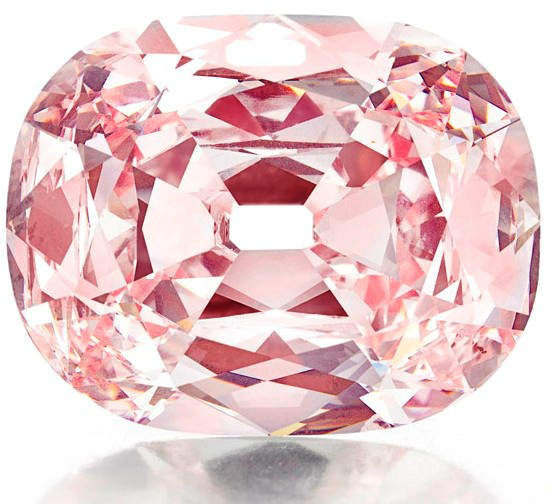
34.65-carat, cushion-cut, fancy intense pink Princie Diamond

Characteristics of the Diamond
Description of the Princie Diamond when it first appeared at Sotheby's London auction in 1960
When the Princie diamond first appeared at a Sotheby's London auction in 1960, the diamond was described as a spectacular pink cushion-cut diamond weighing 34.65 carats. The color and clarity grades of the diamond were not provided at that time as such standard grades were perhaps not known in the trade during that period. However, given the fact that the diamond was of Indian origin, coming from the famous Golconda mines of southern India, the source of all other historic Indian pink diamonds such as the Darya-i-Nur, the Nur-ul-Ain, etc. the color of the Princie diamond was described as a medium pink, the common shade of pink of all other Indian pink diamonds. Being a Golconda diamond the clarity of the diamond was also believed to be exceptional, probably approaching the highest clarity grade internally flawless.
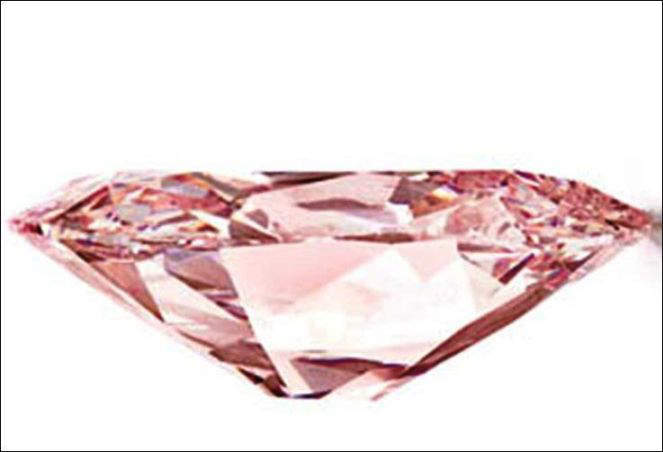
Side View of the cushion-cut Princie Diamond
The 4Cs of the Princie Diamond as provided by GIA when the diamond featured at Christie's New York Magnificent Jewels Sale held on April 16, 2013
According to the GIA certificate 5111433470 dated November 25, 2009 that accompanied the Princie Diamond when it featured at Christie's New York Magnificent Jewels sale held on April 16, 2013, the Princie Diamond is a historic cushion-cut, fancy intense pink, natural color, VS2-clarity stone weighing 34.65 carats.
The Princie Diamond is an extremely rare structurally distorted Type IIa pink diamond that constitute less than 0.1% of all naturally occurring diamonds
A supplemental letter that accompanied the GIA certificate stated that the diamond has been determined to be a Type IIa diamond. Type IIa diamonds are chemically pure and mostly structurally perfect and are absolutely colorless (color-grade D to F), constituting about 1-2% of all naturally occurring diamonds. However, a very small percentage of Type IIa diamonds (less than 0.1%) are structurally distorted, imparting rare fancy colors to such diamonds, such as pink, red, purple, brown etc. Hence, the fancy intense pink Princie Diamnd is an extremely rare chemically pure, structurally imperfect Type IIa diamond, whose occurrence is less than 0.1% of all naturally occurring diamonds.
Bright-orange fluorescence when exposed to ultraviolet radiation is a defining characteristic of the Princie Diamond's Golconda Origin
The Gemological Institute of America further certified that the Pricie Diamond exhibited a bright-orange fluorescence when exposed to ultraviolet radiation. According to the GIA the Princie diamond's unique reaction to ultraviolet radiation is a characteristic of diamonds of known Golconda origin and hence confirms the diamond's classic Golconda origin. GIA further states that out of more than 7 million diamonds that have gone through the Gemological Institute of America's laboratory, no more than 40 of them had exhibited the orangey-red fluorescence or phosphorescence. Of these, the Princie is the largest pink diamond that possesses this outstanding phenomenon. Hence, the Princie is at this time the largest Golconda-type fancy intense pink diamond ever to be graded at the Gemological Institute of America.
Position of the Princie Diamond in the List of known famous pink diamonds arranged in descending order of carat weights
In the list of known famous pink diamonds arranged in descending order of carat weights given below, the Princie Diamond occupies the 5th place, indicating that it is the 5th-largest pink diamond in the world. The table also provides the following important infformation on the Prrincie Diamond:-
1) It is the 4th-largest Golconda Diamond in the world.
2) It is the largest cushion-cut pink diamond in the world.
3) It is the largest fancy intense-pink diamond in the world.
4) Princie Diamond is a Golconda diamond that has registered the highest price so far (US$39.3 million) at a public auction
List of known famous pink diamonds arranged in descending order of carat weights
| S/No | Name | Carat Weight |
Value / Price realized at Auctions (USD) | Price-per-carat (USD) | Shape/Cut | Color |
| 1 | Darya-i-Nur | 186 | Antique Table-cut -Golconda | light pink | ||
| 2 | Nur-ul-Ain | 60 | Antique Oval brilliant-cut - Golconda | light pink | ||
| 3 | Steinmetz pink | 59.60 | US$83.2 million in November 2013 - Sotheby's Geneva (Sale Cancelled) |
US$1.39 million | Oval mixed-cut | fancy vivid pink |
| 4 | Shah Jahaan | 56.71 | Antique Table-cut - Golconda | light pink | ||
| 5 | Princie Diamond | 34.65 | 39.3 million in April 2013 - Christie's New York | US$1.13 million | Cushion-cut - Golconda | fancy intense pink/VS2 clarity |
| 6 | Agra | 32.34 | 4 million sterling pounds in 1990 (about 6 milion USD) | US$ 185,000
|
Antique Cushion-cut - Golconda | fancy light pink |
| 7 | Pink Sunrise | 29.79 | Modified Heart shaped | fancy pink | ||
| 8 | Rose of Dubai | 25.02 | 6 million in 2005 | US$ 240,000 | Modern Pear-shaped | fancy pink |
| 9 | Graff Pink before and after recutting | 24.78 23.88 | 46 million 2010 - Sotheby's Geneva - Nov 2010 | US$1.86 million | Modified emerald-cut | fancy intense pink, after recutting fancy vivid pink |
| 10 | Mouawad Lilac | 24.44 | 1.1 million in 1976 Estimated 20 million in 2007 | Emerald-cut | fancy purplish pink | |
| 11 | Williamson | 23.56 | Wedding Gift to Queen Elizabeth | Round brilliant-cut | fancy pink | |
| 12 | Graff Pink Orchid | 22.84 | Marquise-cut | fancy purplish pink | ||
| 13 | Mouawad Pink | 21.06 | Radiant-cut | fancy pink | ||
| 14 | Hortensia | 20.00 | Antique Pentagonal-cut | light orange pink | ||
| 15 | 1994 Christie's Geneva Auction | 19.66 | 7.4 million in 1994 | US$ 376,400 | fancy pink | |
| 16 | Perfect Pink | 14.23 | 23.2 million in 2010 | US$1.63 million | Emerald-cut | fancy intense pink |
| 17 | Martian Pink | 12.04 | 17.4 million in May 2012 - Christie's Hong Kong | US$1.45 million | Round brilliant-cut | fancy intense pink |
| 18 | May 2011, Sotheby's Geneva Auction | 10.99 | 10.8 million in 2011 | US$ 983,000 | Emerald-cut | fancy intense pink |
| 19 | Graff Pink Supreme | 10.83 | Modern Pear-shaped | fancy pink | ||
| 20 | Argyle Pink Diamond | 10.11 | 6.4-9.6 million | Cushion-cut | fancy intense orangish-pink | |
| 21 | April 2011 Christie's New York Auction | 10.09 | Unsold - Estimated 12-15 million | Cushion-cut | fancy vivid purplish-pink | |
| 22 | Conde Pink | 9.01 | Antique Pear-shape | light pink | ||
| 23 | Huguette Clark Pink Diamond | 9.00 | 15.7 million - Christie's New York, April 2012 | US$1.74 million | Cushion-cut | fancy vivid purplish-pink |
| 24 | Pink Muse | 8.90 | Estimated 12 million | Modern oval brilliant-cut | probably fancy vivid | |
| 25 | Unnamed Vivid Pink Diamond | 8.41 | 17.77 million - Sotheby's Hong Kong, Oct. 2014 | US$2.11 million | Pear-shaped | fancy vivid pink/ Flawless |
| 26 | 1995 Sotheby's Auction | 7.37 | 6.0 million in 1995 | US$ 814,000 | Emerald-cut | fancy intense purplish-pink |
| 27 | Christie's New York, Dec.2010 | 6.89 | 6.9 million in 2010 | US$1.00 million | Emerald-cut | fancy vivid purplish-pink |
| 28 | Graff Vivid Pink | 5.00 | 10.8 million Christie's Hong Kong Dec. 2009 | US$2.16 million | Cushion-cut | fancy vivid pink/VS1 |
©internetstones.com
Please do not copy our tables. We may be compelled to inform the search engines or file a DMCA request if our content and tables are plagiarised.
Other important information that can be derived from the above table
Other significant information that can be derived from the above table are as follows :-
1) The world's largest pink diamond is the 186-carat, table-cut, historic Golconda diamond, the Darya-i-Nur, followed by another historic Golconda diamond, the 60-carat, antique oval brilliant-cut Nur-ul-Ain diamond.
2) The world's most expensive pink diamond is the 59.60-carat, oval mixed-cut, fancy vivid-pink Steinmetz Pink diamond that sold for US$83.2 million at a Sotheby's Geneva auction held in November 2013. However, Sotheby's subsequently cancelled this sale. Sotheby's now hold this diamond and have placed an estimate of US$72 million on it.
3) Following the cancellation of the sale of the Steinmetz Pink diamond, presently the most expensive pink diamond in the world is the 23.88-carat, modified emerald-cut Graff Pink diamond, that sold for US$46 million at a Sotheby's Geneva auction held in November 2010.
4) Only four pink diamonds in the above list are greater than 50 carats. The remaining 24 diamonds are less than 50 carats. Out of this 10 diamonds are between 20 and 50 carats. The remaining 14 diamonds are between 5 and 20 carats. Type IIa pink diamonds are extremely rare in nature (less than 0.1% of all naturally occurring diamonds). Hence it appears that extreme rarity in pink diamonds is combined with their restricted sizes.
5) In terms of price-per-carat the most expensive pink diamond in the world is the 5.00-carat, Graff Vivid Pink Diamond that sold for US$10.8 million at Christie's Hong Kong in Dec.2009, working out to a ppc-value of US$2.16 million. This is followed by the 8.41-carat, unnamed vivid-pink diamond that sold for US$17.77 million at Sotheby's Hong Kong in Oct. 2014, working out to a ppc-value of US$2.11 million.
6) Price-per-carat values of pink diamonds exceed the million-dollar-mark only after 2009. In fact the PPC-value of the 5.00-carat Graff Vivid-Pink Diamond sold at a Christie's Hong Kong auction in December 2009, exceeded even the 2-million-dollar-mark, and to this day remains the most expensive pink diamond in terms of price-per-carat value. The PPC-value of all pink diamonds sold after 2009 is more than one-million dollars.
History of the Princie Diamond
Princie Diamond was first introduced to the world in 1960 and its anonymous owner was subsequently identified as the Last Nizam of Hyderabad
The Princie Diamond was first introduced to the world in 1960 at a Sotheby's auction held in London. Sotheby's described the diamond as a spectacular pink cushion-cut diamond, and said it was being offered as "The Property of a Gentleman." At the time of the sale the identity of the anonymous owner was not known, but subsequently it was revealed that the actual owner of the diamond was none other than the VIIth and the last Nizam of Hyderabad, Mir Usman Ali Khan, one of the richest men in the world in the first half of the 20th century but after his forceful abdication in 1948, following Indian independence retired to Bombay, where he lived on a pension granted by the Government of India. The Princie was purchased by the London branch of Van Cleef & Arpels for 46,000 English pounds equivalent to US$128,000 and then transferred to their Head Quarters in Paris.
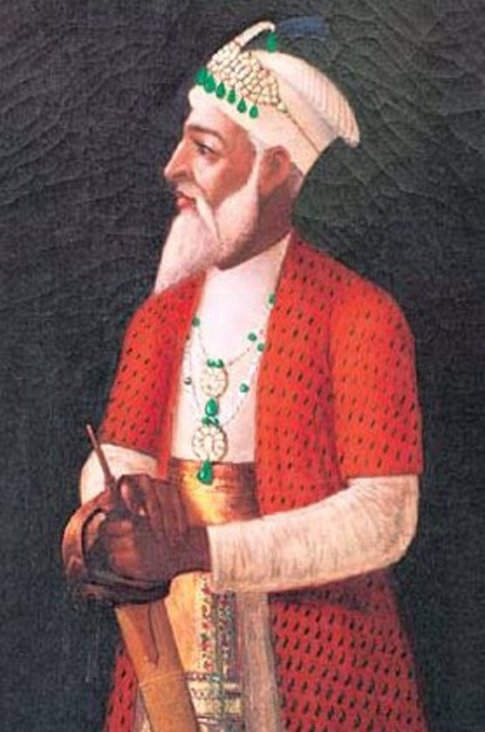
Nizam-ul-Mulk, Asaf Jah I during whose period (1724-48) the Princie rough diamond was probably discovered
The mine-of-origin of the Princie Diamond is undoubtedly the Kollur mines of Golconda.
Once it was established that the Last Nizam of Hyderabad was the owner of the Princie Diamond, the mine of origin of the diamond should be undoubtedly the Kollur mines of Golconda, the source of many historic colorless and colored diamonds such as the D-color Ahmedabad, Archduke Joseph, Kohinoor and Regent Diamonds, pink color Darya-i-Nur, Noor-ul-Ain, Shah Jahan and Agra diamonds and the blue color Hope diamond. As dealt with earlier, the Golconda origins of the Princie Diamond was confirmed by GIA by the unique reaction to ultraviolet radiation, producing a bright-orange fluorescence, a characteristic of diamonds of known Golconda origin. Another historic fact that confirms the Golconda origin of the diamond, is the location of the Kollur mines east of the City of Hyderabad, and falling within the domain of the Kingdom of Hyderabad. During their period of rule most of the valuable diamonds from the Kollur mines entered the treasury of the Kingdom of Hyderabad.
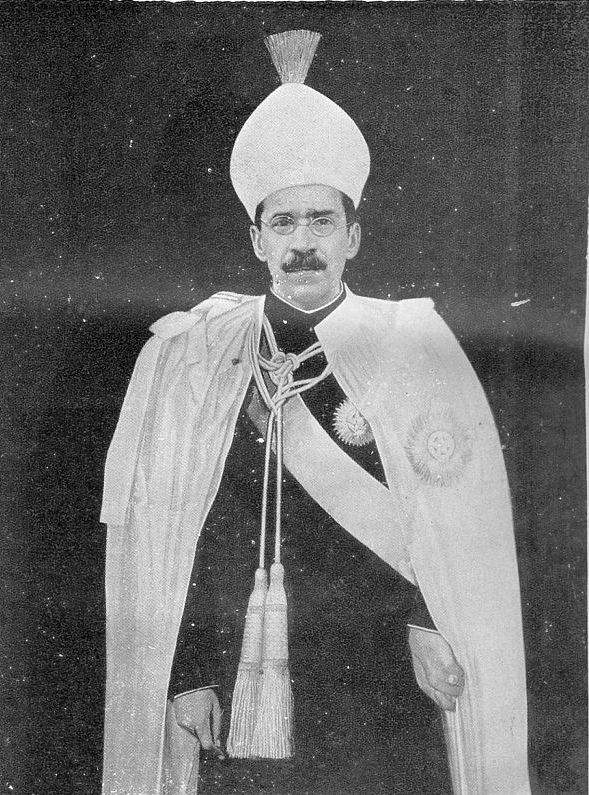
Asaf Jah VII, the Last Nizam of Hyderabad who entrusted Sotheby's London to sell the Princie Diamond
The possible period when the Princie rough diamond was discovered at the Kollur mines ?
The period of rule of the seven Nizams of Hyderabad beginning with Nizam-ul-Mulk, Asaf Jah I and ending with Asaf Jah VII, Mir Usman Ali Khan extended from July 1724 to September 1948. The period of production of diamonds in Golconda extends from 1560 to 1750. 1560 was the year around which diamonds were first discovered in the Kollur region of Golconda east of Hyderabad, in Andhra Pradesh India, and 1750, the year around which the Golconda diamond mines were totally depleted and abandoned. Hence, if at all the Nizams of Hyderabad were able to benefit directly from the diamonds sourced at Kollur it was only for a short period of 26 years, begining from 1724 to 1750, and the Princie Diamond was most probably discovered during this period. Hence, if the Princie diamond entered the treasury of the kingdom of Hyderabad during the period of rule of the Nizams of Hyderabad, it has to be during the 26-year period from 1724 to 1750. That was during the period of rule of the first Nizam of Hyderabad, Asaf Jah I. Hence, the Princie Diamond has a history of approximately 300 years.
The Last Nizam of Hyderabad, Mir Usman Ali Khan inherited a treasure trove of jewels and jewelry from a line of six predecessors starting from the Nizam-ul-Mulk, Asaf Jah I, who ruled from 1724 to 1728, and the Princie Diamond was among them.
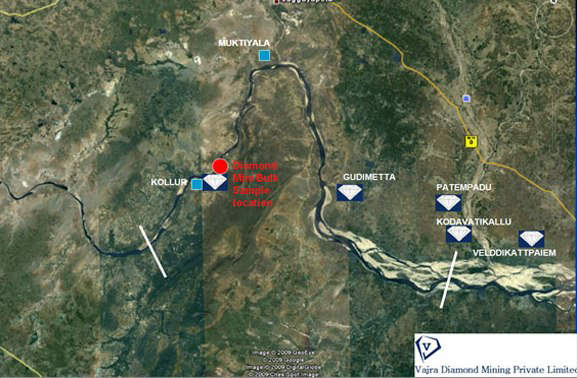
Aerial view of the ancient Kollur mine area where Vajira Diamond Mining Private Ltd are conducting exploratory mining to determine virgin extensions of the ancient alluvial deposits of the Krishna River
Photo - Courtesy Vajira Diamond Mining Private Ltd.
The circumstances that led to the sale of the Princie Diamond by Mir Usman Ali Khan, the Last Nizam of Hyderabad
The domain of the Asaf Jah rulers of Hyderabad was the largest and most prosperous of all princely states in India, covering an area of 82,698 square miles (214,190 sq km) and a population of 16.34 million people, according to the 1941 census. Hyderabad State had a substantially higher standard of living than the rest of India, with its own army, airline, telecommunication system, electricity generation and distribution system, good road and railway network, postal system, large reservoirs and irrigation system, a modern health care system with good hospitals, an education system with good schools, colleges and universities and compulsory primary education, free primary education for the poor, an efficient civil service, modern public buildings, own currency and radio broadcasting service.
Following the British withdrawl from the Indian sub-continent in 1947, and the creation of the independent states of India and Pakistan, the Princely States were given the option to join either India or Pakistan, but Mir Usman Ali Khan refused to join either India or Pakistan. Instead he declared Hyderabad a free and self-governing independent state. The status quo prevailed until September 1948, when the Indian government finally decided to send troops into the Princely state and subdue the Nizam's forces. The Nizam's forces surrendered on September 17, 1948 and the Nizam was forced to abdicate and accept accession to India.
After his forceful abdication in 1948, the VIIth Nizam of Hyderabad, Mir Usman Ali Khan, created two separate trusts for his jewelry and placed them in the vaults of the Flora Fountain branch of HSBC in Bombay (Mumbai). Later he retired to Bombay, where he lived on a pension granted by the Government of India. It is quite possible that he must have retained some of his jewels and sold them at times of financial distress, to support his many dependants. It is under these circumstances that Mir Usman Ali Khan entrusted Sotheby's London to sell the Princie diamond on his behalf in 1960.
Protracted legal battle in the Supreme Court of India over the custody of the Nizam's Jewels which was finally decided in favour of the Nizam's trustees when the Government of India agreed to purchase the entire lot of jewels from the descendants of the late Nizam
The two Trusts created by Mir Usman Ali Khan were known as the "H. E. H. Nizam Jewelry Trust" and the "H. E. H. Nizam Supplemental Jewelry Trust." The stipulation was laid that the jewels should not be sold during the lifetime of his eldest son Azam Jah. Mir Usman Ali Khan died in 1967 followed by his eldest son Azam Jah in 1970. The trustees then decided to sell part of the jewels by an internationally publicized auction in order to meet the staggering tax liabilities of the family. However, just before the auction could take place, a stay order was obtained by the Head of the National Gallery of Arts of India, from the Supreme Court suspending the auctions, on the grounds that the jewels were part of the National Heritage of India and hence should be preserved in the country. The jewels were then returned to the vaults of the HSBC.
A second action was filed by the trustees in the Supreme court in 1979, seeking permission for the disposal of the jewels, in order to meet the pressing financial commitments of the family, that led to a long drawn out legal battle that lasted 16 years. Eventually, the Government of India decided in 1993 to purchase the entire collection from the descendants of the late Nizam, after independent evaluation by renowned auction houses such as Sotheby's and Christies, who placed a value of US$162 million and US$135 million respectively on the collection. Further negotiations were held to decide on a price mutually acceptable to both parties, and finally the GOI decided to purchase the entire collection for a sum of Rs. 218 crores, equivalent to about US$71 million, which the government agreed to pay up in full before taking custody of the jewels.
Van Cleef & Arpels decide to christen the Nizam's Pink diamond as the "Princie Diamond" in honor of the son of Maharani Sita Devi of Baroda, both of whom were special invitees at a party hosted in Paris in 1960 to celebrate the acquiring of the rare and unique pink diamond
After the purchase of the Nizam's pink diamond by the London branch of Van Cleef & Arpels for US$ 128,000, the diamond was transferred to their Head Quarters in Paris. Van Cleef & Arpels then organized a party to celebrate the acquisition of the rare, 34.65-carat, pink diamond, and the flamboyant Princess of India, Maharani Sita Devi of Baroda and her 14-year old son Prince Sayaji Rao Gaekwad of Baroda were Special Guests of Honor. On this special occasion, Van Cleef & Arpels decided to name the diamond "Princie"in honor of the 14-year old son of Maharani Sita Devi whose pet family name was Princie.
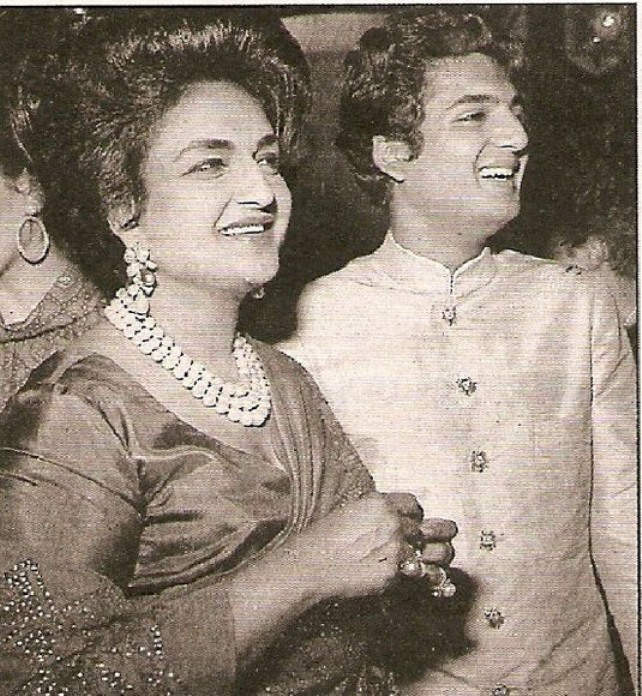
Maharani Sita Devi of Baroda with her son Prince Sayaji Rao Gaekwad of Baroda, whose pet name was "Princie."
According to Van Cleef & Arpels the Princie diamond is one of the largest and finest pink diamonds in the world. Van Cleef & Arpels got the diamond mounted as the centerpiece of a pendant, surrounded by white brilliants, on a necklace of baguette diamonds. The necklace was later sold to an anonymous buyer.
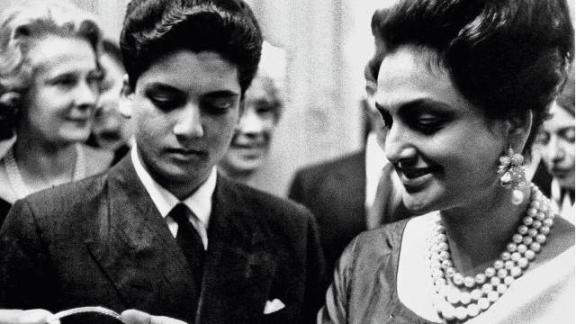
Maharani Sita Devi with her son Princie at the Van Cleef & Arpels party in 1960 admiring the necklace incorporating the Princie Diamond, that was named in her son's honour
Sita Devi the most flamboyant Maharani in the history of India
Circumstances under which Maharni Sita Devi, previously married to the Zamindar of Vayyur, married Maharajah Pratapsinh Rao Gaekwad of Baroda as his second wife
Maharani Sita Devi, popularly known as India's Wallis Simpson by the western media, was the second wife of Maharajah Pratapsinh Rao Gaekwad of Baroda, whom she married in 1943. Maharani Sitadevi was previously married to the Zamindar of Vayyur, and the two of them accidentally met each other at the famous Madras horse races, in 1943. It was a case of love at first sight, and Sita Devi willingly reciprocated the advances of the Maharajah, who was prepared to take her as his wife, in spite of the fact that he was already married happily with four children. But, there were several hurdles to be overcome before they could be united as man and wife. The first major hurdle was for Sita Devi to get a divorce from her husband. She converted herself to the religion of Islam, and under Islamic law her continued status quo as the wife of a Hindu husband was untenable, and she was granted a divorce under Islamic Law. Having obtained a divorce under Islamic Law, she re-converted herself back to her former religion and was now free to marry her lover the Maharajah of Baroda.
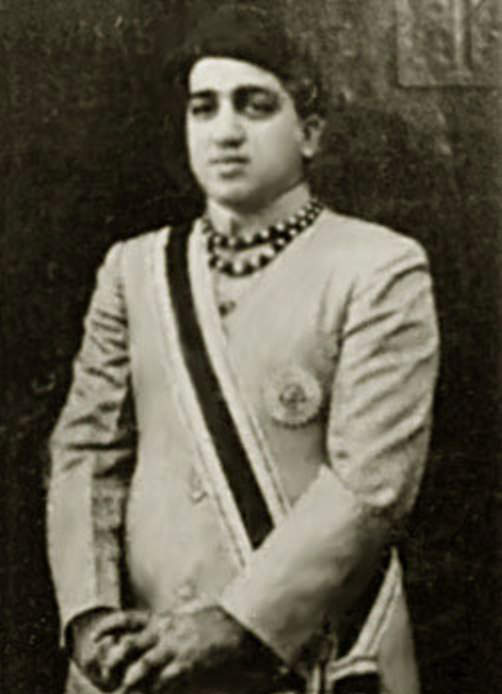
The young Maharajah Pratapsingh Rao Gaekwad
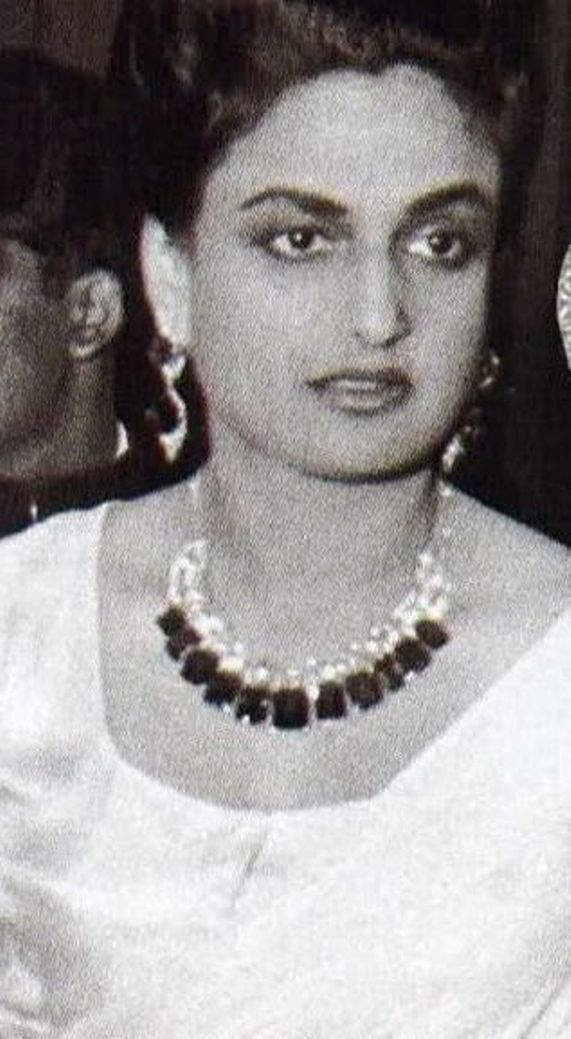
The young Maharani Sita Devi of Baroda
Conflict with the British Viceroy over the Maharajah's actions in circumventing the laws of the country, by taking a second wife when the first wife was still alive
The Maharajah married Sita Devi and took her to his palace in Baroda, as his second wife, but by his actions had violated the laws of his own domain and committed an act of bigamy. According to the laws of Baroda as promulgated by his own grandfather Maharajah Sayaji Rao, no one in Baroda could take a second spouse, as long as the first one was alive. The British Viceroy who was annoyed by the Maharajah's actions in circumventing the laws of the country, summoned him and expressed his displeasure about the whole affair. The Maharajah was forced to take cover, and adduced two reasons for his actions. The first reason was that Sita Devi was an adult, unattached Hindu lady, who was free to make her own independent decisions, and the second was that the laws of bigamy applied only to his subjects, and he as the ruler was exempted from such laws. Legal advisers to the Viceroy told him that the Maharajah's position was legally correct, and there was nothing that the British could do about it. But the Viceroy was advised not to extend recognition and protocol formalities due to her as a legal Maharani of a Princely state.
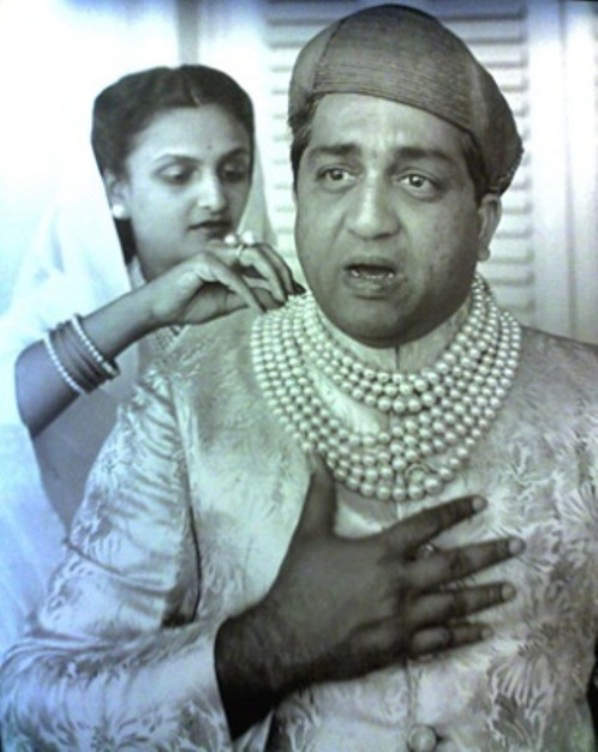
Maharajah Pratapsingh Rao Gaekwad wearing the Baroda pearl necklace. Maharani Sita Devi is in the background making adjustments to her husband's necklace
Maharajah Pratapsinh Gaekwad and his wife Maharani Sita Devi relocate to the sovereign Principality of Monaco after World War II carrying with them most of the treasures of the Maharajah including jewels and jewelry
After the end of world war II the Indian Freedom Movement gathered momentum, and for the extravagant Maharajahs of India, the writing on the wall was very clear. Maharajah Pratapsinh Rao Gaekwad, who was the eighth richest man in the world at that time, and his wife Maharani Sita Devi decided to relocate to a suitable country in Europe in order to prepare for any eventuality in the future. They selected the sovereign Principality of Monaco, the tiny territory of only 0.73 sq miles (1.9 sq km), situated along the Mediterranean coast in the midst of the resort area of the French Riviera as the most suitable site to locate their future residence. They purchased a magnificent mansion in Monaco, and Maharani Sita Devi made it her permanent residence. Following this most of the treasures of the Maharajah, which included valuable jewels and jewelry were moved from Baroda to their new residence in Monaco. Some of the well known items included the famous seven strand natural pearl necklace, the three strand diamond necklace incorporating the 128.48-carat Star of the South diamond, and the 76.5-carat English Dresden diamond as pendants and the famous pearl carpet.
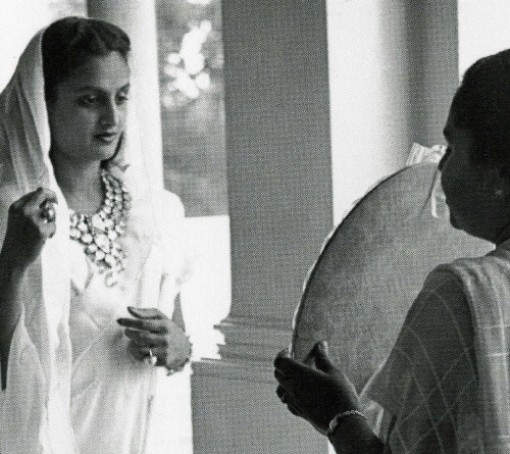
Maharani Sita Devi wearing the three-tiered diamond necklace incorporating the cushion-cut "Star of the South" diamond and the pear-shaped "English Dresden" diamond below it
When Baroda joined the Indian Union after independence Maharajah Pratapsinh Rao Gaekwad is forced to bring back some of the valuables from Monaco
In 1947 when India became an independent republic, Baroda decided to join the Indian Union. Officials of the Government of India took over the treasury of Baroda and were shocked to find that most of the valuable treasures were missing. They forced the Gaekwad to bring back some of the valuables, which include the seven strand pearl necklace. But, Maharani Sita Devi refused to surrender most of the jewels. Instead she got them remounted on new settings by Van Cleef & Arpels. In 1949 Van Cleef & Arpels remounted several emeralds and diamonds into a magnificent fringe necklace called the Hindu necklace. The fringe of 13 emerald drops weighed a total of 150 carats. They also designed a pair of ear pendants, with each pendant containing a polished octagonal drop shaped emerald, suspending a 20-carat diamond briolette.
Meeting of the two Wallis Simpsons from the east and the west at a ball in New York in 1957
A story is also told of an interesting meeting of the two Wallis Simpsons of the east and the west at a ball in New York held in 1957, for which both had received invitations. Wallis Simpson, the Duchess of Windsor, was wearing a diamond choker studded with cabochon emeralds and rose-cut diamonds, for the party, which she had purchased recently from Harry Winston, not knowing that the same jewels had once adorned a pair of anklets worn by Maharani Sita Devi. While other guests at the party were admiring the beauty of the diamond choker, Sita Devi was heard commenting loudly that they had also looked very nice on her feet. The Duchess of Windsor felt humiliated, and on the very next day returned the necklace to Harry Winston.
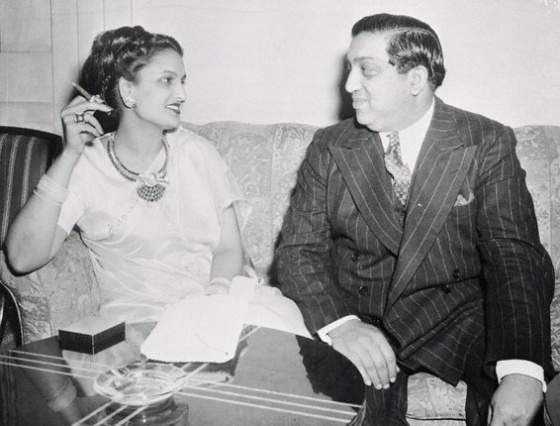
Pratapsingh Rao Gaekwad with his wife Sita Devi during their happy times together in Europe
Pratapsingh Rao Gaekwad and Sita Devi separate and seek divorce in 1956 after 13 years of marriage
The marriage of Pratapsinh Rao Gaekwad to Sita Dev, which had a dramatic beginning in 1943, also came to a dramatic end 13 years afterwards in 1956, when the couple separated and their marriage was dissolved.
After divorcing her husband Sita Devi spends her life with only her son for companionship. Unfortunate death of Princie by suicide after becoming a chronic alcoholic and drug addict
In 1968 Pratapsinh died in exile in London, and Sita Devi spent her remaining years with only her son Princie for companionship. As time passed Sita Devi's glamour and riches faded. Her son Princie's behavior also became a source of serious concern and worry for her. The lad perhaps due to forceful isolation picked up the wrong values from the society which he was thrust into by his mother. He became a chronic alcoholic and drug addict, which eventually led to his suicide by slitting his throat in May 1985.
Maharani Sita Devi passes away in 1986 in France one year after her beloved son's unforunate death.
Sita Devi was unable to reconcile to the loss of her beloved son which became something too great for her to bear up. Not long afterwards in 1986, Sita Devi died in Neuilly-sur-Seine, in France. Without any doubt in the history of India, Sita Devi remains as the most flamboyant Maharani.
The fate of the Princie Diamond after 1961
Van Cleef & Arpels sell the Princie Diamond Necklace in 1961 to an anonymous buyer by a privately negotiated sale
Van Cleef & Arpels got the Princie Diamond incorporated as the centerpiece of a pendant to a necklace of baguette-cut diamonds, highlighted by a white brilliant surround. The necklace was sold in 1961, by a privately negotiated sale for an undisclosed amount to an anonymous buyer whose identity was withheld by the Company.
The Princie Diamond reappears after 52 years at a Christie's New York Magnificent Jewels Sale held on April 16, 2013 but the identity of the person/persons who owned the diamond during this period not revealed
The whereabouts of the Princie diamond is not known for the next 52 years until April 2013, when the diamond was featured at a New York Magnificent Jewels Sale held at the New York Rockefeller Plaza on April 16, 2013. The Christie's Press Release dated March 29, 2013 highlighting the sale of the Princie Diamond was titled :- MAGNIFICENT JEWELS & THE PRINCIE DIAMOND AT CHRISTIE'S NEW YORK APRIL 16.
The relevant section of the press release relating to the Princie diamond read as follows :-
As a special highlight of the sale, Christie's also announces The Princie Diamond (estimate on request), an extraordinary 34.65 carat Fancy Intense Pink cushion-cut diamond. This historic diamond's origin can be traced back to the ancient diamond mines of Golconda in South Central India and was first recorded in the holdings of the Royal family of Hyderabad, rulers of one of the wealthiest provinces of the Mughal Empire.
First offered at auction in 1960 as “Property of a Gentleman” (later revealed to be the Nizam of Hyderabad himself) the diamond was purchased by the London branch of Van Cleef & Arpels for £46,000. The diamond's unique name was bestowed at a party at the firm's Paris store, where it was christened the “Princie” in honor of the 14-year-old Prince of Baroda, who attended the party with his mother Maharani Sita Devi. This is the first time in more than fifty years that this special diamond has appeared at auction, marking an unprecedented opportunity for collectors of the world's finest gemstones.
François Curiel, Chairman of Christie's Jewelry Department, commented, “One of the largest and finest pink diamonds in the world, the Princie Diamond carries a fabulous provenance, which brings together the legendary names of Golconda, Nizam of Hyderabad, and the Maharani Sita Devi of Baroda. This rich history, combined with its rare pink hue, conveys a special charm, which will speak to all collectors in the world seeking the best of the best in gemstones.”
In the press release above Christie's had identified the original owner of the Princie Diamond as the Nizam of Hyderabad, but refrained from identifying the owner of the diamond who purchased it from Van Cleef & Arpels in 1961 and under whose custody the diamond remained for 52 years until 2013.
The Princie Diamond sells for a staggering US$39,323,750 setting three new world records
The Princie Diamond was the last lot in the sale and was given Lot No. 295. The auction catalogue did not provide the pre-sale estimate of the diamond but said it can be provided on request. There was a keen competition by bidders for the Princie Diamond and the hammer was brought down finally at US$39,323,750 in favour of an anonymous collector who bid by phone. The identity of the successful bidder was withheld by Christie's, as much as the identity of the owner of the diamond. Christie's said the staggering price of US$39,323,750 realized at the auction was a new record for any jewel sold at a Christie's auction, surpassing the previous record of US$24.3 million set by the Wittelsbach Diamond at a Christie's auction in December 2008. The price realized was also a new world record for a Golconda diamond sold at an auction, and a record for any jewel sold at an auction in the United States.
Rare and exceptional pink diamonds have become the gemstone-of-choice by investors
The Christie's Press Release dated 16 April 2013 highlighting the successful sale of the Princie Diamond was titled :- POST-SALE RELEASE: THE POWER OF PINK / CHRISTIE'S NEW YORK MAGNIFICENT JEWELS AUCTION ACHIEVES US$81.3 MILLION
The relevant section of the Press Release relating to the Princie Diamond reads as follows :-
An extraordinary 34.65 carat Fancy Intense Pink diamond set a new record high at Christie's New York on April 16, selling for $39,323,750 (£25,560,438 / €29,886,050) with premium, or $1,135,000 per carat. The diamond – a cushion-cut sparkler that originated from the ancient Golconda mines in South Central India -- was purchased by an anonymous collector bidding by phone.
The sale price represents a new record for any jewel sold at Christie's, surpassing the previous house record of $24.3 million set in December 2008 with the sale of the Wittelsbach Diamond. Among important large diamonds, the Princie possesses all of the most desirable qualities today's collectors seek in diamonds: large size, desirable shape and polish, exceptional color and quality, Golconda origins, and a noble history. It was first recorded in the holdings of the Royal family of Hyderabad, rulers of one of the wealthiest provinces of the Mughal Empire. First offered at auction in 1960 as “Property of a Gentleman” (later revealed to be the Nizam of Hyderabad himself) the diamond was purchased by the London branch of Van Cleef & Arpels for £46,000, which corresponds to US$1.3 million today and highlights the tremendous investment opportunities in the world of diamonds. The diamond's unique name was bestowed at a party at the firm's Paris store, where it was christened the “Princie” in honor of the 14-year-old Prince of Baroda, who attended the party with his mother Maharani Sita Devi.
The price-per-carat value of US$1.135 million achieved by the Princie Diamond is in keeping with the ppc-value of over one million dollars achieved for pink diamonds, that began in 2009 with the sale of the 5.00-carat Graff Vivid-Pink Diamond at a Christie's Hong Kong auction in December 2009, making rare and exceptional pink diamonds the gemstone-of-choice by investors. It is important to note that some exceptional pink diamonds have even exceeded the 2-million-dollar mark for ppc values, such as the 5.00-carat Graff Vivid Pink that sold for a ppc-value US$2.16 million at Christie's Hong Kong in Dec. 2009 and the 8.41-carat, unnamed vivid-pink diamond that sold for a ppc-value of US$2.11 million at Sotheby's Hong Kong in Oct. 2014.
Christie's at the center of a legal dispute over the sale of the historic Princie Diamond two years after its sensational sale at New York
Dispute over the legal ownership of the Princie Diamond between Senator Renato Angiollilo's heirs and the heirs of his second wife Maria Girani
Two years after the sensational sale of the historic Princie Diamond at Christie's New York for a staggering US$39.3 miilion shattering the world records for the most expensive jewel sold at an auction in the United States, the most valuable diamond ever sold by Christie's and the most valuable Golconda diamond ever sold at an auction, the auction house Christie's is at the center of a legal dispute following a long-standing and acrimonious dispute between the heirs of the first and second wives of the past owner of the diamond, Senator Renato Angiollilo who purchased the Princie Diamond Necklace from Van Cleef & Arpels in 1961, and whose identity was previously withheld both by Van Cleef & Arpels and Christie's. The dispute was over the legal ownership of the diamond.
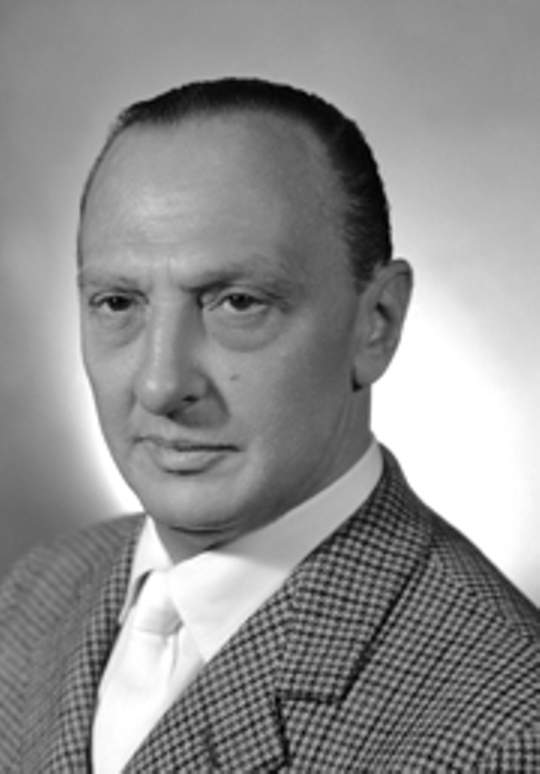
Senator Renato Angiollilo, who purchased the Princie Diamond Necklace from Van Cleef & Arpels in 1961
The heirs of Senator Renato Angiollilo and his second wife Maria Girani
Senator Renato Angiollilo, Italian journalist, prominent politician and founder and editor of the famous and highly successful Italian newspaper Il Tempo had a passion for the collection of fine jewels. The Senator had two children by his deceased first wife Marchesa Olga de Gregorio, Mario Angellilo and Giuseppe Gaetano Angiollilo and a third child Amedeo Angiolillo born out of a relationship with actress Tina Perna Piedmont. In 1960, at the age of 59, Senator Renato Angiollilo married his second wife Maria Girani who was 34 years old. Maria Girani had two children, Marco Oreste Bianchi Milella born during a relationship with Elio Bianchi Millela and Udo Maria Gregory Frank born to her first husband Udo Frank Rosenthal de Beugres.
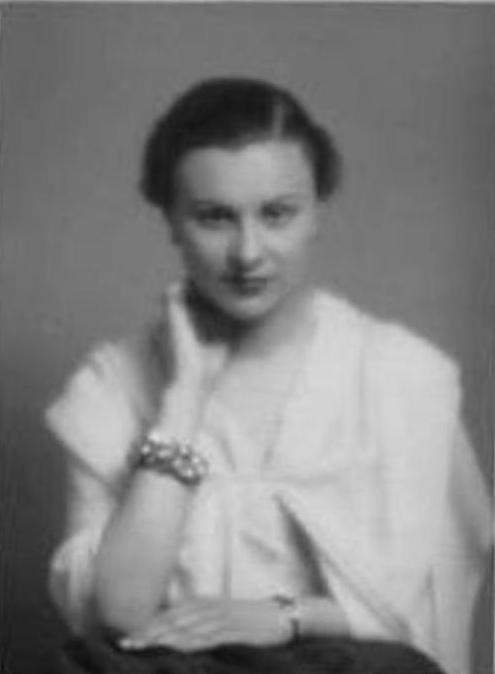
The Young Maria Girani Giovane
Jewels purchased by Senator Renato Angiollilo from Van Cleef & Arpels in 1961 including the Princie Diamond necklace
In early 1961, Senator Renato Angiollilo purchased a diamond necklace from Van Cleef & Arpels in Paris incorporating the 34.65-carat Princie Diamond as the centerpiece of the pendent to the necklace. He had also purchased various other valuable jewels from Van Cleef & Arpels at different times such as a pair of earrings incorporating about 60 carats of sapphires and a necklace with cabochon rubies. Apart from this he had purchased a sapphire ring from Gerrards with a 40-carat sapphire as its centerpiece and a sapphire ring from Harry Winston mounted with a 44.65-carat sapphire.
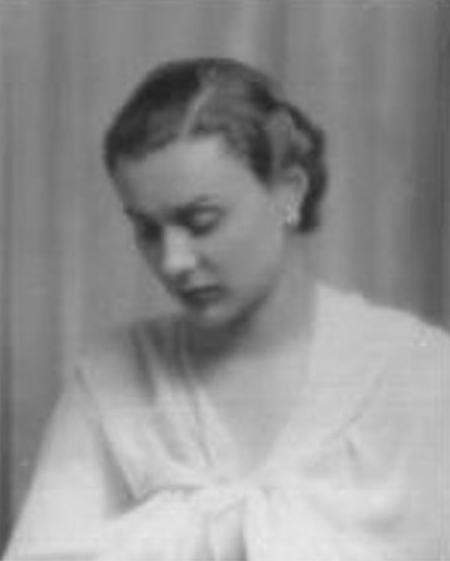
Another image of the young Maria Girani Giovane
Senator Renato Angiollilo's beloved wife Maria Girani adorned herself with the expensive jewels purchased by her husband during political, social and business meetings held in their villa Rampa Mignanelli
As the Senator's beloved wife, Maria Girani appears to have worn these expensive jewels on different occasions both in Italy and when she visited the United States and other countries in Europe. The Senators house in Rampa Mignanelli situated at the famous Spanish Steps in Rome was a hive of activity earning the nickname "fourth chamber" where leading politicians, businessmen, celebrities and journalists met at political, social and business meetings. As the chief hostess of these events Maria Girani Angiollilo bedecked herself with the expensive jewels bought by her husband while in the company of people from all over the world and in the world of politics, culture, finance and business.
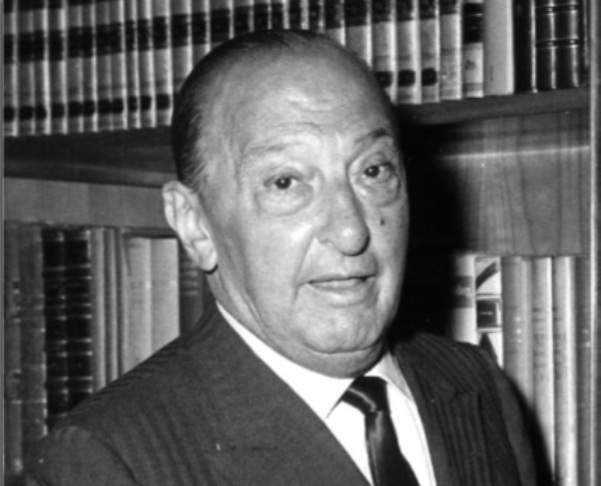
Photograph of older Senator Renato Angiollilo
Eventhough Maria Girani wore the expensive jewels bought by her husband it appears that he still retained their ownership at the time of his death, by virtue of which his heirs by his first wife inherited the jewels
However, despite the fact Maria Girani had made use of the expensive jewels bought by her husband during his lifetime, it is not certain whether the Senator gave the jewels as an outright gift to his wife, because the Senator did not include the jewels in his bequest to his wife by his last will and testament, by virtue of which the Senator's villa in Rome, Rampa Mignanelli was bequeathed to her. In view of this Senator Angiollilo's heirs, his only living son Amedeo Angiollilo; his grandson Renato Angiollilo Jr. by his deceased son Giuseppe Gaetano; his grandson Luigi Angiollilo by his deceased son Mario Angiollilo; his grand-daughter Olga Angiollilo by his deceased son Mario Angiollilo; his grand-daughter Patrizia Angiollilo by his deceased son Mario Angiollilo believed that the ownership of the remainder of their father's/grandfather's estate including the precious gems and jewels owned by him at the time of his death were transferred to them as lawful heirs according to the laws of inheritance of Italy. In proof of Senator Renato Angiollilo's ownership of the jewels including the Princie diamond, at the time of his death, the heirs claimed the existence of an Insurance policy obtained by Senator Renato Angiollilo in his name in 1973 just before his death, that covered the Princie Diamond and other highly valuable jewels purchased from Van Cleef & Arpels, Gerrards and Harry Winston, mentioned earlier. This insurance policy was obtained by the Senator in anticipation of his wife Maria Girani travelling to the United States in 1973 with these jewels.

Maria Girani Angiollilo in whose custody the Princie Diamond remained until her death in 2009
After Senator Renato Angiollilo's death in 1973, Maria Girani requested from the legal heirs of the jewels the custody but not ownership of the jewels, which was readily granted
Senator Renato Angiollilo died in Italy on August 16, 1973. Subsequent to his death, Maria Girani who was holding the jewels mentioned in the Insurance policy in her possession, requested her stepson Amedeo Angiollilo and the grandchildren of her husband, who were the legal heirs of the jewels, that she maintain custody but not ownership of the jewels including the Princie Diamond, that legally belonged to them until her death. This was necessary because of her active life in Italian politics, sponsoring political, social and business meetings at her villa regularly. The heirs of the Senator readily consented to this request given the cordial relationship that existed between them and their stepmother/step grandmother Maria Girani. Maria Girani on her part continued to have very good relationship with her husband's children and grandchildren throughout her lifetime, reassuring them on numerous occasions that the jewels in her possession including the Princie diamond belonged to them by inheritance and that they would be returned to them after her death.
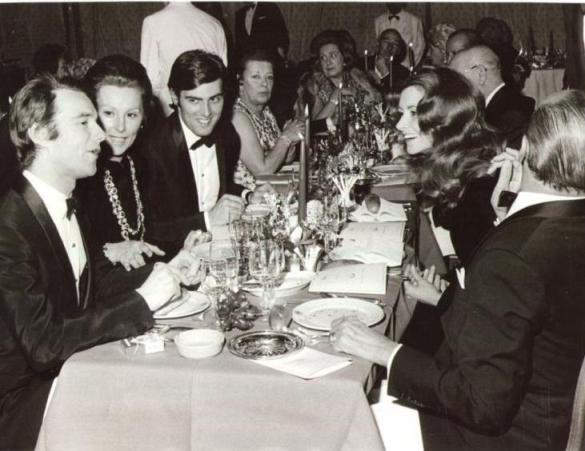
Maria Girani with her children and step-children at a dinner part in Monte Carlo. On her left side is her stepson Amedeo Angiollilo and on her right side her own son Marco Millela
Marco Bianchi Millela, son of Maria Girani denies the existence of jewels belonging to Senator Renato Angiollilo's heirs left in the custody of his mother, that leads to a criminal investigation of the missing jewels
Thirty six years after her husband's death Maria Girani died in Rome, Italy on October 14, 2009, without leaving a last will or testament. After her death Senator Renato Angiollilo's heirs Amedeo Angiollilo and the grandchildren attempted several times to contact Maria Girani's son Marco Oreste Bianchi Milella, with a view of requesting him to return the jewels including the Princie diamond that legally belonged to them by inheritance but was left in the custody of his mother until her death at her own request. However, contacting Marco Bianchi Millela even through his close friends and acquaintances proved very difficult as he had apparently gone into hiding. Finally, Renato Angiolillo Jr. one of the grandson's of the Senator through his son Giuseppe Gaetano, contacted an attorney and through him formally requested Marco Bianchi Millela to return the jewels left in the custody of Maria Girani including the Princie Diamond. Mr. Millela responded to this request through his attorney, stating in writing as follows :- My client has informed me that he is unaware of the existence of the assets of the type that you have indicated nor is he obviously in possession of such assets. In response to Mr. Millela's denial relating to the jewels left in the custody of Maria Girani, the heirs of Senator Renato Angiollilo contacted the Italian law enforcement agencies to commence a criminal investigation of the missing jewels including the Princie Diamond.
Criminal investigation reveals that Marco Bianchi Millela had lied to the Senator's heirs and had tried to dispose of the jewels to a dealer in gemstones Mr. Fontaine and given some to his girl friend. Action instituted against Marco Bianchi Millelabefore the court of Campobasso, Italy
As a result of such criminal investigation it was revealed that Marco Bianchi Millela through his attorney had in fact lied about his ignornce of the existence of jewels belonging to Senator Renato Angiollilo's heirs and his not being in possession of such jewels. On the contrary Marco Bianchi Millela had hid the jewels in question and attempted to dispose of them to an expert dealer in gemstones, Mr. Fontaine, claiming that the jewels had belonged to his late mother, which the latter had believed and in fact purchased some of the jewels. A search of the Monte Carlo homes of Marco Millela and Fontaine led to the discovery of at least two of the jewels in question, a Van Cleef & Arpels Ruby necklace and a pair of sapphire earrings, both of which were listed in the insurance policy of 1973, and were retrieved from Millela's girl friend, who said that these jewels belonged to Mrs. Maria Girani and were given to her by Mr. Millela. Vital information obtained by wiretaps also confirmed that after Maria Girani's death Mr. Millela gave his girl friend a red ruby necklace, and that Millela spoke on the phone with a third party of his possession and control of the Princie Diamond long after he denied through his attorney that he was not in possession of the Princie diamond and other jewels. In consequence of the findings of the criminal investigation, criminal proceedings were instituted against Mr. Marco Bianchi Millela before the court of Campobasso, Italy, which is still pending.
Princie Diamond that disappeared in 2009 reappears at a Christie's auction in New York in April 2013 and Senator Renato Angiollilo's heirs advise Christie's to investigate the provenance of the diamond before going ahead with the sale, which the auction house refused to accept
While criminal proceedings in the italian courts were continuing news reached Senator Renato Angiollilo's heirs that Christie's auction house had advertized the sale of the 34.65-carat fancy intense pink Princie Diamond at its New York Magnificent Jewels Sale to be held on April 16, 2013. One of the Senator's heirs Amedeo Angiollilo, immediately contacted Christie's through his attorney and advised Christie's to investigate the provenance of the diamond as there was a "great likelihood, almost a certainity" that the pink diamond scheduled to be auctioned by Christie's on April 16, 2013 belonged to the heirs of Senator Renato Angiollilo, who were now the rightful owners of the Princie Diamond, which the heirs had been searching for since it disappeared in 2009. He further advised Christie's that the missing Princie Diamond and other jewels that belonged to the late Senator, were the subject of a criminal investigation and court proceedings in Italy implicating Maria Girani's son Marco Bianchi Millela and Mr. Fontaine an expert gem dealer who had purchased some of the jewels. Christie's was also informed that a search of the Monte Carlo homes of Marco Millela, his girl friend and Fontaine just about three weeks before the auction on March 28, 2013 led to the discovery and seizure of some of the jewels in question, a Van Cleef & Arpels Ruby necklace and a pair of sapphire earrings.
Christie's said that Marco Bianchi Millela who claimed to be the beneficial owner of the Princie Diamond after the death of his mother Maria Girani had already transferred the ownership of the diamond to the anonymous consignor, a Swiss Corporation, for over US$20 million and hence the auction house believed that the consignor had a valid title to sell the diamond under Swiss Law
In response to this Christie's admitted that the Princie Diamond scheduled to be auctioned on April 16, 2013 was the same diamond previously in the custody of Maria Girani, but her son Marco Bianchi Millela had claimed to be the 100% beneficial owner of the diamond after the death of his mother Maria Girani. Christie's further said that Mr. Millela had transferred the ownership of the diamond through a broker to its anonymous consignor, a Swiss Corporation, under Swiss Law, for a sum of over US$20 million. Hence, Christie's believed that its Consignor had a valid title to transfer the Princie Diamond to any prospective purchaser. Christie's also threatened to sue Amedeo Angiollilo if he attempted to prevent the auction house from selling the Princie Diamond.
The ownership of the Princie Diamond is transferred to an anonymous purchaser by the aanonymous consignor after the record-breaking sale that realized US$39.3 million.
Subsequently, Christie's proceeded with the auction of the Princie diamond on April 16, 2013 selling the diamond to an anonymous telephone bidder for approximately US$40 million. The ownership of the diamond was transferred from the anonymous consignor, the Swiss Corporation to the anonymous purchaser, while Christie's earned a commission of over US$3.8 million.
Senator Renato Angiollilo's heirs file a suit in the Supreme Court of the State of New york seeking the custody of the Princie Diamond or damages at least equal to the market value of the diamond
Consequent to the failure of Christie's to stop the sale of the Princie Diamond as requested by the heirs of Senator Renato Angiollilo, who believe they are the lawful owners of the Princie Diamond, the heirs have filed an action in the Supreme Court of the State of New York against Christie's, the anonymous consignor of the Princie Diamond and the anonymous purchaser of the Princie Diamond, either to recover the Princie diamond or damages at least equal to the market value of the Princie diamond, as well as recovery of interest, attorney fees, costs and punitive damages. The Plaintiffs (heirs) also seek a declaratory judgement that the Plaintiffs are the rightful owners of the Princie Diamond. Despite Christie's claim that its consignor has a clear title to the Princie Diamond transferred under Swiss Law, the Plaintiffs are seeking redress from the court under New York law that provides, that once there is a "thief," an involuntary transfer, or the property is lost in the chain of title, no one can take good title.
You are welcome to discuss this post/related topics with Dr Shihaan and other experts from around the world in our FORUMS (forums.internetstones.com)
Back to Famous Diamonds,Gemstones and Pearls
Related :-
External Links :-
1)https://www.christies.com/lotfinder/jewelry/the-princie-diamond-5672735-details.aspx
2)https://www.christies.com/about/press-center/releases/pressrelease.aspx?pressreleaseid=6270
3)https://www.christies.com/about/press-center/releases/pressrelease.aspx?pressreleaseid=6312
4)https://iapps.courts.state.ny.us/fbem/DocumentDisplayServlet?
documentId=YEKlzAh8NlQQah3eHZc9dg==&system=prod
References :-
1)RELEASE: MAGNIFICENT JEWELS & THE PRINCIE DIAMOND AT CHRISTIE'S NEW YORK APRIL 16 - Christie's Press Release, March 29, 2013.
2)POST-SALE RELEASE: THE POWER OF PINK CHRISTIE'S NEW YORK MAGNIFICENT JEWELS AUCTION ACHIEVES US$81.3 MILLION - Christie's Press Release, April 16, 2013.
3) The Princie Diamond - Sale 2694, Lot 295 - https://www.christies.com/lotfinder/jewelry/the-princie-diamond
4)Christie's Sued in Row Over $40 Million Princie Diamond - By Logan Sachon, Social Media Journalist. March 23, 2015. https://www.jckonline.com
5) Action filed at the Supreme Court of the State of New York. https://iapps.courts.state.ny.us
6)Christie's Sued by Italian Senator's Heirs Over Pink Diamond - by Christian Dolmetsch, March 20, 2015. https://www.bloomberg.com/news
7) The Krishna River Project (Golconda Diamonds) - Vajira Diamond Mining Private Ltd. https://www.vajradiamondmining.com/krishna.html
8) Renato Angiolillo - From Wikipedia, the free encyclopedia.
9) Maria Angiollilo - from Wikipedia, the free encyclopedia.
 Home
Security & Guarantee
How it Works
Technology Partners
Updated Tables
Famous Diamonds
More Famous Diamonds
Famous Pearls
Famous Gemstones
Contact Dr Shihaan Larif
Contact Senior Editor
Famous Jewelry
Reference Database
Forums
Learning Center
Gemstone Gallery
e-mail Notifications
Advertise
Press Release
About Us
Privacy Policy
Contact Us
FAQ'S
Site Map
Staff Mail Login
Staff Documents
Birthstones
History
Minerals
Shows
Live Metal Prices
Jewellery Gallery
News
Marketplace
Marketplace Support
Open Store
Online Auctions
Join Us & Contribute
Directory
Classifieds
List your products
Wholesale Trading
Post Buy Request
Go Green Policy
Site Updates
Upcoming-ToDo List
Latest News
Latest Articles
Latest Blog Updates
Chat Rooms
Job Board
User Gallery
Videos
New Newsletter Archive
Old Newsletter Archive
Jewelry & Mineral Blog
User Blogs & Social Network
Search
Answers (Q & A)
Valuation
Help me find a diamond/jewelry
pin.internetstones.com- Social Pinboard- Sart yours & connect with millions
Invite Friends From Yahoo, Gmail etc-One Click
Home
Security & Guarantee
How it Works
Technology Partners
Updated Tables
Famous Diamonds
More Famous Diamonds
Famous Pearls
Famous Gemstones
Contact Dr Shihaan Larif
Contact Senior Editor
Famous Jewelry
Reference Database
Forums
Learning Center
Gemstone Gallery
e-mail Notifications
Advertise
Press Release
About Us
Privacy Policy
Contact Us
FAQ'S
Site Map
Staff Mail Login
Staff Documents
Birthstones
History
Minerals
Shows
Live Metal Prices
Jewellery Gallery
News
Marketplace
Marketplace Support
Open Store
Online Auctions
Join Us & Contribute
Directory
Classifieds
List your products
Wholesale Trading
Post Buy Request
Go Green Policy
Site Updates
Upcoming-ToDo List
Latest News
Latest Articles
Latest Blog Updates
Chat Rooms
Job Board
User Gallery
Videos
New Newsletter Archive
Old Newsletter Archive
Jewelry & Mineral Blog
User Blogs & Social Network
Search
Answers (Q & A)
Valuation
Help me find a diamond/jewelry
pin.internetstones.com- Social Pinboard- Sart yours & connect with millions
Invite Friends From Yahoo, Gmail etc-One Click




Our Global Jewelry Industry Job Network


Buy & Sell in our Marketplace

Subscribe to our Newsletter

List in our Classifieds

List in our Directory

User Uploaded Gallery

Powered by Ultra Secure
Amazon (USA) Cloud Network

Founder Internet Stones.COM
Register in our Forums

| Featured In
|
|
|
|
|
|
|
|







Blog & Education Feed
Articles Feed
 |
 |
 |

Copyright © .Internet Stones.COM. All rights reserved.