The Pumpkin Diamond
Open FREE Unlimited Store Join Our Newsletter
Lareef A. Samad B.Sc (Hons)
Origin of name
The name "Pumpkin" is a rather unusual name for a diamond, but this was the name selected for the diamond by it's purchaser Ronald Winston, of the House of Harry Winston, who bought the stone at a Sotheby's auction, just one day before the Halloween Day in 1997. A hollowed out pumpkin, carved with a demonic face, and lit with a candle inside, known as a "jack-o-lantern" is a popular symbol of the Halloween Day, which falls on the 31st of October each year. Another possible reason for the selection of the name "Pumpkin", would have been the fancy vivid orange color of the diamond which almost resembles the color of a cut pumpkin.
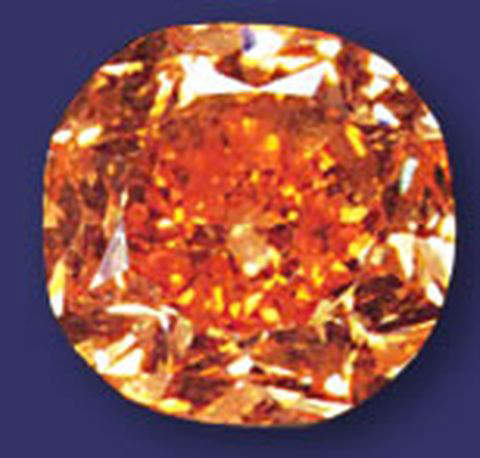
5.54-carat, fancy vivid orange, cushion-cut Pumpkin diamond

Characteristics of the diamond
The 4Cs of the diamond
The diamond is a 5.54-carat, fancy vivid orange, cushion-cut stone. In spite of it's smaller size, the extreme rarity of the orange color in diamonds, makes the "Pumpkin" a notable and famous diamond. In fact the G. I. A. had reported that the "Pumpkin" diamond was one of the largest fancy vivid orange colored diamonds rated by them. Fancy vivid is a high color rating for any colored diamond, and stones of this color grade are rare and unique. The combined rare color grade, in an extremely rare color, orange, makes the "Pumpkin" one of the "rarest of the rare" of colored diamonds.
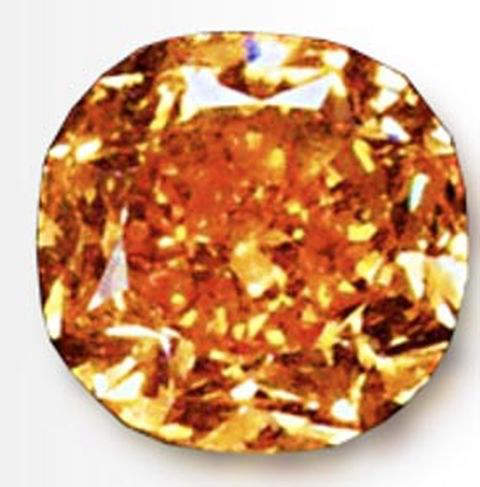
Another enlarged image of the 5.54-carat Pumpkin Diamond
Orange diamonds are rare Type 1b diamonds
Color in diamonds is caused by impurities, structural abnormalities, or natural irradiation. The commonest impurity found in diamonds is Nitrogen. Almost 98 % of all natural diamonds contain Nitrogen as impurity, and this property is made a basis for the classification of diamonds. Diamonds that contain detectable quantities of Nitrogen are called type I diamonds and those that do not contain detectable quantities of Nitrogen are called type II diamonds. 98% of all natural diamonds are type I and the remaining 2% are type II.
Type I diamonds are again sub-divided into two depending on whether the Nitrogen atoms are found in groups or scattered as single atoms.
Type Ia - Nitrogen atoms are found in groups or aggregates of two or more atoms. Almost 98% of type I diamonds belong to this sub-group.
Type Ib - Nitrogen atoms are scattered as single atoms. Only 0.1% of type I diamonds belong to this sub-group. Orange diamonds also belong to this sub-group. The Nitrogen atoms absorb visible light in the blue end of the spectrum producing the intense yellow color known as canary yellow, orange or sometimes amber colors. As only 0.1 % of all naturally occurring diamonds belong to this group, the canary yellow, orange and amber colors are extremely rare in diamonds.
Thus orange diamonds are rare type Ib diamonds.
History
Early History of the diamond
Country and mine of origin of the diamond
The diamond was mined in South Africa in 1997, but the mine of origin is unknown. It might have sometimes originated in the alluvial deposits of Southern Africa, because the original owner of the stone is believed to be an unnamed farmer. However, in the past the Zwartruggen dikes of South Africa, had been identified as a relatively prolific source of amber and orange colored diamonds, with 2-5 % of the output from these mines being amber or orange colored. A small number of amber and orange diamonds were also found in the output from the Finsch and Premier mines.
Characteristics of the rough Pumpkin diamond
The rough Pumpkin diamond when it arrived at the William Goldberg Corporation was a brownish-orange, 11-carat rough diamond.
The cutting of the rough Pumpkin diamond
The rough stone was cut and polished by diamantaire William Goldberg himself of the Goldberg Diamond Corporation. Orange diamonds are often modified by a brown color and the rough pumpkin diamond was no exception. However, surprisingly as the cutting proceeded a unique pure orange color was revealed, which assumed an intense orange color when the cutting was completed.
Grading of the Pumpkin diamond by the GIA
Sale of the Pumpkin Diamond
The cut and polished orange diamond was put up for auction at Sotheby's New York, on October 30, 1997 and was purchased by Ronald Winston of the House of Harry Winston for a price of US$ 1.3 million. The unnamed orange diamond was then christened the "Pumpkin Diamond" by Ronald Winston.
The Pumpkin Diamond Ring
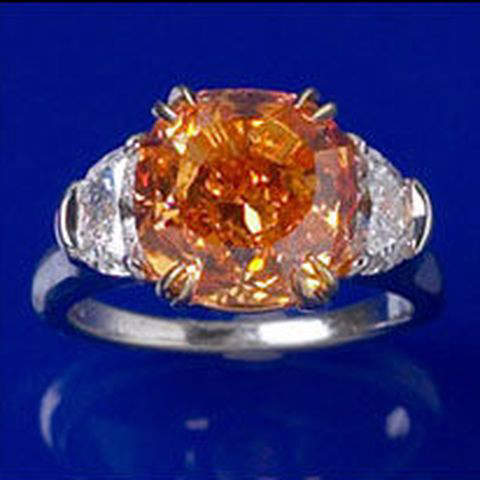
Ronald Winston later set the diamond in a ring between two smaller white diamonds. Halle Berry is reported to have worn the ring to the 2002 Oscars, where she won the Academy Award for the best actress for her role in the film Monster's Ball.
The Pumpkin diamond is displayed at the Smithsonian's NMNH in the year 2003
The "Pumpkin" diamond was displayed as part of the Smithsonian's "Splendor of Diamonds" Exhibition, held between June 27th and September 30th, 2003, which also featured other famous diamonds, such as the Millennium Star (colorless), the Alnatt diamond (yellow), the Heart of Eternity (blue), Steinmetz Pink (pink), the Ocean Dream (blue-green)and the Mousaieff Red (red)diamonds. Diamonds of all colors were represented in the Splendor of Diamonds exhibition, except for green, purple and brown/cognac colored diamonds. The "Pumpkin" diamond was given the rare honor of being selected for this exhibition, because it was perhaps the only known diamond of its color and size in existence, like the blue-green Ocean Dream diamond.
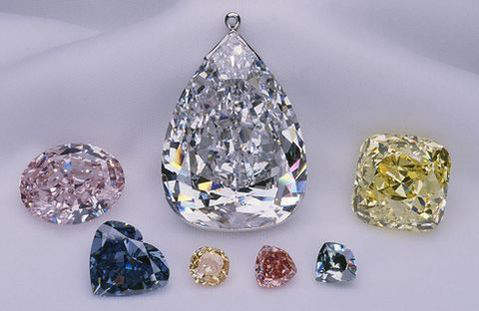
Pumpkin diamond displayed at the Smithsonian's NMNH as part of the Splendor of Diamonds Exhibition
Starting from the pear-shaped Millennium Star in the center, the diamonds in the photograph above in the clockwise direction are - the Allnatt diamond, the Ocean Dream diamond, the Mousaieff Red diamond, the Pumpkin diamond, the Heart of Eternity diamond and the Steinmetz Pink diamond.
Last transaction and present owners of the diamond
The diamond's estimated value in the year 2005 was around US$ 3 million, and was rumored to have been sold to an anonymous buyer in March 2005.
Other Noteworthy Orange diamonds
1) Sotheby's Magnificent Jewels & Jadeite Hong Kong Sale, October 5, 2011. Lot No. 2669 - Very Rare And Exquisite Fancy Vivid Orange Diamond And Diamond Ring
The 18K white gold ring is set with a 4.19-carat fancy vivid orange, cushion-shaped diamond. The shank of the ring is set throughout with brilliant-cut white diamonds.
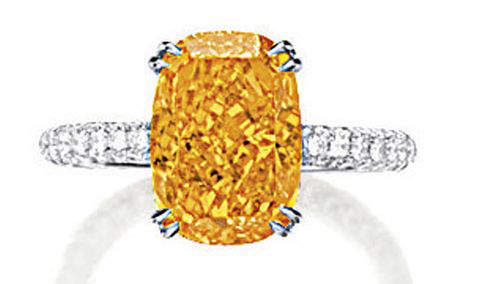
4.19-carat, cushion-cut, fancy vivid orange diamond set in a ring
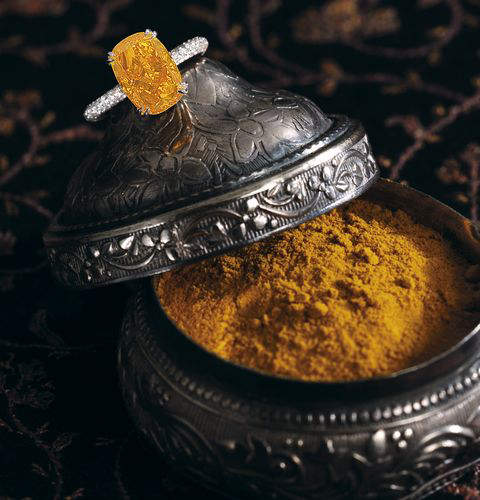
Another image of the fancy vivid orange, cushion-cut diamond comparing the color of the diamond with a pure orange substance in a container
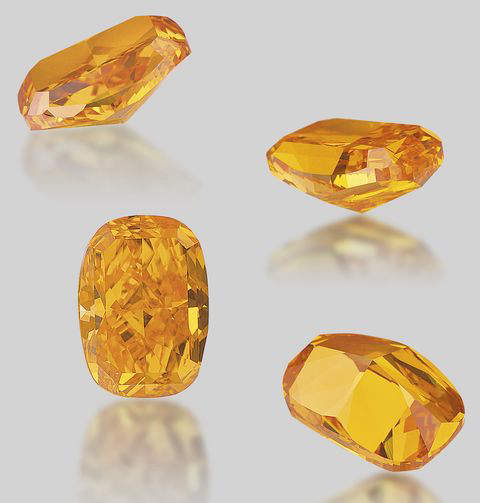
Various views of the unmounted 4.19-carat, fancy vivid orange diamond
A pre-sale estimate of HKD 19,000,000 to 23,000,000 (USD 2,441,120 -2,955,041) was placed on the orange diamond ring, which was eventually sold for a price slightly higher than the upper pre-sale estimate, HKD 23,060,000 (USD 2,962,749). This was the highest price ever paid for a fancy vivid orange diamond at an auction.
2) Lady Orquidea Diamond - 2.00-carat, fancy-vivid orange, heart-shaped diamond from the Lady Heart Diamond Collection
The Lady Orquidea diamond is a pure orange diamond without any brown component from the Lady Heart Diamond Collection, that consists of four other heart-shaped colored diamonds of different colors - red, pink, blue and canary yellow - set as the centerpiece of a pendant or ring. The diamond is a 2.00-carat, fancy vivid-orange, heart-shaped stone, set as the centerpiece of a white gold cluster ring in a heart-shaped bezel, surrounded by two rows of pave-set, round brilliant-cut diamonds, the rows maintaining the heart-shape of the central diamond.
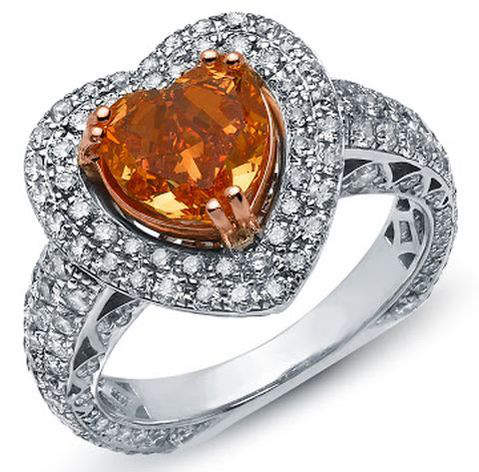
Heart-shaped Lady Orquidea Orange diamond set as the centerpiece of a white gold cluster ring
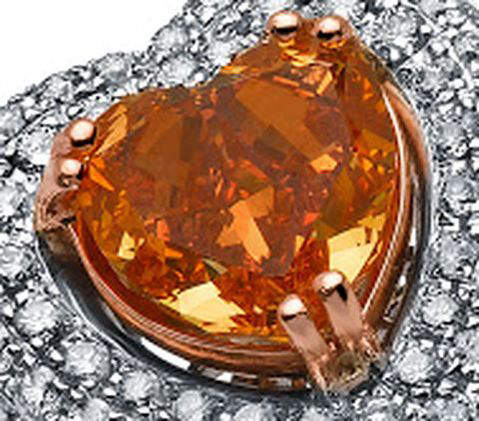
Close-up of Lady Orquidea Orange Diamond
3) A 1.00-carat natural, modified cushion-cut, pure orange diamond offered for sale at the URL :- https://usidiamonds.in/orange_diamonds
A 1.00-carat, natural, modified cushion-cut, pure orange diamond has been offered for sale at the URL of U.S.I. GEMS, Manufacturers, Wholesalers and Exporters of White Loose Diamonds, Natural Fancy Colored Diamonds & EGL Certified Diamond Jewellery
Considering the rarity of orange diamonds, an orange diamond of 1.00-carat size is significant, and deserves inclusion in this webpage dedicated to orange diamonds. The diamond appears to be pure orange and by comparison with other images appears to have a high color grading approaching fancy intense, fancy deep or fancy vivid.
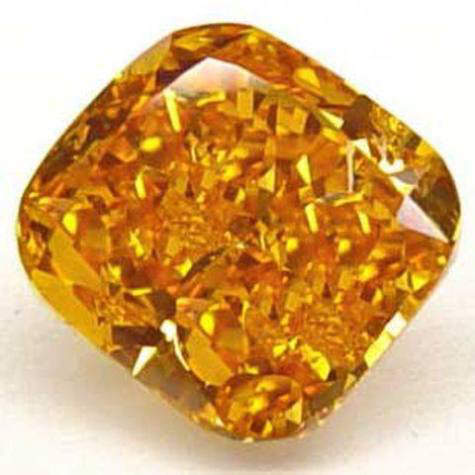
1.00-carat, natural, modified cushion-cut, pure orange diamond with a color grade approaching fancy intense to fancy vivid
Prospective customers interested in buying the above orange-colored diamond should please contact U.S.I. Gems at the following URL :- https://usidiamonds.in/orange_diamonds
4) The largest fancy vivid orange diamond in the world that sold for 35.5 million dollars at a Christie's Geneva auction in November 2013
On November 12, 2013, Christie's reported the record-breaking sale of an extremely rare fancy vivid orange diamond known as "The Orange" weighing 14.82 carats, for a whopping US$ 35.5 million, at its Geneva Magnificent Jewels Auction. The sale set two new world records :- the highest price-per-carat (US$ 2.4 million) paid for any diamond sold at an auction and the highest ever price paid for an orange diamond at an auction. "The Orange" weighing 14.82 carats is the largest fancy vivid orange diamond in the world.
After this record-breaking sale another fancy-colored rare diamond- Orange- has entered the exclusive class of colored diamonds that includes pink and blue diamonds, that has registered sky-rocketing and mind-boggling prices at public auctions in recent times.
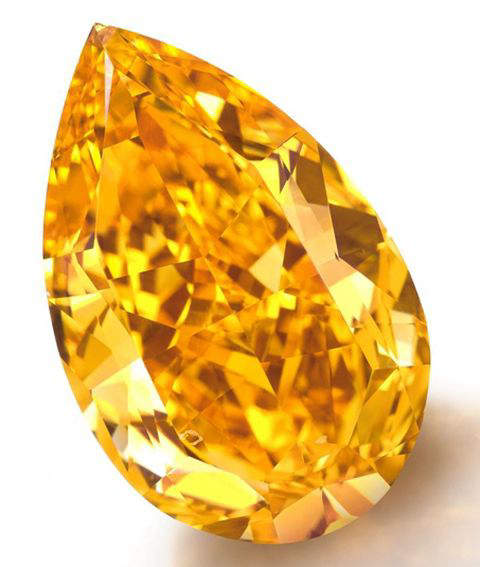
14.82-carat fancy vivid orange pear-shaped diamond -World's largest fancy vivid orange diamond
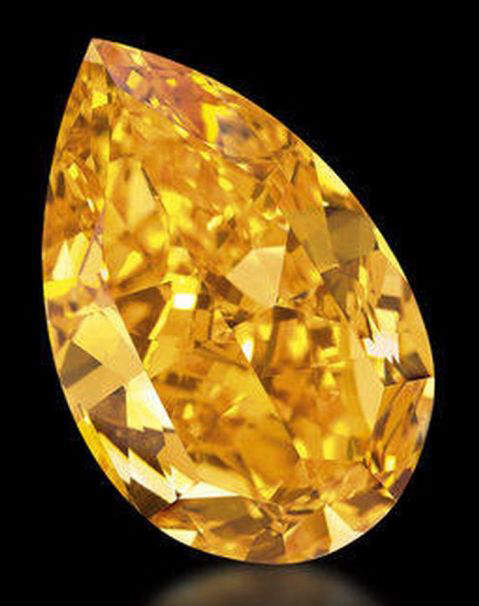
Another view of the 14.82-carat fancy vivid orange diamond
Related :-
External Links :-
https://www.williamgoldberg.com/famous-diamonds/
https://news.internetstones.com/some-diamonds-that-created-headlines-in-2013
References :-
1) The Pumpkin Diamond - Famous Diamonds, www.williamgoldberg.com
2) The Lady Heart Diamond Collection - https://www.internetstones.com/lady-heart-diamond-collection-mandara-orquidea-leilani-diantha-zahira.html
3) The Orange - The Largest Fancy Vivid Orange Diamond in the World - Christie's Press Release -https://www.christies.com/presscenter/pdf/2013/RELEASE_THE_ORANGE_DIAMOND.pdf
 Home
Security & Guarantee
How it Works
Technology Partners
Updated Tables
Famous Diamonds
More Famous Diamonds
Famous Pearls
Famous Gemstones
Contact Dr Shihaan Larif
Contact Senior Editor
Famous Jewelry
Reference Database
Forums
Learning Center
Gemstone Gallery
e-mail Notifications
Advertise
Press Release
About Us
Privacy Policy
Contact Us
FAQ'S
Site Map
Staff Mail Login
Staff Documents
Birthstones
History
Minerals
Shows
Live Metal Prices
Jewellery Gallery
News
Marketplace
Marketplace Support
Open Store
Online Auctions
Join Us & Contribute
Directory
Classifieds
List your products
Wholesale Trading
Post Buy Request
Go Green Policy
Site Updates
Upcoming-ToDo List
Latest News
Latest Articles
Latest Blog Updates
Chat Rooms
Job Board
User Gallery
Videos
New Newsletter Archive
Old Newsletter Archive
Jewelry & Mineral Blog
User Blogs & Social Network
Search
Answers (Q & A)
Valuation
Help me find a diamond/jewelry
pin.internetstones.com- Social Pinboard- Sart yours & connect with millions
Invite Friends From Yahoo, Gmail etc-One Click
Home
Security & Guarantee
How it Works
Technology Partners
Updated Tables
Famous Diamonds
More Famous Diamonds
Famous Pearls
Famous Gemstones
Contact Dr Shihaan Larif
Contact Senior Editor
Famous Jewelry
Reference Database
Forums
Learning Center
Gemstone Gallery
e-mail Notifications
Advertise
Press Release
About Us
Privacy Policy
Contact Us
FAQ'S
Site Map
Staff Mail Login
Staff Documents
Birthstones
History
Minerals
Shows
Live Metal Prices
Jewellery Gallery
News
Marketplace
Marketplace Support
Open Store
Online Auctions
Join Us & Contribute
Directory
Classifieds
List your products
Wholesale Trading
Post Buy Request
Go Green Policy
Site Updates
Upcoming-ToDo List
Latest News
Latest Articles
Latest Blog Updates
Chat Rooms
Job Board
User Gallery
Videos
New Newsletter Archive
Old Newsletter Archive
Jewelry & Mineral Blog
User Blogs & Social Network
Search
Answers (Q & A)
Valuation
Help me find a diamond/jewelry
pin.internetstones.com- Social Pinboard- Sart yours & connect with millions
Invite Friends From Yahoo, Gmail etc-One Click




Our Global Jewelry Industry Job Network


Buy & Sell in our Marketplace

Subscribe to our Newsletter

List in our Classifieds
List in our Directory

User Uploaded Gallery

Powered by Ultra Secure
Amazon (USA) Cloud Network

Founder Internet Stones.COM
Register in our Forums
| Featured In
|
|
|
|
|
|
|
|







Blog & Education Feed
Articles Feed
 |
 |
 |

Copyright © .Internet Stones.COM. All rights reserved.