Queen Isabella Emerald
Open FREE Unlimited Store Join Our Newsletter
Origin of name
The "Isabella Emerald" gets its name from Queen Isabella of Portugal, the queen consort of King Charles V (1516 to 1556), the Holy Roman Emperor, the King of Spain, and Archduke of Austria, who inherited a vast empire extending across Europe, from Spain and the Netherlands to Austria and the Kingdom of Naples, and also the overseas territories of Spanish America. Queen Isabella coveted the emerald and longed to possess it, after hearing glowing accounts of the emerald from Hernan Cortez, in a letter written to her from Mexico. The emerald known as the mystical "Emerald of Judgment" was presented to Cortez, by Montezuma II, the King of the Aztec Kingdom, at the time Cortez entered the city of Tenochtitlan with his troops on November 8, 1519. Hernan Cortez named the emerald in honor of Queen Isabella, the Queen consort of Charles V, the Holy Roman Emperor and the King of Spain.
It is said that Cortez tried to use the emerald to entice the Queen, so that she would use her influence on Charles V, to bestow on him the title of the Governor of New Spain, and provide him with men, weapons and ships, to capture the rest of the New World. But, Charles V was bankrupt due to campaigns undertaken against England, France and Italy, and was unable to help Cortez. He was however appointed as governor of New Spain, but Queen Isabella never acquired the emerald which she coveted so much. Eventually, Cortez gifted the emerald to his second wife, Dona Juana De Zuniga.
Characteristics of the Emerald
The "Queen Isabella Emerald" has gone down in the history of famous gemstones, as an emerald that had to be discovered twice, once from its natural habitat as a rough emerald, in one of the ancient mines in Colombia, where it was formed millions of years ago in hydrothermal veins, pegmatites, or at the contact zones of large igneous intrusions, that invaded aluminous schist, shale or impure limestone, and the second time after it was lost when the ship carrying it to Spain from the New World, sank in the Atlantic Ocean somewhere in the so-called "Bermuda Triangle." When Montezuma the king of the Aztec empire, gifted the "Queen Isabella Emerald" to Cortez it was already cut and polished, in the form of an ancient table-cut, oblong, rectangular-shaped, somewhat flat gemstone, having a deep-green color characteristic of emeralds originating from the ancient Muzo mines of Colombia. Cortez in his letter to Queen Isabella, described the gemstone as "a mystifying powerful emerald crystal so large that it would fill the palm of her hand."
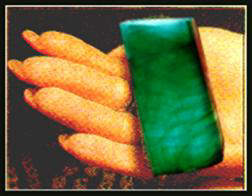
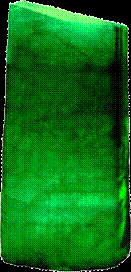
The renowned emerald was lost in transit between Mexico and Spain in 1757, when the Spanish vessel that transported it, together with hundreds of other chests containing emeralds, gold, and Aztec artifacts like jade death masks, gold idols, crystal skulls and instruments of human sacrifice, caught fire and sank, in the region what is now known as the Bermuda triangle, about 12 miles offshore of the Florida coast, somewhere between Sebastian and Cape Canaveral. The "Isabella Emerald" remained lost in the seabed of the Atlantic Ocean for over 200 years until it was re-discovered in the year 1992 by a team led by Victor Benilous, president of the Archaeological Discovery Ventures, a company based in Palm Beach, Florida, who in 1987 was credited with the discovery of the oldest shipwreck (1554) in the western hemisphere.
The emerald has a weight of 964-carats, documented as perhaps the largest gem-quality faceted emerald in the world, supported by a GIA certificate testifying to its authenticity as a natural Colombian emerald, with good clarity and transparency, and valued at over $ 20 million according to current market estimates. This still appears to be an undervaluation when compared to the price fetched by the 7.85-carat cushion-cut "Carolina Prince Emerald" in 1999, which sold for a price of $ 500,000, working out to $ 63,694 per carat. If we consider this as the yardstick to evaluate the "Isabella Emerald" which being a Colombian emerald is undoubtedly of superior quality, the estimated value of the "Isabella Emerald" should be around $61 million.
History of the Emerald
The great civilizations of pre-Columbian America
The Olmec Civilization
Pre-Columbian America, before Christopher Columbus set foot on the New World, was a cradle of great human civilizations equal in status or even greater than the ancient civilizations of the Old World, such as the Mesopotamian (6,000-600 BC) and ancient Egyptian (3,200-31 BC) civilizations of the Middle East or the Mohenjo-daro (2,600-1,900 BC) or Harappa civilizations (3,300 -1,300 BC) of the Indus valley in India or the ancient Chinese civilizations (7,000-6,000 BC). The Olmec civilization (1,400-400 BC) of Mesoamerica is one of the oldest civilizations of pre-Columbian America, from which most subsequent civilizations were subsequently derived. The word "Olmec" in the Nahuati language spoken by the Aztecs, means "Rubber People", which signifies the first civilization in the world that extracted natural rubber from the rubber plant, and made use of them for certain purposes. Archeological evidence supports the view that natural rubber was used by these people to produce a rubber ball that was used by them for a popular ball game. Ball courts, and even actual balls used for the game had been excavated by archeologists, consolidating this view. The fact that the ancient Olmec had enough time for leisure in a mundane world, at a time when acquiring food, clothing and shelter was more critical for their survival, provides enough evidence for the advanced nature of this civilization, that created large cities where such basic needs of the people were easily met by agricultural development. Increased agricultural production went hand in hand with the development of non-farming activities, such as the arts, architecture, construction engineering and commerce.
Marvels of architecture and construction engineering of this period include, high-rise platforms, pyramids, altars, tombs, hydraulic works and drainage systems that carried water into palace complexes for drinking and bathing, filling decorative ponds and pools and for waste run-off. Cultural achievements of this civilization include, the use of volcanic basalt, stone and jade in sculpturing, that produced the renowned carved colossal heads, as well as smaller artifacts and figurines such as the "Were Jaguar"; the development of a vigesimal (base 20) numeral system, using bars and dots; using zero in the numeral system long before mathematicians of the old world recognized its importance; development of a calendar, counting time from a specific and significant starting date, a concept that developed in the old world much later; development of an early form of hieroglyphic writing like the ancient Egyptians, which had 182 symbols with specific meanings; development of a trading network with other parts of Mesoamerica, trading in items such as jewelry, ceremonial masks, burial items, small figurines and other artifacts, turned out of stone, emeralds, jade, serpentine and other minerals, knives and arrow-points made of obsidian, and mirrors made of polished iron-ore like haematite.
The Olmec civilization that lasted from around 1,400 to 400 BC, is considered by archaeologists as the "mother civilization" of Mesoamerica, from which all other subsequent civilizations such as the Maya, Zapotec, Teotihuacan, Mixtec, Toltec and Aztec were derived. The development of Mesoamerican civilizations is divided by archaeologists into three major time periods, known as the Pre-Classic (1,500 BC-300 AD), the Classic (300 AD-950 AD) and the Post-Classic (950 AD-1521 AD).
1) Pre-Classic period (1,500 BC-300 AD) :-
The Olmec, Maya and Zapotec Civilizations
Civilizations of this period include the Olmec (1,200 BC-400 BC), the Maya (1,000 BC to 1521 AD), and the Zapotec (500 BC-1,000 AD). The Olmec civilization that began and flourished during this period gradually declined and came to an end in 400 BC. The Maya civilization that began around 1,000 BC continued until the end of this period, and further extends into the Classic and Post-Classic periods. The Zapotec that began around 500 BC, continued until the end of the Pre-Classic and moves into the Classic period. Prominent Olmec cities include La Venta and San Lorenzo Tenochtitlan. Important early Maya cities include Nakbe, El Mirador, San Bartolo, and Cival in the southern Maya lowlands The Zapotec flourished in the valley of Oaxaca and their main city center was Monte Alban.
2) Classic period (300 AD-950 AD) :-
The Maya Civilization
The Maya civilization continues throughout the Classic period and subsequently enters the Post-Classic Period. The southern Maya lowlands reach the peak of their development, with large scale construction and urbanism, and significant intellectual and artistic development, and also the recording of monumental inscriptions. Prominent Mayan cities of this period include Tikal, Copan, Palenque and Calakmul. However during the 8th and 9th centuries AD, the Mayan centers of the southern lowlands went into decline and were abandoned thereafter, caused by natural or man-made disasters.
The Zapotech Civilization
The Zapotec civilization also continued throughout the Classic period, and by 700 AD, Monte Alban was the capital of the Zapotec land, with a population of over 250,000 people. During the late Classic period, after 900 AD, Monte Alban's influence outside and inside the valley of Oaxaca, gradually began to decline.
The Teotihuacan Civilization
Another civilization that flourished during the Classic period but unfortunately came to an end around 700 AD, was the Teotihuacan civilization, which actually originated around 100-200 BC, in the Pre-Classic period, soon after the decline and demise of the Olmec civilization. The Teotihuacan civilization which arose in the valley of Mexico, was centered around the city of Teotihuacan, and had a population of over 100,000 people during the peak period of its development, one of the largest cities in America, and perhaps the whole world during this period. The city was a planned city of over 2,000 structures, mainly domestic quarters, decorated with paintings and murals, and with elaborate drainage systems. The most imposing structures in the city were two enormous pyramids. called the "Pyramid of the Sun" and the "Pyramid of the Moon" built between 1st and 2nd century AD, and were linked by a broad avenue. The great city and its civilization suddenly came to an end around 700 AD, possibly caused by draught, crop failure, disease, fire or invasion, or a combination of these factors.
3) Post Classic Period (950 AD-1521 AD)
The Maya States
The Maya centers of civilization of the southern lowlands, in Northern Guatemala, Belize and El Salvador, collapsed in the Classic period, but the centers of civilization in the northern Maya lowlands, in the Yucatan Peninsula survived and continued to flourish during the Post-Classic period. Some of the important centers during this period were Chichen Itza, Uxmal, Edzna, and Coba. After the decline of the Chichen and Uxmal ruling dynasties, the Mayapan ruled all of Yucatan until 1450, when the region disintegrated into several city-states, and remained so until the Yucatan was conquered by the Spanish. Some Maya states in the Southern Maya highlands in the Guatemala and Chiapas highlands also survived in the Post-Classic period. One such Maya kingdom was the Kiche kingdom of Qumarkaj.
The Zapotec and the Mixtec
Between AD 900 to 1000, the influence of the once powerful Zapotec capital, Monte Alban declined rapidly, and the capital was abandoned. The Monte Alban state was replaced by several competing smaller states, a situation that lasted until the Spanish conquest. The declining Zapotec civilization was replaced by the Mixtec civilization, who inhabited the regions of Oaxaca, Guerrero and Pueblo, and set up their capital at Tilantongo. They also took control of the abandoned city of Monte Alban, making major improvements to the city, and adding to the splendor and glory of the city.
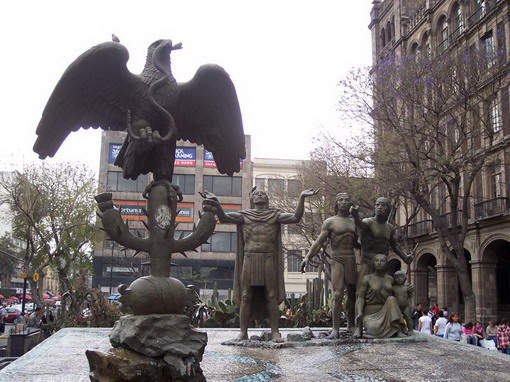
Sculpture commemorating the sign from the god Huitzilopochtli, about the future Aztec civilization
The Aztec Empire
After the collapse of the Teotihuacan, a new city rose to power around the year 950 AD, that took control of the valley of Mexico. This was the capital city of the Toltec Indian Empire, known as Tula. The capital city attained its maximum size and power between 950 and 1150 AD, and its population reached around 60,000 people. By the year 1200 AD, Tula had lost much of its influence, and the city was almost abandoned. The Aztec Indians claim there ancestry from the Toltec Indians, who left Tula after its collapse and moved south towards lake Texcoco. They took refuge on two islands near the western shore of Lake Texcoco. The Aztecs believed in a legend that held that they were destined to establish a great civilization in a marshy area, that would be identified by the appearance of a cactus growing out of a rock, with an eagle perched on the cactus, clutching a snake in its talons. When they arrived at the swamps on the shore of lake Texcoco, their priests proclaimed that they had seen the promised vision of the eagle, and hence they decided to establish their permanent settlement on the islands of the lake. They began farming on the surrounding swampy lands, by raising the land to create small islands, on which they planted different food crops. Eventually in 1325, they founded the city of Tenochtitlan, on one of the islands of the lake. In the year 1376, the Aztecs elected their first Huey Tlatoani, Acamapichtli, who took up residence in Tenochtitlan. The city gradually grew during the next 100 years, but was paying tribute to a much stronger state Azcapotzalco, until the year 1427, when Tenochtitlan formed a triple alliance with the city states of Texcoco and Tlacopan.
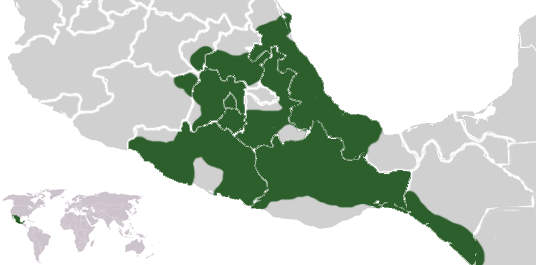
The Aztec Empire
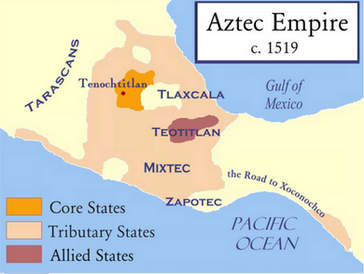
Photograph Above, Creative Commons
The triple alliance which became a powerful force in the region, embarked on a series of conquests and in the next 100 years became the dominant power in the valley of Mexico, forming an empire that extended from central Mexico to the Guatemalan border. Tenochtitaln also became the dominant power in the alliance.
Acamapichtli was succeeded by his son Huitzilihuitl in 1391, who ruled until his death in 1415. Huitzilihuitl was succeeded by his son Chimalpopoca who was assassinated in 1426 by Maxtla, son of Tezozomoc, the ruler of Azcapotzalco. This assassination led to the formation of the triple alliance, by Chimalpopoca's successor, Itzcoatl. When Itzcoatl died in 1440, he was succeeded by Montezuma I, a brother of Chimalpopoca. The main architects of the Aztec empire are said to be Montezuma I and his half-brother Tlacaelel, who is believed to have reformed the Aztec empire and the religion. The Aztec empire reached its greatest period of glory during the reign of Ahuitzotl, from 1486 to 1502. Ahuitzotl's successor Montezuma II, had ruled the Aztec Empire for almost 17 years, when in 1519, the Spanish Conquistadors led by Hernan Cortez landed on the gulf coast of Mexico.
Hernan Cortez sets sail to Hispaniola
Hernan Cortez also known as Fernando Cortez was born in 1485, in Medellin, in the kingdom of Castille in Spain. He was a second cousin of Francisco Pizzaro, who later conquered the Inca empire of Peru. He studied law at the University of Salamanca at the age of 14, but dropped out after two years. He then served as a notary for sometime in Seville. Young and restless, Cortez heard about the exploits of the Spanish Conquistadors who returned from the West Indies, about their conquests and discoveries, and about the enormous quantities of gold, emeralds and other valuables, available in these lands. Such stories only helped and motivated the young Cortez, to look for an opening to set sail to the New World, to make a life of his own in these lands of opportunities. The breakthrough came in 1503, when he was allowed to set sail to the New World, in a ship commanded by Alonso Quintero, and finally arrived in Santo Domingo, the capital of Hispaniola (Haiti). The Spanish Governor of Hispaniola was a distant relative of Cortez, and helped him settle in the Island, where he was made a notary for the town of Azuza.
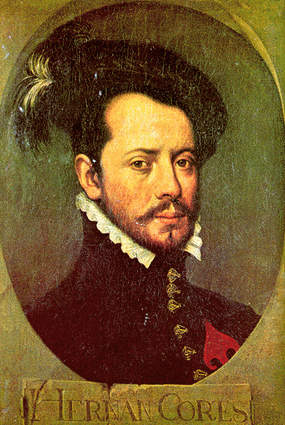
Cortez joins the expedition to Cuba
In the year 1510, Diego Velazquez de Cuellar, an aide to the governor of Hispaniola, was sent on an expedition to conquer Cuba, and Cortez joined him on this expedition. Cortez distinguished himself in this campaign as a brave soldier, and earned the admiration of Diego Velazquez, who appointed Cortez as his secretary, when he was made the Governor of the newly conquered territory. He was also made the mayor of Santiago in Cuba, and granted large extent of lands, Indian slaves, mines and herds of cattle. However, with time their relationship became strained, particularly after Cortez started an amoral relationship with the Governor's sister-in law Catalina Juarez. Eventually, under pressure from governor Velazquez, Cortez reluctantly married Catalina Juarez.
Cortez sets sail to Mexico as the commander of an expeditionary force
The greatest opportunity in the life of Cortez, came in 1518, when 15 years after he first set foot in the West Indies, governor Velazquez, appointed him as the commander of an expedition to conquer Mexico for the Spanish Crown. However, at the last moment governor Velazquez had second thoughts about the expedition, and removed Cortez from the command. Cortez ignored the last minute orders from the governor, which amounted to an act of open mutiny and set out on the expedition with his men as planned in February 1519. In March 1519, he and his men landed in the Gulf Coast, in the Yucatan Peninsula, which was a Mayan territory, and formally claimed the land for the Spanish Crown. He then led a campaign against the Indians of Tabasco, whom he defeated in battle, and received a gift of 20 young Indian women, as an act of goodwill. Among them was a girl by the name of Malinche, who could speak both Nahutal and Maya languages, who eventually became Cortez's mistress, enabling him to communicate in both languages.
One of the greatest acts of cruelty committed by Cortez at Cholula
By July 1519, Cortez had taken Veracruz, and by mid-August 1519, he decided to march on Tenochtitlan, the prosperous capital of the Aztec empire, with 400 men, 15 cavalry, 15 canons, and hundreds of Indian archers and helpers. As Cortez marched along to Tenochtitlan, he made alliances with several native tribes who were opposed to the Aztecs, such as the Tlaxcala, Tlaxcaltec, and the Totonacs, and the Tlaxcaltec contributed 3,000 men to swell army of Cortez. In October 1519, Cortez and his large army marched into the second largest city of the Central Mexico, Cholula, with a population of 100,000 people and famous for its great temple of Quetzalcoatl and hundreds of other temples, and massacred thousands of unarmed members of the nobility gathered in the central plaza, going down in history as one of the greatest acts of cruelty committed by the Spanish conquistadors.
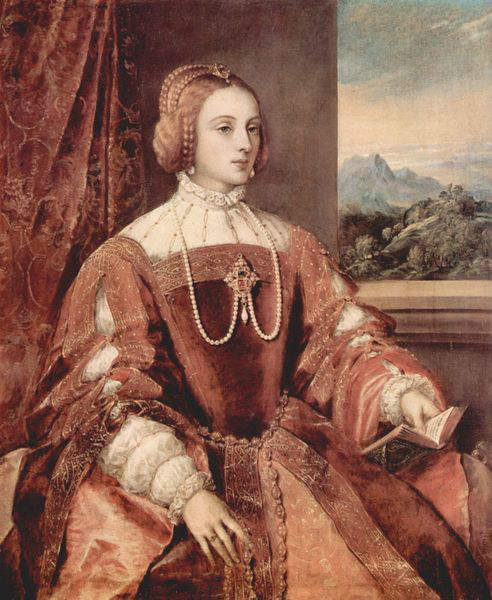
Queen Isabella, queen consort of king Charles V of Spain, Holy Roman Emperor
Cortez marches into Tenochtitlan and receives lavish gifts of gold and emeralds which include the Isabella Emerald
The news of the massacres at Cholula reached the Aztec king Montezuma II at Tenochtitlan, who had enough time to plan out a strategy to face the forces of Cortez, if they decided to move towards his capital. Montezuma II was intelligent enough to realize that his forces were not a match to the overwhelming fire power of Cortez's army, and decided not to challenge his army if they chose to enter his capital. On November 8, 1519, Cortez decided to enter Tenochtitlan, and was warmly welcomed by the Aztec emperor Montezuma II, who allowed them to enter the heart of the Aztec empire, without any hindrance. The king then gave lavish gifts of gold, silver and emeralds to Heranan Cortez and his Spanish soldiers, in order to make them happy, and prevent another Cholula-type massacre. Hernan Cortez being the commander was singled out for special treatment, and was showered with large quantities of gold and emeralds by the king. It is believed that the large mystical "Emerald of Judgment" which subsequently came to be known as the "Isabella Emerald" was also among the gifts received by Cortez. According to a letter written by Cortez to king Charles V of Spain around this time, the Aztecs had considered Cortez either as an emissary of the feathered serpent god Quetzalcoatl or Quetzalcoatl himself, which according to an ancient prophecy had predicted that Quetzalcoatl, would return as a white man with a red beard, from the east to reclaim his empire in the year of Reed One. In the year 1519, the year of Reed One, Hernan Cortez, a white man with a red beard, landed from the east, on the shores of the Aztec empire, as if to fulfill that prophecy. This probably explains the behavior of Montezuma II and his people, who initially received Hernan Cortez and his army with great regard and respect, and gifted the "Emerald of Judgment" the most powerful instrument of Aztec culture, to Hernan Cortez, the God Quetzalcoatl reincarnate, to whom the emerald rightfully belonged.
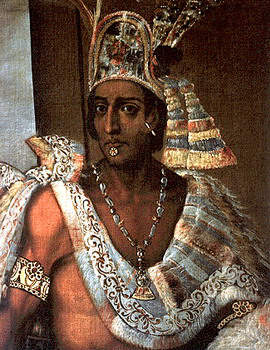
Emperor Montezuma II
Montezuma is killed by his own subjects
Everything was peaceful for sometime, Hernan Cortez and his soldiers enjoying the hospitality of the Aztecs in their capital city. However news reached Cortez one day that the Spanish army on the coast had been attacked by the Montezuma's men. Cortez immediately took Montezuma as hostage in his own palace, forcing him to swear allegiance to king Charles V. Montezuma, was probably forced to surrender a large treasure of gold and emeralds, as ransom in return for his freedom. Peace again returned to Tenochtitlan and the Spanish continued to remain in the city without opposition for the next six months, when an expedition from Cuba, consisting of 1,100 men, sent by Governor Diego Velazquez landed in Mexico in April 1520. Cortez immediately left Tenochtitlan to meet the expeditionary force, and defeated them without much difficulty, in spite of their numerical strength. In the absence of Cortez in Tenochtitlan, a Spanish officer, Pedro de Alvarado, took the law into his own hands and massacred 200 Aztec nobles who had gathered for a religious ceremony, triggering an immediate local rebellion. Cortez hurriedly returned to Tenochtitlan, and proposed an armistice, counting on the support of Montezuma. But, Montezuma was killed by his own subjects in July 1520, who accused him of being too lenient towards the foreign invaders. Cortes had no alternative but to flee Tenochtitlan with his men to the safety of Tlaxcala, his allies in the war with the Aztecs. But the Aztecs made the escape of Cortez and his men difficult, by destroying the bridges leading to the island city of Tenochtitlan, forcing his men to swim across the deep waters of the lake Texcoco. During this hurried get away Cortes lost several of his men either by drowning or being massacred by the Aztecs who attacked his rearguard.
The fall of Tenochtitlan
After the death of Montezuma II, on July 1st 1520, his brother Cuitlahuac succeeded him as king of the Aztec empire, but was able to rule only for 80 days, as he succumbed to an attack of small pox, during an epidemic that spread across the region, also believed to have started from a Spanish soldier. Cuitlahuac was then succeeded by Cuauhtémoc, a nephew and son-in-law of emperor Montezuma II, who remained emperor until the fall of Tenochtitlan in 1521.
Cortez lost 870 men, and all his artillery during the hurried and panicky escape from Tenochtitlan, as well as most of the looted and gifted treasures. It appears that the renowned mystical "Emerald of Judgment" which subsequently became the "Isabella Emerald" and which was presented personally to Cortez by King Montezuma, was not lost during this turbulent period. After retreating to Tlaxcala, Cortez re-grouped his forces and gathered more native Indian allies, in preparation for another assault on Tenochtitlan. In the meantime more reinforcements had arrived from the Spanish in Cuba, including weapons and ammunition. Cortez moved cautiously, at first subduing all cities allied with the Aztecs. He then cut off all supplies to Tenochtitlan, and organized a siege of the island city. The city could not withstand the siege for quite long and on August 13, 1521, the Aztec Lords decided to surrender, and Cuauhtémoc was captured while crossing Lake Texcoco in disguise. Then from the year 1521 to 1524, Cortes personally governed Mexico. The fall of Tenochtitlan marked the end of the Aztec civilization, one of the greatest Mesoamerican civilizations that originated in the 10th century A.D. On the ruins of Tenochtitlan, the Spanish built the modern city of Mexico.
Cortez appointed as Governor of New Spain (Mexico)
King Charles V, the Holy Roman Emperor and King of Spain, appointed Cortez as the governor and captain general of the newly conquered territory that was known as New Spain. In his capacity as the governor, Cortez was responsible for overseeing the construction of Mexico City, on the ruins of the ancient city of Tenochtitlan. Cortez set out to acquire more territory for the Spanish crown, and from 1524 to 1526, led an expedition to Honduras. It was during this expedition that he finally executed Cuauhtémoc by hanging, fearing that he might have led an insurrection if left in Mexico.
Cortes returned to Spain in 1528, and was received by King Charles with great honor, who bestowed him with several honors such as the Order of Santiago and Marquis of the Oaxaca Valley. However he was not restored as governor or given any administrative office, even though he still retained full military authority, with permission to pursue his conquests for the Crown. Cortes returned to Mexico in 1530, and settled down in his estate at Cuernavaca, about 30 miles south of Mexico City.
Cortez gifts the Isabella Emerald to his second wife Dona Juana de Zuinga
Cortez married twice. His first wife was Catalina Juarez Marcada, who died at Coyoacan in 1522. He was accused of murdering his first wife but the accusations were never proved. After landing in Mexico in 1519, he took a mistress by the name of La Malinche also known as Dona Marina, one of the 20 Indian girls whom he received as gift after defeating the Indians of Tabasco. When Cortez returned to Spain, he took his second wife in 1529, the daughter of Don Carlos Ramirez de Arellano, the 2nd count of Aguilar, by the name of Dona Juana Ramirez de Arellano de Zuniga. Cortez gifted the celebrated emerald given by Emperor Montezuma, the "Emerald of Justice" aka the "Isabella Emerald" to his second wife Dona Juana de Zuniga.
Death of Cortez in 1547
In 1541, Cortez returned to Spain again for the second time, and was allowed to join an expedition against a naval base of the Ottoman empire in the Barbary coast in Algiers, used by Barbarossa Hayreddin Pasha, an Ottoman Admiral who dominated the Mediterranean Sea for decades. The expedition however failed and resulted in defeat for the second time for the naval forces of Charles V. Cortez now heavily in debt after spending his own money to finance expeditions, returned to his family in Mexico in 1547. On December 2nd 1547, Cortez died of Pleurisy at the age of 62, in Castilleja de la Cuesta, in Seville province of Mexico.
The Isabella Emerald and the Cortez/Zuinga family treasures are lost at sea in 1757
The descendants of Cortez who settled in Mexico, continued to serve the Spanish Crown and acquired great wealth and positions of power in the country. Over the years they collected a treasure trove of gold, emeralds, and Aztec artifacts such as gold idols, death masks, crystal skulls etc. The "Isabella Emerald" also remained a part of the family treasure. Then in the 1750s almost 200 years after the death of Cortez, the family requested from the King of Spain, Ferdinand VI, for larger land grants in Mexico, and additional favors in return for the Cortez/Zuinga family fortune. The King agreed to the request and dispatched a courier with a small fast ship in 1756, to bring back the treasure to Spain. The treasures were loaded on to the ship, and according to its manifest, contained a hundred chests of emeralds which included the 964-carat mystical "Isabella Emerald", gold idols, gold and jade death masks of Aztec emperors, crystal skulls and other instruments of human sacrifice. The ship then set sail from Mexico in 1757, from one the ports on the Gulf Coast, probably Veracruz, New Spain's main port on the Gulf Coast.
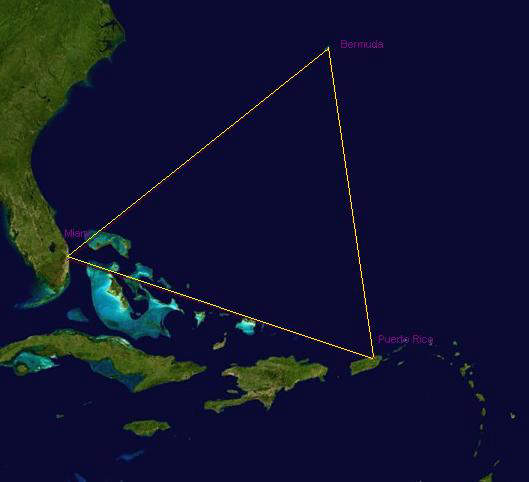
NASA Photo of the Bermuda Triangle
The ship sailed across the Gulf of Mexico, and through the Straits of Florida, entered the Atlantic Ocean. Then as the ship was sailing through the Bermuda Triangle, tragedy struck the ship, as it had struck mysteriously so many other vessels that passed through the triangle before. The ship caught fire and sank in the Atlantic Ocean, several miles off the Florida coast. But, the exact position where the ship went down was not known. The only information about the position of the ship was given by the captain of another ship, who saw the ship burning and reported the number of hours since they were in sight of land.
Descendant of Cortez/Zuinga family commissions A. D. Ventures Ltd. in 1992, to locate and salvage the lost treasures
The Cortez/Zuinga family treasures that sank in the Atlantic Ocean remained there for over 200 years, and some members of the family knew about its loss as the information was passed down secretly from generation to generation. Then in the year 1992, 235 years after the loss of the ship, a descendant of the Cortez/Zuinga family commissioned the firm Archaeological Discovery Ventures Ltd. based in Palm Beach, Florida, to locate the missing ship, and possibly retrieve the ancient treasures, trapped in the ship, that included the famous "Isabella Emerald." The selection of the firm A.D. Ventures Ltd, was based on the track record of its founder and CEO, Victor Benilous who was credited with the discovery of the oldest shipwreck in the western hemisphere, dating back to 1554 A.D.
Apart from the month and year of the shipwreck, the manifest of the cargo in the ship, and its passengers, and the general area in which the shipwreck took place, viz. the infamous "Bermuda Triangle," the family was not able to provide any further information, that would lead to a quick salvage operation. However, the evidence of the captain of a ship in the immediate neighborhood of the disaster, who had seen the ship on fire before sinking, was available. It only said that the incident occurred so many hours and minutes from the last time they had seen land.
Victor Benilous uses unconventional methods to locate the site of the 1757 shipwreck
The rather vague information provided on the possible site of the shipwreck was supplemented by Victor Benilous' wide knowledge on the ancient Spanish navigational routes. If only he had the knowledge of the normal speeds achieved by sailing ships in the 16th century, he would have been able to roughly calculate the area where the ship would have gone down. In the absence of such information, Victor Benilous, was forced to resort to unscientific means of locating the possible site, which seemed to have worked in previous projects. He sought the assistance of two psychic or remote viewers, who were presented with detailed maps of the suspected area and asked to pinpoint the site. Working independently of one another, the two psychics identified an area, which was only 5 cm apart on the maps. Armed with this information and with one of the psychics on board, the search started using the normal salvage equipment such as a proton magnetometer, side scan sonar and bottom profiler. As located on the map by the psychics, within a 5-mile radius, 7 shipwrecks were discovered. The psychic on board then pointed out an area in the sea, where he said an incredible power and force, like a giant beacon was calling out to him. The divers went down at the spot pointed out by the psychic, and to everybody's astonishment brought out a 6-sided crystal skull, made of star rose quartz. A silver bar recovered from a position next to the skull was stamped with the date 1757. Victor Benilous knew immediately that he was on the correct tract.
The "Emerald of Judgment" aka the "Isabella Emerald" is re-discovered together with other treasures
The salvage ship anchored at the area where the crystal skull was discovered, and commenced operations. The area was about 12 miles (19 km) off the shore of Florida coast, somewhere between Sebastian and Cape Canaveral. The area where the wreckage of the mid-18th century Spanish galleon was discovered, was said to be very deep, requiring special expertise and technology for exploration. Within a short period of starting operations, the salvage team had recovered a significant part of the enormous lost treasures, and it was reported that Victor Benilous' second discovery in 1992, was perhaps the single most important and valuable treasure wreck ever discovered in the history of salvaging ancient shipwrecks.
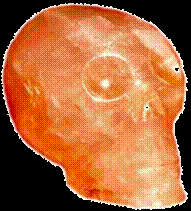
Rose Quartz Crystal Skull
© A. D. Ventures Inc
The most significant achievement of this operation was the recovery of the 964-carat, oblong, ancient table-cut, deep green Isabella Emerald, which was the mystical "Emerald of Judgment" presented by Montezuma II to Hernan Cortez on November 8, 1519, and which had been the most valuable possession of the Cortez/Zuinga family up to 1757. The other most significant recovery of the operation was Cortez's signet ring made of silver, with the coat of arms of the Cortes and Zuinga family, used by Cortez as a signature ring to seal and stamp the covers of his official communications with the king of Spain, to maintain their secrecy. Incidentally, the discovery of the signet ring was one of the confirmatory evidences that the shipwreck was indeed that of the ship carrying the Cortez/Zuinga family treasure.
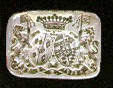
Cortez Silver Signet Ring
Among the other items recovered from the lost treasure include :-
1) Over 100,000 carats of cut and polished emeralds.
2) Over 1,000,000 carats of uncut rough emeralds.
3) The World's largest emerald conglomerate weighing 25,644 carats.
4) 8 very rare Mayan ceremonial crystal skulls.
5) Several Mayan and Aztec jade and gold masks.
6) Hundreds of pieces of gold and emerald jewelry.
7) Several gold and silver bars.
8) Several golden idols.
9) Sacrificial knives and instruments.
10) Other Mayan and Aztec artifacts.
The "Isabella Emerald" had been certified as authentic by a former University of Chicago lapidary professor as well as by the Gemological Institute of America (GIA). The value of the Queen Isabella Emerald has been placed around $20 million.
The dramatic discovery of the mid-18th century shipwreck and the recovery of the lost treasures including the "Isabella Emerald" was given world wide media coverage in all the major newspapers and magazines around the world, The Treasure Diver Magazine and the Sources Magazine, called it the "Greatest Treasure Ever Found" and together with the Time Magazine (International Issue) featured it on their front covers.
A short profile of Dr. Victor Benilous
Victor Benilous born July 4, 1950, was a man of varied and divergent interests in life, reflective of the multifarious disciplines he pursued at various higher educational institutions. He studied Psychology at McGill University, Electronic Technology at MIT, and Business Administration at Concordia University. Among the various interests and professions he pursued in life include the following :-
1) Assisted in the development of a Ground Effect vertical take off and landing vehicle (VTOL), through technical associates, at NASA, Cape Kennedy.
2) As a professional diver, Victor received international acclaim in 1987, for the discovery of the oldest shipwreck in the western hemisphere, dating back to 1554.
3) In 1989, Victor founded the Archaeological Discovery Ventures Inc. based at Palm Beach, Florida, and became its CEO. The company attained international prominence again in 1992, for the discovery of the mid-18th century Spanish shipwreck and the recovery of the lost Hernan Cortes treasure, that included the 964-carat "Isabella Emerald", the world's largest faceted gem-quality emerald, and other ancient Mayan and Aztec artifacts.
4) Victor's divergent interests in life was highlighted in 1988, when he founded the Palm Beach Theological Seminary College, and became its first Chancellor. The laudable objectives of this religious institution, which is non-denominational and non-sectarian, is the commitment to end religious and race discrimination, through the study of comparative religions, exploring the common bonds that root people together.
5) In 1988, Victor co-founded the "New Frontiers Productions Inc." with a former producer of 20/20. The company produced documentaries for major network and cable syndicates.
6) His expeditions for recovering lost treasures, not only reached the unfathomed depths of the ocean, but also inaccessible terrain on land such as the Superstitious Mountains of Arizona. Since 1989, he organized and headed ten expeditions to these mountains, in search of the Lost Dutchman's Gold.
7) Victor's abilities in locating hidden treasures were again put to the test in 1994, when he was commissioned by a retired U.S. intelligence official to do a covert operation to recover the lost "Mussolini Diamonds," that were buried on the outskirts of a town, during the invasion of Sicily in 1945. Instead of using any unconventional methods like employing psychics or remote viewers, Victor went about this challenging assignment in a very scientific and professional manner. At the outset Victor retrieved de-classified documents and copies of original maps used in the invasion, from the Library of Congress. Then using GPS and ground-penetrating radar, Victor successfully recovered the diamonds from the burial site.
Victor Benilous is indeed a rare and gifted human being, and his divergent interests in life listed above, bears ample testimony to this fact. Little wonder therefore that in 1992, Victor Benilous was included in the list of "Two Thousand Notable American Men" and in 1995, in the list of Five Thousand Personalities of the World for Outstanding Contributions in Archaeology.
You are welcome to discuss this post/related topics with Dr Shihaan and other experts from around the world in our FORUMS (forums.internetstones.com)
Related :-

 Home
Security & Guarantee
How it Works
Technology Partners
Updated Tables
Famous Diamonds
More Famous Diamonds
Famous Pearls
Famous Gemstones
Contact Dr Shihaan Larif
Contact Senior Editor
Famous Jewelry
Reference Database
Forums
Learning Center
Gemstone Gallery
e-mail Notifications
Advertise
Press Release
About Us
Privacy Policy
Contact Us
FAQ'S
Site Map
Staff Mail Login
Staff Documents
Birthstones
History
Minerals
Shows
Live Metal Prices
Jewellery Gallery
News
Marketplace
Marketplace Support
Open Store
Online Auctions
Join Us & Contribute
Directory
Classifieds
List your products
Wholesale Trading
Post Buy Request
Go Green Policy
Site Updates
Upcoming-ToDo List
Latest News
Latest Articles
Latest Blog Updates
Chat Rooms
Job Board
User Gallery
Videos
New Newsletter Archive
Old Newsletter Archive
Jewelry & Mineral Blog
User Blogs & Social Network
Search
Answers (Q & A)
Valuation
Help me find a diamond/jewelry
pin.internetstones.com- Social Pinboard- Sart yours & connect with millions
Invite Friends From Yahoo, Gmail etc-One Click
Home
Security & Guarantee
How it Works
Technology Partners
Updated Tables
Famous Diamonds
More Famous Diamonds
Famous Pearls
Famous Gemstones
Contact Dr Shihaan Larif
Contact Senior Editor
Famous Jewelry
Reference Database
Forums
Learning Center
Gemstone Gallery
e-mail Notifications
Advertise
Press Release
About Us
Privacy Policy
Contact Us
FAQ'S
Site Map
Staff Mail Login
Staff Documents
Birthstones
History
Minerals
Shows
Live Metal Prices
Jewellery Gallery
News
Marketplace
Marketplace Support
Open Store
Online Auctions
Join Us & Contribute
Directory
Classifieds
List your products
Wholesale Trading
Post Buy Request
Go Green Policy
Site Updates
Upcoming-ToDo List
Latest News
Latest Articles
Latest Blog Updates
Chat Rooms
Job Board
User Gallery
Videos
New Newsletter Archive
Old Newsletter Archive
Jewelry & Mineral Blog
User Blogs & Social Network
Search
Answers (Q & A)
Valuation
Help me find a diamond/jewelry
pin.internetstones.com- Social Pinboard- Sart yours & connect with millions
Invite Friends From Yahoo, Gmail etc-One Click




Our Global Jewelry Industry Job Network


Buy & Sell in our Marketplace

Subscribe to our Newsletter

List in our Classifieds

List in our Directory

User Uploaded Gallery

Powered by Ultra Secure
Amazon (USA) Cloud Network

Founder Internet Stones.COM
Register in our Forums

| Featured In
|
|
|
|
|
|
|
|







Blog & Education Feed
Articles Feed
 |
 |
 |

Copyright © .Internet Stones.COM. All rights reserved.