Queen Mary Conch Pearl Brooch
Open FREE Unlimited Store Join Our Newsletter
Origin of name
Conch pearls were popular in Europe in the late 19th and early 20th centuries, and were incorporated in Art Noveau and Edwardian jewelry. The Queen Mary Conch Pearl Brooch was designed and set during this period about a hundred years ago, and derives its name from its one time owner Queen Mary (1867-1953), the Queen consort of King George V, who ascended the British throne after the death of his father King Edward VII on May 6, 1910. The brooch was probably designed by the Crown Jewelers of the time Garrard & Co. who were responsible for the design and execution of several fabulous pieces of crown jewelry at the time such as the Delhi Dunbar Parure and the Imperial Crown of India, the special crown created for King George V, for the occasion of his coronation as the King and Emperor of India on December 12, 1911.

Characteristics of the Queen Mary Conch Pearl Brooch
The Queen Mary Brooch is an excellent example of a conch pearl jewelry of the Edwardian period (Belle Epoque period) that extended from 1901, the year of death of Queen Victoria to around 1915, five years after the death of King Edward VII in 1910. Jewelry of this period are also known as Belle Epoque (beautiful time) jewelry, signifying the era of elegance, fun and frivolity ushered in after the self imposed mourning period of Queen Victoria following her husband Prince Albert's demise in 1861. The brooch is a pendant brooch similar to the Belle Epoque pendant brooch incorporating the Drexel Pearl. But unlike the Drexel Pearl brooch which is a circle brooch, the Queen Mary brooch has a somewhat triangular shape, incorporating a deep-pink conch pearl weighing 24.9 carats (99.6 grains) as its centerpiece. The triangular shape of the brooch seems to have been dictated by the almost similar shape of the conch pearl, a living testimony to the ingenuity of the unknown designer, who seems to have designed the brooch to suite the shape of the conch pearl. The lower end of the brooch consists of a rectangular extension from the base of the triangle, from which a second oval shaped deep-pink conch pearl with a silky sheen and having a weight of 28.1 carats (112.4 grains) is suspended as a pendant. The combination of the triangle and rectangle gives the appearance of an arrow head to the brooch. The framework of the brooch is made of platinum set with small rose-cut diamonds.
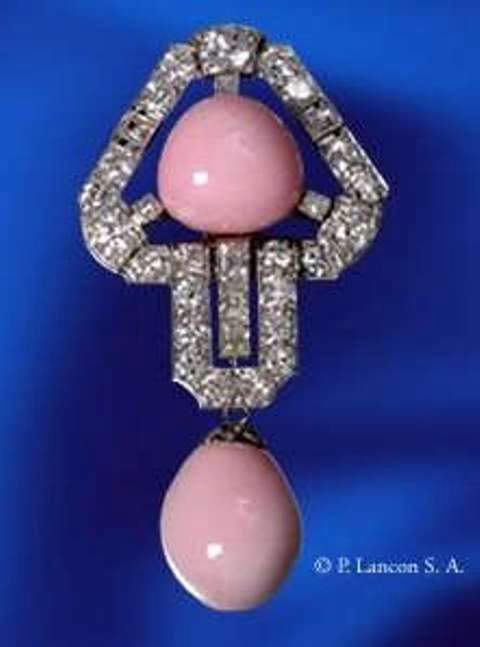
The Queen Mary Conch Pearl
©Smithsonian Institution
Thus the two conch pearls incorporated in the brooch have the spectacular chatoyancy effect known as "flame structure" which appears as a silky sheen on the surface of the pearl. The extraordinary size of the two conch pearls which is much above the average size of conch pearls met with in nature, and the historic provenance of the pearls, elevates the Queen Mary Conch Pearls to the status of extremely rare and famous pearls in the world.
Are conch pearls true pearls like pearls produced by oysters and mussels ?
What causes the iridescence of true pearls ?
Pearls are produced not only by bivalve mollusks (Bivalvia) such as oysters and mussels, but also by univalve mollusks (Gastropoda) such as snails and sea snails. Among the gastropod sea snails that produce pearls are the queen conch (Strombus gigas), found in the Caribbean and Gulf of Mexico, the horse conch (Pleurocopa gigantea), the largest sea snail found along the Atlantic coast of the Americas, from North Carolina to Brazil, and the melo melo sea snail found in the South China Sea. However, the pearls produced by the sea snails are not considered to be true pearls, as they do not produce the nacre that is responsible for the luster and iridescence of true pearls. Nacre also known as "mother-of-pearl" is a combination of organic and inorganic components. The organic component of nacre is a scleroprotein called conchiolin, and the inorganic component is composed of crystalline calcium carbonate, mainly aragonite in the form of hexagonal platelets. The transparent aragonite platelets are arranged in continuous parallel lamina separated by sheets of conchiolin. The thickness of the aragonite platelets, which is 0.5 µm is comparable to the wavelength of visible light. This causes the constructive and destructive interference of different wavelengths of visible light falling on the platelets, causing different colors of light to be reflected at different viewing angles, producing the effect known as iridescence.
Conch pearls are non-nacreous but shows a form of chatoyancy called "flame structure"
The non-nacreous gastropod pearls like the conch pearls are referred to as calcareous concretions, and are similar to the kidney stones produced in humans. They are said to be porcellaneous having the matte appearance of porcelain or ceramic. The conch pearls although non-nacreous often exhibit a unique flame-like shimmering effect on its surface known as a "flame structure." This is an optical effect, a form of chatoyancy, caused by the interaction of light rays with the microcrystals on the surface of the pearl. Calcite, a crystalline form of calcium carbonate is the main component of conch pearls. The calcite microcrystals are arranged in concentric layers in a lamellar fashion, forming bundles of microcrystalline fibers, whose alignment causes the chatoyancy by the interaction of light rays with the microcrystals.
What causes the chatoyancy in conch pearls ?
The word chatoyancy is derived from the French word "oeil de chat" meaning "cat's eye" used to refer to the optical effect that produces a luminous streak running like a brilliant slit across an oval-shaped gemstone like chrysoberyl, beryl, quartz, tourmaline, apatite and moonstone. Chatoyancy is caused by the fibrous nature of the material such as tiger eye quartz, or by fibrous inclusions like rutile within the gemstone such as cat's eye chrysoberyl. The luminous streak of reflected light is always perpendicular to the direction in which the fibers are aligned. If the needle-like inclusions are aligned in two or three directions in relation to the crystal structure, the chatoyancy becomes more complex, and two or three light bands are formed resulting in the chatoyancy effect known as asterism, as found in star sapphires and star rubies and other gemstones. In conch pearls, especially the common pink variety, the optical effect does not produce a luminous streak of reflected light as in the "cat's eye effect" or asterism, but produces a flame like shimmering effect, known as a "flame structure" also believed to be a form of chatoyancy, caused by the interaction of light with microcrystals of calcite that are arranged in concentric layers.
Attempts to reclassify conch pearls as true pearls ?
The spectacular shimmering effect produced by pink and white conch pearls, known as a "flame structure" reminiscent of a fire burning on the surface, have led some pearl experts to reconsider their classification under calcareous concretions, and elevate them to the status of true pearls. The effect is so striking in some conch pearls that it surpasses the iridescent effects of some low grade true pearls. This was one of the compelling reasons that prompted Kenneth Scarrat, the director of GIA in Bangkok, to suggest that conch pearls be elevated to the status of "true pearls" from their present disparaging status as calcareous concretions.
Conch pearls, the popular pearl of the future ?
Reasons for decline in popularity of conch pearls after the Belle Epoque periods
The conch pearls were once popular and used in jewelry during the Belle Epoque period from 1901 to 1915. But since then their popularity had waned after the availability of different varieties of true pearls, and particularly after the successful production of cultured Japanese Akoya pearls in the 1920s, which almost wiped out the harvesting of the elusive natural pearls in many traditional pearl fishing areas of the world. However, in the Caribbean and the Gulf of Mexico, the Queen conch, Strombus gigas continued to be harvested on an unprecedented scale not for their conch pearls but for their meat which became a popular delicacy in this region. The over exploitation of the queen conch off the coast of Florida and in the Caribbean has transformed the popular sea snail into an endangered species, and many countries have imposed restrictions on their exploitation.
Conch pearls were a by product of the queen conch fishing industry. Susan Hendrickson builds up one of the largest collections of conch pearls in the world
The continuous harvesting of the queen conch for food, ensured a steady supply of the beautiful conch pearls during this period, as a by product of the queen conch meat industry, but unfortunately there were no takers for these pearls as their demand had dropped drastically. Only connoisseurs and collectors of conch pearls purchased these rare beauties from the fisherman. One such collector of conch pearls was Susan Hendrickson, the marine archaeologist, paleontologist and professional diver, who achieved international fame for her discovery of the largest, most complete and best preserved fossil skeleton of Tyrannosaurus rex in 1990 in the Black Hills of South Dakota. Besides her multifarious interests in the field of marine archaeology, as a paleontologist and as a professional diver, Susan Hendrickson also took a keen interest in the collection of rare conch pearls, while she went on diving expeditions to the Caribbean. She purchased conch pearls from the queen conch fisherman, and built up one of the largest collections of conch pearls in the world.
Possible reasons for the recent surge in popularity of conch pearls
Recently conch pearls are again experiencing a surge in popularity. This may be partly due to the increase in demand for natural pearls in a market where cultured pearls had reigned supreme for over eight decades. Attempts to culture conch pearls had not succeeded probably due to the sensitivity of the sea snail producing it, and the spiral shape of the shell that denies access to the pearl-producing part of the snail. Thus conch pearls available in the market are all undoubtedly natural pearls. The rarity of the conch pearls have also enhanced their value. The frequency of occurrence of conch pearls is only about one in 10,000 queen conch snails, and out of this less than 10% are of gem quality. Another factor that has increased the popularity of conch pearls is their availability in a wide array of colors, such as pink, white, yellow, brown and golden; the most sought after color being a salmon-colored orange-pink. In addition the presence of the unique "flame structure" particularly in the pinkish and whitish tones of conch pearls, adds to their value. The specific gravity of conch pearls is 2.85, making them heavier than any other known type of pearls. The conch pearls are also quite hard and resistant compared to other pearls. Susan Hendrickson, who owns the largest conch pearl collection in the world, has now gone into partnership with Georges Ruiz, the renowned Geneva-based jewelry manufacturer, to produce conch pearl jewelry and popularize their usage.
Are conch pearls affected by ultraviolet rays in sunlight ?
All organic gems are affected by exposure to ultraviolet light, and conch pearls are not an exception. The effect of ultraviolet light may not be apparent until after prolonged exposure over many years. The color of conch pearls tend to fade significantly over time, the ultraviolet rays possibly destroying the color causing pigments. Thus it has been recommended that conch pearls be worn mainly in the evenings and not exposed to excessive sunlight. Even Black Tahitian pearls have been reported to have undergone fading in strong sunlight, as apparent from the story of the natural black pearl that lost its luster and color after exposure to sunlight in a jeweler's shop window, as related in the "Book of the Pearl" by Kunz.
The deep-pink color and flame structure of the conch pearls in the Queen Mary Brooch, has apparently remained unchanged for the last 100 years. This was probably due to the proper storage of the brooch during this period that prevented its exposure to ultraviolet light, and other factors such as excessive heat and dehydration, that are also believed to be involved in color fading. Age was also thought to be a factor in color fading, but the fact that the Queen Mary Brooch conch pearls had survived for nearly 100 years without a significant reduction in color, shows that its effect is only minimal. It is important to remember that conventional indoor electric lighting, including light display in show cases in the jewelry store, do not affect the color and luster of conch pearls.
History of the Queen Mary Brooch and Conch Pearls
The probable period when the brooch was designed
The Queen Mary Brooch was designed and executed sometime after King George V ascended the throne of Great Britain, after the death of his father King Edward VII on May 6, 1910. The brooch was probably given as a gift by the king to his queen consort, Mary of Teck. The period from 1901, the year King Edward VII ascended the throne to 1915 is known as the Belle Epoque Period or the Edwardian Period with reference to fashion and jewelry designing. Given the fact that the use of conch pearls in jewelry was a trend during this period, and the design of the brooch similar to designs of brooches of the period, it can be safely assumed that the Queen Mary Conch Pearl Brooch also originated during the Belle Epoque Period. Thus in all probability the brooch was designed somewhere between 1910 and 1915.
The source of the conch pearls incorporated in the brooch
The source of the conch pearls on the Queen Mary brooch was undoubtedly the queen conch (Strombus Gigas) living in the neotropical Atlantic waters of the Caribbean and the Gulf of Mexico. They are found in Bermuda, southern Florida, southern Mexico, the entire Caribbean region, Venezuela and Brazil. The queen conch has been used by humans mainly as a source of food since pre-historic times. Besides this the shell of the conches had been used as bugles or trumpets, hand weapons, paint and ink holders, in pottery and also in the manufacture of jewelry. Conch pearls found occasionally in the queen conch had been a by product of the conch pearl fishery, which has a long tradition in the Caribbean region. In the late 19th and early 20th centuries when the use of conch pearls in jewelry was popular, most of the conch pearls recovered from the queen conches of the Caribbean region reached the jewelry markets of western nations including Great Britain. The conch pearls of the Queen Mary Brooch might also have reached Britain in a similar manner during this period, probably from one of many colonies of the United Kingdom in the Caribbean, such as Barbados, Bahamas, Antigua and Barbuda, Jamaica, Dominica, Trinidad and Tobago, Grenada, Saint Lucia, and Saint Vincent and Grenadines.
Strombus gigas - the Queen Conch
Classification :-
Phylum : Mollusca
Class : Gastropoda
Order : Sorbeoconcha
Sub-order: Hypsogastropoda
Family : Strombidae
Genus : Strombus
Species : gigas
Habitat of queen conches
Strombus gigas (queen conch) is a species of very large edible sea-snail, a marine gastropod mollusk coming under the family Strombidae, which are true conchs. It is one of the largest mollusks native to the tropical zone of the Western Atlantic Ocean from Bermuda to Brazil. The favorite habitat of the queen conch are beds Turtle grass (Thalassia), and Manatee grass (Cymodocea) and sand flats in warm and shallow waters, in the sub-tidal zone, at depths of 1 to 30 meters. The adult conches feed mainly on algae associated with sea grass such as Cladophora sp. and Polysiphonia sp., but the larvae survive on plankton. Being herbivorous the queen conch can only live in a habitat where it can graze successfully. That is at depths where penetrating sunlight can support the luxuriant growth of sea grass and algae associated with it, known as the "photic zone." This explains the preference of queen conches for warm and shallow habitats. However queen conches have also been found in deeper waters up to a maximum depth of 60-70 meters (195-227 feet)
External structure of the queen conch
Like most gastropods, the soft body of Strombus gigas, is protected by a hard spiral shell The body can be divided into three segments, the head, visceral mass and the foot. The head has two pairs of tentacles, out of which, the larger tentacle is concerned with the sense of sight, having photosensitive eyes. The smaller tentacle on the other hand is involved with the senses of touch and smell. At the end of the snout or proboscis is the mouth. Queen conches eat algae and other organic debris. The radula, a rough tongue-like organ with thousands of tiny tooth-like protrusions called denticles, help in the feeding process.
At the posterior end of the foot is a sickle-shaped operculum, which functions and appears like a claw. The operculum has multiple functions, such as acting in co-ordination with the foot, to help the conch in its locomotion and regain its normal orientation after the animal is overturned. It also functions as a defensive weapon against predators.
Growth of the conch shell
The adult snail has a large spiral shell ranging in length from 6 to 12 inches (15 to 31 cm). The shell is created by the mantle, a thin layer of tissue situated between the body and the shell. The conch builds the hard shell by extracting calcium carbonate from the sea water. The growth of the shell begins even before the egg hatches into a veliger larva. At the time of hatching the shell is transparent and has already one and a half whorls. It then metamorphoses into a larva with a four whorled shell, which is no more transparent. As the larva settles down and begin to grow, the growth of the shell keeps pace with the growth of the body. At 2 to 3 months the color of the shell is white, but at 5 to 6 months brown stripes begin to form. At 3 months the shell is just 1 cm in length, but at 12 months (one year) the shell attains a length of 10 cm. The shell forms pointed spines, which helps to protect the young conches from predators. As the conch continues to grow the shell also increases in length and continues to grow in a spiral. Finally when the conch is about 3 to 4 years old, the shell stops growing and begins to form a broad flared lip. The formation of the flared shell lip is an indication that the queen conch has reached its full growth and attained maturity, and is now ready for reproduction. The length of the shell is now between 20 to 30 cm (8 to 10 ins). Adult queen conch shells can be white, tan or cream colored. However the inner surface of the shell including the flared lip shows different shades of pink, and sometimes cream, peach (pinkish-orange) or yellow. As the queen conch grows older, the shell only increases in thickness and becomes heavier; and the long and pointed spines get worn out and blunted. The shell of old animals get covered with algae and other sedentary sea creatures can also settle on it.
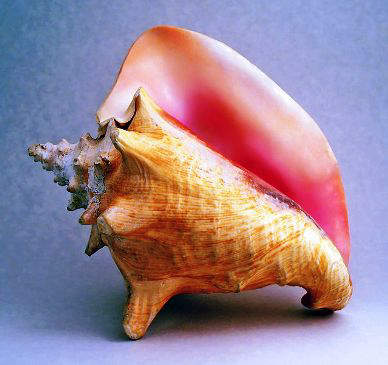
Adult Queen Conch Shell- Strombus gigas
Life span of queen conches
Queen conches achieve their maximum growth when they are about 3 to 5 years old, and can grow to a maximum length of about 30 cm (12 ins), attaining a weight of about 2.3 kg (5 lbs). If left undisturbed in their natural habitat queen conches can have a life span of about 20 to 30 years
Reproduction of queen conches
In queen conches sexes are separate and fertilization is internal. Mature male and female conches have been observed to copulate from mid-March to November. Copulation occurs when the male inserts a black, spade-like penis called a verge into the female's siphonal notch. The female retains the sperms for several weeks, and releases them only while laying eggs in order to fertilize them. Eggs are laid in continuous strands and each strand may contain up to three-quarters of a million eggs. Strands are laid at an average rate of 1.5 meters per hour; and each millimeter of egg strand contains an average of 13 eggs. The time taken for a female to spawn all its eggs is less than a day. Eggs are usually deposited on the sand, and therefore the presence of a sandy substrate is a requirement for spawning, apart from water quality, food supply and temperature which also can influence spawning.
Hatching of eggs and development of larvae into adults
The fertilized eggs begin embryonic development immediately after fertilization, forming a Gastrula after 16 hours, and a trochophore after 58 hours. Eventually after 7 days they become larvae, which hatch out of the eggs and become free floating and are known as veligers. Veligers have a small transparent shell called protoconch, which eventually develops into an adult shell. Four wing-like lobes are formed in the larvae after 6 days, and an additional 2 lobes after 12 days. The veligers float in the water for about 3 weeks, and then settle on substrates such as beds of sea grass. The lobes develop into the foot. Not all veligers find a suitable substrate and around 60 % of them perish. After about 1-2 months the young conch resembles an adult. It takes almost 3 to 4 years for a conch to attain sexual maturity and develop the broad flared lip of the shell. At maturity the length of the shell measures 20 to 30 cm, equivalent to 8 to 10 ins.
Economic importance of queen conch
In ancient times queen conch had been used mainly as a source of food. Besides this in ancient times the conch shells also had multiple other uses, such as being used as bugles and trumpets, hand weapons, paint and ink holders, and for the manufacture of jewelry. In modern times the queen conches are continued to be valued as a nutritious and cheap source of food in the West Indies and the Caribbean. The meat of queen conches are rich in protein and low in fats and carbohydrates. Its flavor is similar to that of scallops, abalones and clams, and lacks the "fishy taste" found in most sea foods. Thus the main use of queen conches is as a source of food, and the conches are mainly harvested for this purpose. The demand for the conch meat has resulted in over-fishing of queen conches throughout most of its range, leading to the imposition of restrictions on their fishing. Besides, being used as human food, conch meat is also used as fishing bait.
The queen conches are also valued for their shells. The beautiful pinkish shells are sold as souvenirs. The shells are also used commercially to make cameos, curios and certain types of jewelry such as earrings.
Some queen conches, about one in 10,000, can produce pearls, that have a great value as gemstones. The production of conch pearls is thus a by product of the harvesting of queen conches for their meat.
Conservation status of queen conches
Rise and collapse of the queen conch fisheries in the Caribbean
The queen conch is found in the territorial waters of at least 36 countries and dependant territories in the Caribbean, from the State of Florida in the United States to the northern coast of South America. Queen conch fishery was a thriving industry in most of these countries up to the 1960s, supplying conch meat to the domestic and international markets. Some countries such as the Honduras, Haiti and the Dominican Republic earned valuable foreign exchange by the export of queen conch meat. Thus the queen conch became one of the most important fishery resources in the Caribbean, sustaining an industry whose output had an annual wholesale value of US $60 million. However, the unprecedented local and international demand for the conch meat led to overfishing and poaching, resulting in the rapid decline of populations throughout the range of the species, in the 1970s. Habitat degradation such as loss of important nursery habitats like shallow-water seagrass meadows close to the shore, have been suggested as contributory factors. One region where the fishery almost totally collapsed due to the serious depletion of the population, was the U.S. State of Florida, which imposed a moratorium in 1986, followed by the listing of the species under CITES (Convention for the International Trade of Endangered Species) in 1992, and then a total ban on conch fishing. Other countries where a total or temporary closure of the fishery had been effective are Cuba, Colombia, Mexico, Netherlands Antilles, the Virgin Islands (US) and Venezuela. One country where the conch populations were seriously affected was Bermuda (UK), which imposed a ban on conch fishing in 1998.
Measures taken by producing countries to conserve natural populations of queen conch and help in their recovery
In the international trade in Conch meat 78% of the total annual production was imported by the United States, followed by 19 % by France. The U.S. was in the unique position of being both a producer and leading consumer of conch meat. Being the world's leading importer of conch meat, the U.S. was in a position to dictate terms to the producing countries to adopt measures to conserve the natural populations of queen conch. In 1992, the US persuaded the producing countries to adopt a proposal for listing queen conch in Appendix II of the CITES, and thus the queen conch became the first large scale fisheries product to be regulated by the CITES. In 1995, CITES recommended that all countries prohibit the importation of queen conch from Honduras, Haiti and the Dominican Republic, as they had not implemented the guidelines suggested by CITES for the management of their queen conch resources. In 1996 the first meeting of the International Queen Conch Initiative held in San Juan, Puerto Rico, adopted the declaration of San Juan in which the countries of the Caribbean pledged to work together to establish a common management regime for the sustainable exploitation of the queen conch.
In the year 2003, CITES found that despite all the good intentions, declarations and collaboration of the past seven years, the queen conch populations continued to decline, and announced stronger measures would be taken to regulate the fishery and promote its recovery. In response to these measures the Dominican Republic and Honduras, decided to toe the line and stop the export of queen conch from September 29, 2003, and implement the recovery programs outlined by the CITES Animal Committee. However CITES also recommended that the embargo placed on Haiti be continued due to their arrogance and refusal to implement recommended guidelines within the agreed time frame. CITES also suspended all trade in queen conch shellfish with immediate effect. It is hoped that the drastic measures adopted by CITES would have a beneficial effect on the dwindling queen conch populations and help in their recovery.
Queen Mary - A short biography
From her birth to her marriage
Queen Mary (1867-1953) who was previously Princess Victoria Mary of Teck, was the Queen Consort of King George V, King of the United Kingdom and the British Dominions and the Emperor of India, who ruled from 1910 to 1936. She was the daughter of Francis, Prince and Duke of Teck and Princess Mary Adelaide of Cambridge, and was born at Kensington Palace, London, in May 1867. She was a great-granddaughter of King George III and was a second cousin to Queen Victoria, who was also her godmother and after whom she was named Victoria Mary. Her pet name however was "May" after the month in which she was born. In 1891 at the age of 24, she was betrothed to Victor Albert, the Duke of Clarence, the eldest son of the Prince of Wales, Prince Edward Albert, who was the eldest son of Queen Victoria, and heir to the British Throne. However the Duke of Clarence died six weeks later in the influenza pandemic of 1891-1892, before the marriage could take place. Queen Victoria who had taken a liking to Mary and who was behind the choice of Mary as bride for the Duke of Clarence, was not discouraged and still wanted to see Mary become Queen of England one day. She therefore persuaded Prince George, the Duke of York, the second son of Prince Edward Albert, and the second in line to the British Throne, to propose to Princess Mary. The marriage took place on July6, 1893, and turned out to be a very successful marriage that produced six children.
From the time she became the Princess of Wales to her death
After the death of Queen Victoria in 1901, Princess Mary, the Duchess of York, became the Princess of Wales, when her father-in-law, Prince Edward Albert ascended the throne as Edward VII on January 22, 1901. When Edward VII died on May 6, 1910, the Prince of Wales ascended the throne as George V, and Princess Mary became the Queen Consort of the United Kingdom. Queen Mary supported her husband throughout the period of World War I, during the major political changes that followed the war, the rise of nationalism and socialism, and during his ill health. After King George V's death in 1936, her eldest son Edward ascended the throne as Edward VIII, but to her dismay he abdicated the same year to marry twice-divorced American socialite Mrs. Wallis Simpson. Edward VIII was succeeded by his shy and stammering younger brother Albert, who ascended the throne as George VI. Queen Mary provided great support to her timid, stammering son, in the early years of his reign. This support continued until his death in February 1952. George VI was succeeded by his eldest daughter Elizabeth Alexandra Mary, who ascended the throne as Queen Elizabeth II. Queen Mary died of lung cancer in March 1953 at the age of 86, one year after her granddaughter Queen Elizabeth II ascended the throne as the Queen of the United Kingdom. During this period from February 1952 to March 1953, there were three Queens in the country, Queen Mary, her daughter-in-law Queen Elizabeth, the Queen Mother and the reigning Queen, Elizabeth II.
Queen Mary transforms the British royal family's jewel collection into one of the greatest collections in the world
Queen Mary has gone down in history as the queen who did more to project the image of the queen as a stately, heavily bejeweled and dignified figure than any other English queen had done before. She is also credited with setting the tone of the British Royal Family, as a model of regal formality and propriety, especially during state occasions. She became famous for superbly bejeweling herself for formal events. She had a great passion for collecting objects of art, jewels and jewelry. Besides this she collected many items with royal connection, such as porcelain, cameos, royal seals, Faberge animals, gold boxes encrusted with jewels and jeweled fans.
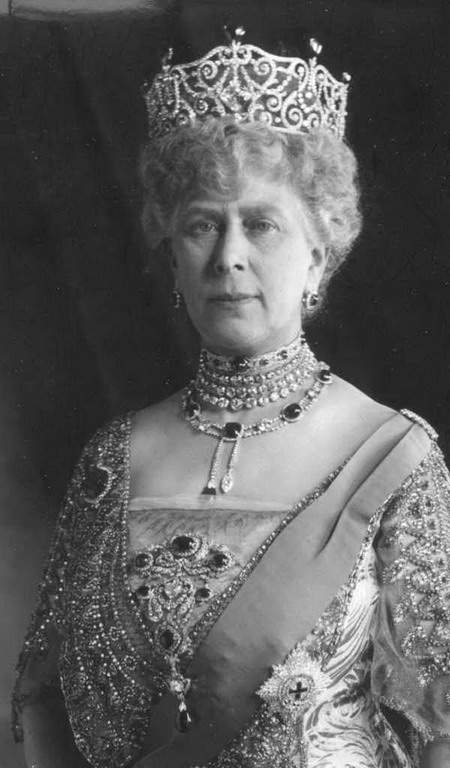
Queen Mary wearing the Cambridge and Delhi Dunbar Parure
According to James Pope-Hennessy, who wrote a biography of Queen Mary, she is said to have had an obsessive zeal for reorganizing the royal collections and the furniture in the royal residences, and of retrieving portraits, plates, pieces of furniture, miniatures and relics which had in earlier years been dispersed, and which she now re-integrated into the collections at Windsor Castle. According to another authority, it was Queen Mary's dedication and careful planning that transformed the British royal family's jewel collection, both the Crown Jewels and the personal jewelry collection, into one of the greatest jewelry collections in the world.
She is credited with acquiring the Romanov Jewels that once belonged to Russia's Dowager Empress Marie Feodorovna, sister of England's Queen Alexandra, who escaped the Russian Revolution, and brought with her part of one of the most magnificent jewelry collections in the world. She purchased the jewels from Empress Marie Feodorovna's two daughters after her death.
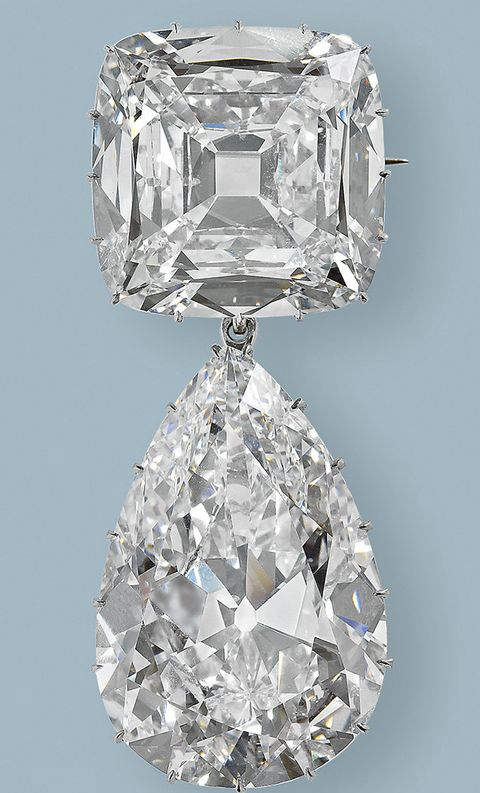
The Cullinan IV(above) and III(below) ,combined as a brooch
King George V and Queen Mary also inherited the famous Cullinan diamonds, consisting of 6 large and 96 smaller satellite diamonds, which were originally presented as a rough diamond weighing 3,106 carats, to King Edward VII, by the Transvaal Government to mark the occasion of his 66th birthday on November 9, 1907. The cutting of the Cullinan was entrusted to J. Asscher & Co. of Amsterdam, and began on February 10, 1908, and was probably completed before the end of the year. After the diamonds were delivered to King Edward VII, he ordered that the 530.20-carat Cullinan I, aka "the Greater Star of Africa," the largest faceted diamond in the world at that time, be mounted on the Royal Scepter. The second largest diamond, the 317.4-carat Cullinan II, aka "the Lesser Star of Africa" was mounted on the brow or band of the Imperial State Crown of Great Britain. The other Cullinan diamonds remained as part of the Crown Jewels, and before they could be used in any settings King Edward VII died on May 6, 1910. Thus after King George V ascended the throne in 1910, Queen Mary got the opportunity to use the remaining Cullinan diamonds and incorporate them in fabulous pieces of jewelry. The 94.40-carat Cullinan III diamond was incorporated in the finial of Queen Mary's Crown, but when required could be dismounted and combined with Cullinan IV to form a pendant brooch. Cullinan IV was also mounted on Queen Mary's Crown, but could be dismounted and used as above. Cullinan V also had a dual use, one, mounted in a brooch for Queen Mary, and the other to be worn in the circlet of her crown, as a replacement for the Koh-i-Noor, when it was removed to be mounted on a new crown for Elizabeth, the Duchess of York, after her husband George VI's ascension to the throne, when Edward VIII abdicated in 1936. The 4.39-carat Cullinan IX diamond was mounted on a ring with a prong setting for Queen Mary.
Another magnificent suite of jewelry that was owned by Queen Mary was the Cambridge and Delhi Dunbar Parure, that was designed by the Crown Jewelers, in anticipation of the coronation of King George V and Queen Mary, on June 22, 1911, and their subsequent proclamation as Emperor and Empress of India, at a special Durbar that was held on December 12, 1911. One of Queen Mary's greatest moments came in 1913, when she as the Queen Consort of England attended the wedding of Kaiser Wilhelm's daughter, heavily bedecked with jewelry, and was hailed as the most spectacular royal guest at the gathering. Thus the Queen Mary Conch Brooch, the subject of this web article, was also undoubtedly a piece acquired by Queen Mary during her reign.
The Queen Mary Conch Pearl Brooch is exhibited at "The Allure of Pearls" Exhibition
The Queen Mary Conch Pearl Brooch was one of 12 of the world's most extraordinary pearls that went on display at the Janet Annenberg Hooker Hall of Geology, Gems and Minerals, on the second floor of the National Museum of Natural History of the Smithsonian Institution from March 18th to September 5th, 2005. The exhibition that was christened "The Allure of Pearls" brought together 12 of the most famous and exceptionally rare pearls, a collection of varied colors, sizes and beauty, so rare that only a few people such as the most prestigious pearl merchants and distinguished jewelry collectors, have ever had the opportunity to behold. The exhibition that was organized by the National Museum of Natural History of the Smithsonian Institution was co-sponsored by the Gemological Institute of America, Paspaley Pearls Pty. Ltd. and Iridesse Pearls. The Queen Mary Conch Pearl Brooch was loaned for the occasion by its present owners Georges Ruiz and P. Lancon S.A. Georges Ruiz is the Geneva-based renowned jewelry maker who together with Susan Hendrickson, the marine archaeologist, and collector of conch pearls, have attempted to popularize the use of conch pearl jewelry. However, it is not known how the "Queen Mary Conch Pearl Brooch, instead of entering the British Crown Jewels, or the personal jewelry collection of Queen Elizabeth II, eventually came to be owned by Georges Ruiz and P. Lancon S.A.
Jeffery Post, the curator of the National Gem Collection at the Smithsonian's National Museum of National History, commenting on "The Allure of Pearls" exhibition, said, " 'The Allure of Pearls' brings together a tremendous collection of some of the rarest, largest and most spectacular pearls in the world. Visitors will be amazed at the great variety of the pearl's colors and shapes. Each one is beautiful and each has a fascinating story."
You are welcome to discuss this post/related topics with Dr Shihaan and other experts from around the world in our FORUMS (forums.internetstones.com)
Related :-
2) Cambridge and Delhi Dunbar Parure
3) Drexel Pearl
References
1)The Allure of Pearls - website of the Smithsonian's NMNH, www.mnh.si.edu/exhibits
2) Conch Pearls - www.pearl-guide.com
3) Chatoyancy - From Wikipedia, the free encyclopedia
4) Queen Conch - www.naturefoundationsxm.org/education/queen-conch
5) Conch Pearls - Pearl-Guide.com
6) Conch Pearl, Pink Pleasure - by David Federman - www.modernjeweler.com
7) Mary of Teck - www.bbc.co.uk/dna/h2g2
8) Mary of Teck - From Wikipedia, the free encyclopedia
9) CITES suspends trade in queen conch shellfish - Press Release, www.cites.org
10) Marine Invertebrates of Bermuda - Queen Conch -Strombus gigas - by Matthew M. James and James B. Wood
11) International Queen Conch Initiative - Caribbean Fishery Management Council, www.stroumbusgigas.com
12) Queen Conch (Strombus gigas) - www.nmfs.noaa.gov
13) Strombus gigas - From Wikipedia, the free encyclopedia
14) Conch - From Wikipedia, the free encyclopedia
15) Gem Profile 10 : Conch Pearl, www,airesjewelers
16) Susan Lee Hendrickson - www.wingsworldquest.org
 Home
Security & Guarantee
How it Works
Technology Partners
Updated Tables
Famous Diamonds
More Famous Diamonds
Famous Pearls
Famous Gemstones
Contact Dr Shihaan Larif
Contact Senior Editor
Famous Jewelry
Reference Database
Forums
Learning Center
Gemstone Gallery
e-mail Notifications
Advertise
Press Release
About Us
Privacy Policy
Contact Us
FAQ'S
Site Map
Staff Mail Login
Staff Documents
Birthstones
History
Minerals
Shows
Live Metal Prices
Jewellery Gallery
News
Marketplace
Marketplace Support
Open Store
Online Auctions
Join Us & Contribute
Directory
Classifieds
List your products
Wholesale Trading
Post Buy Request
Go Green Policy
Site Updates
Upcoming-ToDo List
Latest News
Latest Articles
Latest Blog Updates
Chat Rooms
Job Board
User Gallery
Videos
New Newsletter Archive
Old Newsletter Archive
Jewelry & Mineral Blog
User Blogs & Social Network
Search
Answers (Q & A)
Valuation
Help me find a diamond/jewelry
pin.internetstones.com- Social Pinboard- Sart yours & connect with millions
Invite Friends From Yahoo, Gmail etc-One Click
Home
Security & Guarantee
How it Works
Technology Partners
Updated Tables
Famous Diamonds
More Famous Diamonds
Famous Pearls
Famous Gemstones
Contact Dr Shihaan Larif
Contact Senior Editor
Famous Jewelry
Reference Database
Forums
Learning Center
Gemstone Gallery
e-mail Notifications
Advertise
Press Release
About Us
Privacy Policy
Contact Us
FAQ'S
Site Map
Staff Mail Login
Staff Documents
Birthstones
History
Minerals
Shows
Live Metal Prices
Jewellery Gallery
News
Marketplace
Marketplace Support
Open Store
Online Auctions
Join Us & Contribute
Directory
Classifieds
List your products
Wholesale Trading
Post Buy Request
Go Green Policy
Site Updates
Upcoming-ToDo List
Latest News
Latest Articles
Latest Blog Updates
Chat Rooms
Job Board
User Gallery
Videos
New Newsletter Archive
Old Newsletter Archive
Jewelry & Mineral Blog
User Blogs & Social Network
Search
Answers (Q & A)
Valuation
Help me find a diamond/jewelry
pin.internetstones.com- Social Pinboard- Sart yours & connect with millions
Invite Friends From Yahoo, Gmail etc-One Click




Our Global Jewelry Industry Job Network


Buy & Sell in our Marketplace

Subscribe to our Newsletter

List in our Classifieds

List in our Directory

User Uploaded Gallery

Powered by Ultra Secure
Amazon (USA) Cloud Network

Founder Internet Stones.COM
Register in our Forums

| Featured In
|
|
|
|
|
|
|
|







Blog & Education Feed
Articles Feed
 |
 |
 |

Copyright © .Internet Stones.COM. All rights reserved.