Sancy Diamond
Open FREE Unlimited Store Join Our Newsletter
Origin of name
The Sancy Diamond gets it's name from Nicholas Harlay de Sancy of France, who was the one time owner of this fiery stone of Indian origin, shaped like a shield and weighing 55.23 carats. Harlay de Sancy acquired the stone either in 1570 when he was the French Ambassador to Turkey, based in Constantinople or in 1592 when as financier to King Henry IV of France, was on a mission to the Netherlands on royal business.
The exact year and the circumstances under which Harlay de Sancy acquired this unique and historic diamond seem to be controversial, and this confusion and controversy can be seen throughout the long, colorful and interesting history of this diamond.
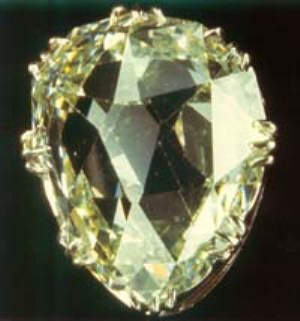
The Sancy Diamond

Characteristics of the diamond
The diamond is a 55.23-carat shield-shaped stone, without a pavilion, that attests to it's old cut. The stone is almost colorless, with a very faint greenish-yellow tint. The stone was considered to be the largest white diamond in Europe until the arrival of the Regent diamond in the seventeenth century.
Early history
The stone is undoubtedly of Indian origin, considering the period, it made it's first appearance in the 14th century, when India was the only source of diamonds in the World. The famous Golconda mines of southern India had not been discovered around this time, and therefore the stone might have originated in the Sambalpur mines by the banks of the Mahanadi River, situated on the eastern side of the central provinces of India. Most of the diamonds of ancient origin and the middle ages are believed to have originated in these mines. The diamond river mentioned by Ptolemy is believed to be the Mahanadi River.
The diamond is believed to have been smuggled out of India in the 14th century, by a Venetian diamond cutter. The first recorded evidence of the existence of the Sancy in Europe is in the dowry inventory of Valentina Visconti, daughter of Galeazzo di Visconti, the Duke of Milan, in 1389. At that time the diamond weighed over 100 carats. Valentina married the Duke d' Orleans Louis I, brother of King Charles VI of France (1380-1422). Louis sat on his brother's council, after Charles VI decided to rule alone having attained the age of 20 years in 1388. He dispensed with the services of his uncles who were serving in the administrative council, with Philip the Bold, the Duke of Burgundy, acting as regent. Around 1392, just 4 years after assuming full powers as King of France, Charles became ill with fever and convulsions, the first of his 44 attacks of madness. The attacks lasted from 3-9 months and were interspersed with 3-5 months of sanity, for the remainder of his life.
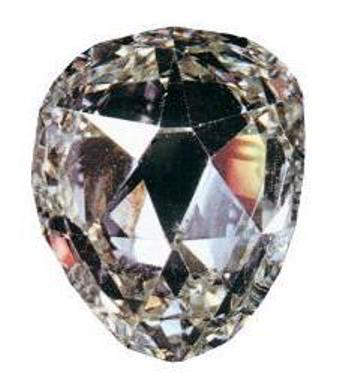
The Sancy Diamond
With royal authority weakening, a power struggle developed between the Duke de Orleans, Louis I and his uncle Philip the Bold, Duke of Burgundy. However Philip died in 1404, and the rivalry continued with his son John the Fearless, successor to Philip the Bold. The family feud finally ended up with the murder of Louis I, by the agents of John the Fearless, in 1407. Immediately after the assassination of Louis I, a long feud ensued between the Armagnacs, partisans of Louis' heirs, and the Burgundians. John the fearless allied himself with King Henry V of England and defeated the French forces at the battle of Agincourt in 1415.
Valentina who was very bitter over her husband's assassination by the Burgundians, used the Sancy diamond to obtain funds, to finance the struggle by the Armagnac faction against the Burgundians. But following the defeat of the Armagnac faction, the Sancy diamond fell into the hands of Duke John the Fearless, as a spoil of war. The Sancy then remained with several generations of the Dukes of Burgundy, until it reached Charles the Bold, the great grandson of John the Fearless. The diamond was believed to bring good luck to the Dukes of Burgundy, and Charles carried it into battle on several occasions, always ending up victorious, until it was lost in the Battle of Granson in 1476. Misfortune followed after this, Charles losing two battles against the Swiss. In the last Battle at Nancy on Jan 5,1477, Charles was killed and his mutilated body was discovered some days later.
It now appears that the Sancy that was purported to have been lost in battle, was actually hidden away by the Bishop of Basel along with another famous Jewel, the "Three Brothers Jewel", also belonging to Charles the Bold. After a lapse of almost 14 years the "Three Brothers Jewel' was sold secretly to Jacob Fugger who was a great financier. Fugger also acquired the Sancy after this through the Hertenstein family of Lausanne. It was Fugger who got the Sancy cut to it's present weight of 55.23 carats.
In the early 16th century the Sancy was sold to Manuel the Fortunate, the King of Portugal from 1495 to 1521, in exchange for northern European exclusivity for the lucrative pepper contract from Portugal's colonies. The death inventory prepared after Manuel's death in 1521, lists the Sancy as the first item of jewelry weighing 11.046 grams equivalent to 55.230 carats (11.046 x 5 ).
The Sancy remained a part of the Portuguese Crown Jewels until 1580, when Philip II of Spain invaded Portugal to assert his right as the heir to the Portuguese throne against Antonio de Crato, who was defeated and sought refuge in Paris. Antonio de Crato escaped with most of the crown jewels to France. later he sold some of the crown jewels to King Henry III of France and the others to Queen Elizabeth I of England. Antonio's sale of the valuable crown jewels of Portugal, to the Crowns of France and England was done with the intention of obtaining help from either France or England, for any future campaign to regain his lost throne. This is confirmed from the official historic documents of both countries. The Sancy was sold to Queen Elizabeth I. It is said that Queen Elizabeth I got her portrait painted while wearing the Sancy diamond. The Entry of the Sancy into the crown jewels of England was also significant, as it was united with the Three Brothers Jewel, acquired by Elizabeth's brother, Edward VI in 1547. The two stones were re-united after 1477, when they were part of the jewels belonging to Charles the Bold, Duke of Burgundy. Later Elizabeth I needed funds to finance a military campaign to assist the Dutch in their struggle for independence from Spain. To obtain the funds she decided to pawn the Sancy diamond, which was dispatched to Antwerp through the Earl of Leicester to be pawned to Francesco Rodriguez.
The Sancy that was pawned n Antwerp was never redeemed and found it's way to Netherlands, where it was purchased in 1592 by Nicholas Harlay de Sancy, the financier to Henry III and later Henry IV of France. Subsequently when Nicholas Harlay de Sancy visited England on an official mission, Queen Elizabeth I had wanted the diamond back, but Harlay de Sancy politely refused. Later Nicholas Harlay had to explain to King Henry IV as to how he acquired the diamond. He said that he acquired the diamond on one of several missions to Netherlands on royal business.
Another version of how the Sancy came into the possession of Nicholas Harlay de Sancy, states that he purchased it in 1570, at Constantinople, when he was the ambassador of France to Turkey. But, how the Sancy came to Constantinople, when it was still a part of the crown jewels of Portugal and remained so up to 1580, is quite puzzling. Therefore this version of events is untenable, and might have been created by Nicholas Harley de Sancy, to convince King Henry IV, that he had been in possession of the stone all along.
The childless Elizabeth I died on March 24, 1603 and was succeeded by James VI of Scotland, the first Stuart King of England, who took the title of James I. At the beginning of the 17th century, Harlay de Sancy, was in dire financial straits, and looked desperately for a prospective customer for his valuable Sancy diamond. Eventually he was able to sell his diamond to King James I of England in 1604, and thus the diamond returned back to England.
In March 1625, when James I died, his second surviving son Charles I, succeeded as King of Great Britain. Charles I inherited the Sancy with the other crown jewels, and presented it to his wife Henrietta Maria (daughter of Henry IV of France) as a wedding gift, when he married her soon after ascending the throne. The Sancy along with other Crown Jewels was pawned around 1626 in Amsterdam, when Charles I was in desperate need of funds to pursue his unpopular war efforts against Spain and later France. It was around this time that the Dutch jeweler Thomas Cletscher made his famous drawings of the Sancy diamond.
In the 1630s Charles redeemed the crown jewels including the Sancy, but the continued conflicts between Charles I and his Parliament, one trying to limit the powers of the other, eventually led to a serious confrontation between the Royalists and the Parliamentarians in 1641, both groups enlisting troops and collecting arms for a possible outbreak of war. Queen Henrietta went to Holland in February 1642 to raise funds for her husband, by pawning the crown jewels again including the Sancy. Around July 1642 tension had been running high in both camps and on August 22nd Sporadic fighting broke out all over the Kingdom. In February 1643, a shipload of arms from Holland, purchased by Queen Henrietta after pawning the crown jewels, landed in Yorkshire, a royalist stronghold. Charles I had his court and military headquarters in Oxford, and Henrietta joined him at Oxford in July 1643. Queen Henrietta gave her husband all the encouragement he needed during this crucial moment of his rule.
In the year 1645, Charles sent his family away to France, and full scale war broke out on June 14, 1645. Charles forces suffered defeat after defeat and eventually Charles I was captured in 1647. Charles was put on trial for treason in January 20th 1649, on the insistence of the Army, found guilty and sentenced to death on Jan 27th, 1649. Charles I was finally put to death by beheading on Jan 30, 1649.
After the death of Charles I, Cardinal Mazarin, the Prime Minister of France and regent of King Louis XIV took over Henrietta's debts. Cardinal Mazarin redeemed the crown jewels that were pawned and with the Queen's consent took possession of the gems and bequeathed them with other fine stones to Louis XIV (1643-1715). From Louis XIV, the Sancy passed to Louis XV, who was King of France from 1715 to 1774. Louis XV was the great grandson of King Louis XIV. His rule as king was ineffectual and contributed to the decline of royal authority, that led to the outbreak of the revolution in1789. Louis XV died in 1774 and was succeeded by his grandson Louis XVI, formerly Louis Auguste, duke de Berry. Louis XVI (1774-1792) was the last king of France in the line of Bourbon monarchs, preceding the revolution of 1789. The monarchy was abolished on September 21, 1792. Subsequently both Louis XVI, and his Queen consort Marie Antoinette, were guillotined on charges of counter revolution on January 21, 1793.
Modern history
In 1792, the French crown jewels, which included the Sancy, the Tavernier blue, the Regent, etc. were stolen from the Garde Meuble (royal treasury) in Paris. Some of the gems were later recovered, but there is controversy about the recovery of Sancy. Some historians believe that the Sancy was recovered, only to be sold by the Directorate as a expendable symbol of royal decadence. It was reported to be sold to the Spanish Crown's Minister, Manuel de Godoy, but was never confirmed, The Sancy is believed to have been in the possession of the Queen of Spain, until the arrival of Joseph Bonaparte, to take over the Iberian peninsula on behalf of his brother, Napoleon Bonaparte. Joseph took possession of the Sancy, and hid it with other treasures, without the knowledge of his brother. The stone then re-appeared only after 20 years in Florence after the expiry of the statute of limitations, and was sold to the fabulously rich Prince Anatoly Demidov of Russia. Demidov's exceptionally beautiful wife Aurora is pictured with the Sancy in a portrait hanging in Ekatereinburg.
According to other historians the Sancy was never recovered after it was stolen from the Garde Meuble, but re-appeared in 1828, and was sold by a French merchant to Prince Anatoly Demidov of Russia.
The Sancy remained with Prince Anatoly Demidov up to 1865, when he decided to sell it to an Indian entrepreneur, Sir Jamsetee Jeejeebhoy for £50,000. Two years later the stone was displayed by the French Jeweler G Bapst, at the Paris exposition, with a price tag of 1,000,000 French Francs.
In 1906, the Sancy was purchased by Viscount William Astor (Ist Viscount Astor) as a wedding gift when his son Waldorf Astor (2nd Viscount Astor) married Nancy Langhorne of Virginia. Lady Astor often wore the big shield shaped gem in a tiara on state occasions. Lady Astor holds the unique distinction of being the first woman to sit in the British House of Commons, being elected to Parliament on November 28 , 1919. In 1962 the Sancy diamond featured prominently at the "Ten Centuries of French Jewelry"exhibition held at the Louvre Museum. When Lady Astor died in 1964, the Sancy was inherited by her son the 3rd Viscount Astor, and remained in the Astor Family until 1976. Finally the Louvre Museum of France purchased the Sancy from the Astor Family in 1976, for an undisclosed sum , in a deal financed by the Banque de France.
The following is a summary of the ownership of the Sancy in chronological order :-
S/N | Name of Owner | period | number of years |
| 1 | Valentina Visconti-daughter of Duke of Milan | 1389-1415 | 26 |
| 2 | Duke John the Fearless-Duke of Burgundy | 1415-1419 | 4 |
| 3 | Philip the Good-Duke of Burgundy | 1419-1467 | 48 |
| 4 | Charles the Bold-Duke of Burgundy | 1467-1477 | 10 |
| 5 | Bishop of Basel-Switzerland | 1477-1491 | 14 |
| 6 | Jacob Fugger | 1491-1495 | 4 |
| 7 | Manuel I-King of Portugal | 1495-1521 | 26 |
| 8 | John III-King of Portugal | 1521-1557 | 36 |
| 9 | Sebastian-King of Portugal | 1557-1578 | 21 |
| 10 | Henry-King of Portugal | 1578-1580 | 2 |
| 11 | Antonio de Crato-King of Portugal | 1580-1580 | 0 |
| 12 | Queen Elizabeth I-Queen of England | 1580-1581 | 1 |
| 13 | Pawned to Francisco Rodriguez at Antwerp | 1581-1592 | 11 |
| 14 | Nicholas Harlay de Sancy | 1592-1604 | 12 |
| 15 | King James I-King of Great Britain | 1604-1625 | 21 |
| 16 | Charles I-King of Great Britain | 1625-1642 | 17 |
| 17 | Pawned at Holland by Queen Henrietta, Queen Consort of Charles I | 1642-1649 | 7 |
| 18 | Cardinal Mazarin-Prime Minister of France | 1649-1654 | 5 |
| 19 | King Louis XIV-King of France | 1654-1715 | 61 |
| 20 | King Louis XV-King of France | 1715-1774 | 59 |
| 21 | King Louis XVI-King of France | 1774-1792 | 18 |
| 22 | Burglary of French Crown Jewels | - | - |
| 23 | Recovered and sold to Spanish Crown's Minister | 1792-1793 | 1 |
| 24 | Queen of Spain | 1793-1808 | 15 |
| 25 | Joseph Bonaparte-Brother of Napoleon Bonaparte | 1808-1828 | 20 |
| 26 | Prince Anatoly Demidov of Russia | 1828-1865 | 37 |
| 27 | Sir Jamsetee Jeejeebhoy of India | 1865-1906 | 41 |
| 28 | Lady Nancy Langhorne Astor of England | 1906-1964 | 58 |
| 29 | 3rd Viscount of Astor of England | 1964-1976 | 12 |
| 30 | Louvre Museum | 1976 to date | - |
| 31 | Total | 1389-1976 | 587 |
Thus, since it's arrival from India in the late 14th century, the Sancy had passed through at least 15 countries in Europe, affecting almost all the royal families of Europe. The countries in the sequence of it's appearance in history are Italy (Milan), Burgundy (France), Switzerland, Portugal, England, Antwerp (Belgium), France, England, Netherlands, France, Spain, France, Russia, India, England, France. At least in two countries, England and France, the diamond had appeared on more than one occasion, five times in France and thrice in England. The stone also returned for a short time to it's country of origin India.
The total number of years the stone remained in each country up to 1976 when it became the property of the French Louvre Museum are as follows :-
S/N | Country | Number of years |
| 1 | France | 263 |
| 2 | England | 109 |
| 3 | Portugal | 85 |
| 4 | India | 41 |
| 5 | Russia | 37 |
| 6 | Switzerland | 18 |
| 7 | Spain | 16 |
| 8 | Antwerp | 11 |
| 9 | Holland | 7 |
| 10 | Total | 587 |
Thus the Sancy is the most celebrated stone in history, that has passed through more countries, and affected more royal families than any other diamond in history.
Considering the long period the diamond had remained in France, about 263 years out of a total history of 587 years, the Sancy Diamond is without any doubt an outstanding relic of the proud National Heritage of France, and it's present home the Louvre Museum, is the most appropriate abode for such a great and historic diamond.
Back to Famous Diamonds,Gemstones and Pearls
 Home
Security & Guarantee
How it Works
Technology Partners
Updated Tables
Famous Diamonds
More Famous Diamonds
Famous Pearls
Famous Gemstones
Contact Dr Shihaan Larif
Contact Senior Editor
Famous Jewelry
Reference Database
Forums
Learning Center
Gemstone Gallery
e-mail Notifications
Advertise
Press Release
About Us
Privacy Policy
Contact Us
FAQ'S
Site Map
Staff Mail Login
Staff Documents
Birthstones
History
Minerals
Shows
Live Metal Prices
Jewellery Gallery
News
Marketplace
Marketplace Support
Open Store
Online Auctions
Join Us & Contribute
Directory
Classifieds
List your products
Wholesale Trading
Post Buy Request
Go Green Policy
Site Updates
Upcoming-ToDo List
Latest News
Latest Articles
Latest Blog Updates
Chat Rooms
Job Board
User Gallery
Videos
New Newsletter Archive
Old Newsletter Archive
Jewelry & Mineral Blog
User Blogs & Social Network
Search
Answers (Q & A)
Valuation
Help me find a diamond/jewelry
pin.internetstones.com- Social Pinboard- Sart yours & connect with millions
Invite Friends From Yahoo, Gmail etc-One Click
Home
Security & Guarantee
How it Works
Technology Partners
Updated Tables
Famous Diamonds
More Famous Diamonds
Famous Pearls
Famous Gemstones
Contact Dr Shihaan Larif
Contact Senior Editor
Famous Jewelry
Reference Database
Forums
Learning Center
Gemstone Gallery
e-mail Notifications
Advertise
Press Release
About Us
Privacy Policy
Contact Us
FAQ'S
Site Map
Staff Mail Login
Staff Documents
Birthstones
History
Minerals
Shows
Live Metal Prices
Jewellery Gallery
News
Marketplace
Marketplace Support
Open Store
Online Auctions
Join Us & Contribute
Directory
Classifieds
List your products
Wholesale Trading
Post Buy Request
Go Green Policy
Site Updates
Upcoming-ToDo List
Latest News
Latest Articles
Latest Blog Updates
Chat Rooms
Job Board
User Gallery
Videos
New Newsletter Archive
Old Newsletter Archive
Jewelry & Mineral Blog
User Blogs & Social Network
Search
Answers (Q & A)
Valuation
Help me find a diamond/jewelry
pin.internetstones.com- Social Pinboard- Sart yours & connect with millions
Invite Friends From Yahoo, Gmail etc-One Click




Our Global Jewelry Industry Job Network


Buy & Sell in our Marketplace

Subscribe to our Newsletter

List in our Classifieds

List in our Directory

User Uploaded Gallery

Powered by Ultra Secure
Amazon (USA) Cloud Network

Founder Internet Stones.COM
Register in our Forums

| Featured In
|
|
|
|
|
|
|
|







Blog & Education Feed
Articles Feed
 |
 |
 |

Copyright © .Internet Stones.COM. All rights reserved.