Seed Pearl Necklace in the Metropolitan Museum of Art - Mary Louisa Brown Seed Pearl Necklace
Open FREE Unlimited Store Join Our Newsletter
Origin of Name
The necklace was perhaps worn by Mary Louisa Brown in 1849, at the time of her marriage to Howard Potter
The 19th-century seed pearl necklace designed around the period 1845-50, in the United States, at the height of the popularity of seed pearl jewelry, in the U.S., the United Kingdom and other European countries, was a family heirloom believed to have descended in the family of Howard Potter, an industrialist, investment banker, diplomat and philanthropist, who helped found the Metropolitan Museum of Art, together with other benefactors like William E. Dodge, Theodore Roosevelt Sr. and others, and became one of the members of its first board of trustees.

Some of the other public institutions he helped to establish were the American Museum of Natural History, the Children's Aid Society and the New York Orthopedic Hospital. According to family tradition Mary Louisa Brown, daughter of James Brown of Brown Bros. & Co, probably wore this seed pearl necklace on the occasion of her marriage to Howard Potter in September, 1849. The necklace which remained in the family for over 150 years, was eventually gifted to the Metropolitan Museum of Art, by Mrs. Janet H. Dehn in the year 2003.
The necklace was a valuable addition to the Metropolitan Museum of Art, in New York City
Seed pearl jewelry are delicate pieces of jewelry held together by horsehair and silk, natural fibers used in the 19th century for stringing pearls. Unless such pieces had been restrung during the course of time, its difficult to keep them together as a single piece, in their original format. Thus, most of the beautiful pieces of seed pearl jewelry created in the 19th century, had disintegrated and disappeared forever. Therefore, seed pearl jewelry are among the most scare items of antique jewelry one can find in an antique jewelry store. To find an entire seed pearl parure, the usual form in which they were sold, completely intact is an extreme rarity, and may be seen perhaps only in a natural history museum,, such as the Mary Lucile Stevens Seed Pearl Parure in the Treasure House of the Smithsonian Institution, and several seed pearl jewelry sets in the British Museum. Thus, the Mary Louisa Brown Seed Pearl Necklace, in a fairly perfect state of preservation, in spite of being over a century-and-a-half old, is an extremely valuable addition to the Metropolitan Museum of Art, where it is preserved and displayed today, under the American Decorative Arts Section.
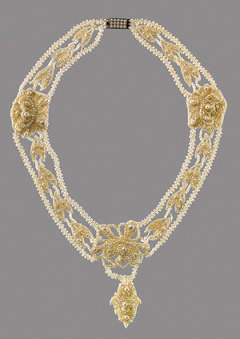
Seed Pearl Necklace in the Metropolitan Museum of Art- Mary Louisa Brown Seed Pearl Necklace
© Metropolitan Museum of Art
Click to Enlarge (External Link)
Characteristics of the Seed Pearl Necklace
The necklace is a "Princess" under the modern system of classification of pearl necklaces
The double strand seed pearl necklace is 50.8 cm (20 inches) long, and under the modern system of classification of pearl necklaces falls under the category of "Princess," whose range of length is between 17-20 inches. See table below.
Modern classification of pearl necklaces based on the length of the strand
| S/N | Length of strand in inches |
Category |
| 1 | 10"-13" | Collar |
| 2 | 14"-16" | Choker |
| 3 | 17"-20" | Princess |
| 4 | 21"-24" | Matinee |
| 5 | 25"-34" | Opera |
6 |
>35" | Rope |
The materials used on the necklace are seed pearls, yellow-gold, mother-of-pearl, horsehair and silk
Three floral plaques, also mounted with seed pearls on thin sheets of mother-of-pearl, covered with yellow-gold, are placed at three points on the necklace; one as the centerpiece of the necklace, and the other two at symmetrical positions on either side of the necklace. The plaques are joined by the two strands of seed pearls, and on the rear side to the clasp. The pearls on the floral plaques appear to be spherical, but those on the strands are baroque in shape. The rectangular shaped clasp also appear to be mounted with seed pearls. The gaps between the two strands are filled with a foliage motif, consisting of pairs of spindle-shaped leaves, also mounted with seed pearls, on a yellow-gold backing. The pairs of leaves are connected together by two narrow strands of pearls, representing the stem. Between the centerpiece and the two floral plaques on either side are four pairs of leaves. The number of pairs of leaves, between the floral plaques on the sides and the clasp behind, are three on each side. Another floral cluster hangs from the central plaque, by a sagging short strand of seed pearls. The diameter of the seed pearls vary from 1.59 mm to 5.0 mm, and the pearls are strung together with fine white horsehair, the preferred fiber for stringing together seed pearls at that time, as it could pass through the extremely minute drill holes, through which silk thread could not normally pass. The floral plaques of the necklace are backed by silk for the convenience and comfort of the wearer.
History of Seed Pearl Jewelry
The Source of the Seed Pearls
Pearls that were known as "Madras Pearls" actually originated on the Sri Lankan side of the Gulf of Mannar
Seed pearls are presently defined as natural pearls less than 2 mm in diameter and less than a quarter grain in weight. This definition however, had changed from time to time, and previously pearls up to a diameter of 5 mm were considered as seed pearls. The world's most prolific source of seed pearls in the past had been the Persian Gulf and the Gulf of Mannar, the traditional source of natural pearls in the world. This obviously coincided with the existence of the saltwater pearl oyster, Pinctada radiata in these waters, the most prolific pearl and seed pearl producer since ancient times. According to George Frederick Kunz as stated in his book, "The Book of the Pearl" the quantity of seed pearls obtained in the Ceylon pearl fishery from the Gulf of Mannar, exceeded that of any other fishery in any part of the world. The seed pearls produced in the Gulf of Mannar and the Persian Gulf, eventually found their way to the pearl markets of Bombay and Madras, two of the largest cities and commercial centers of India during the British period. In fact Madras was one of the first British outposts in India, where they built a fortress, and from where they eventually colonized the entire Indian sub-continent. Madras, was also the headquarters of the British East India Company. Pearls from the Ceylon pearl fishery in the Gulf of Mannar, reached Madras on the eastern coast on India, where they were drilled, and strung into strands, using horsehair or silk, and then exported in large quantities to the European pearl markets, where they came to be known as "Madras Pearls," though in fact the pearls originated on the Sri Lankan side of the Gulf of Mannar. Significant quantities of seed pearls from the Gulf of Mannar, also entered the Kingdom of Hyderabad, ruled by the Nizams, where a jewelry industry based on pearls, and patronized and encouraged by the Nizams, was based.
Pearls from the Persian Gulf reached the pearl markets of Bombay
Pearls from the Persian Gulf, usually reached Bombay, another port of call for British ships on the western coast of India. The seed pearls that reached Bombay, were drilled and strung into strands, and sold in the local pearl markets, where there was a great demand for such pearls from the Maharajahs of the Princely states of India, who paid better prices than those obtainable in London. The estimated 2 million pearls that went into the production of the "Pearl Carpet of Baroda" in the 1860s, are all "Basra pearls" from the Persian Gulf, that was purchased by the Gaekwar of Baroda, Maharajah Khande Rao (1856-1870), through his agents based in Bombay.
China and Japan was another source of seed pearls in the past
Another, source of seed pearls in the past was China and Japan, where a natural pearl industry based on Pinctada fucata (Akoya pearl oyster) and Pinctada martensii (Akoya-gai pearl oyster), which were closely related to Pinctada radiata existed. The Chinese seed pearls were also drilled and strung with horsehair, before they were exported to Europe. Thus the main source of seed pearls that reached Europe in the 18th and 19th centuries, were China and Madras, the ports from where these pearls were exported.
History of the Usage of Seed Pearls
Multiple uses of seed pearls in the past in Asian countries
Before seed pearl jewelry became popular in Europe in the 19th-century, during the Victorian period, seed pearls had been put into multiple uses in the countries of the east, such as India, Persia and the Arab countries of the Middle East. In India, the seed pearls were strung and used in multi-strand necklaces or twisted into multi-strand ropes. They were also used in embroidering royal robes and carpets, the studding of thrones, crowns and other royal paraphernalia. Seed pearl strands were also used in interior decorations in the courts and palaces of the kings and emperors of India and Persia. In Europe, large quantities of seed pearls that reached the capital cities from Venezuela, via Seville in Spain, was used mainly in the embroidery of royal robes in the 16th and 17th centuries, such as the famous seed pearl studded dresses of Queen Elizabeth I.
The use of seed pearls in Europe become popular in the late Georgian and early Victorian periods
In Europe, the use of seed pearls in jewelry, first became popular in the late Georgian period, from the last quarter of the 18th-cenntury to the early quarter of the 19th-century. The popularity of seed pearls however reached a climax in the early Victorian period, between 1837 and 1860, a period during which the rapid industrialization of Europe, created an increased middle class who could afford to purchase such pieces of jewelry. This was a period during which symbolism reigned supreme, and great symbolic meanings were attached to types of gemstones and jewelry motifs used in personal adornment. Seed pearl jewelry were associated with innocence and purity, and were believed to be ideal pieces of jewelry to be gifted to a girl on her 18th birthday, as her first formal piece of jewelry or to a bride on her wedding day.
Seed pearl jewelry were first introduced to the United States during the Federal period, but the manufacture of seed pearl jewelry in America started in the 1820s or 1830s.
Seed pearl jewelry were first introduced into America during the Federal period, immediately after the revolution, and were imported from Europe, together with its symbolic values. However, the first workshop to produce seed pearl jewelry in the United States, was started in the 1820s or 1830s by Henry Dubosq, who used the same methods employed for its production, as he had seen in England and Germany, and importing his raw materials initially from Europe, and later directly from the source countries of India and China. As in Europe, seed pearl jewelry in the United States were gifted to young girls at the age of 18, as their first formal piece of jewelry, or to a bride on her wedding day. By the mid-19th century the wearing of seed pearl jewelry, became fashionable for all formal occasions, and was a must even in the ballroom. The usage of seed pearl jewelry received its highest recognition in America in 1865, when President Abraham Lincoln, purchased a suite of seed pearl jewelry, consisting of a necklace and two bracelets, from Tiffany & Co. for his wife, Mary Todd Lincoln, to be worn at his inauguration, held on Saturday, March 4, 1865. In 1855, Tiffany's displayed a $1,000 seed pearl parure, at the International Exposition held at the Crystal Palace, in New York.
The Metropolitan Museum of Art
Early History of the Museum
The Metropolitan Museum of Art, popularly known as "The Met," situated on the eastern edge of Central Park, in New York City, is one of the world's largest art galleries, having a permanent collection of more than 2 million works of art, divided into 19 curatorial departments, each manned by a specialized staff of curators and scholars. The museum was founded in the year 1870, by a group of American citizens, that included businessman, bankers and financiers, apart from leading artists and intellectuals of the time, with the object of bringing art and works of art, closer to the American people, and to encourage and develop the study and appreciation of fine arts. The museum that opened on February 20, 1872, was first housed in a building, located at 681, Fifth Avenue, in New York City. The first President of the Museum was John Taylor Johnston, a railroad executive, who gifted his personal art collection to the museum; and the founder Superintendent of the museum was the publisher, George Palmer Putnam. The artist, Eastman Johnson served as a co-founder of the museum; and Luigi Palma di Cesnola, the former Civil War officer, as its first Director. The museum that initially consisted of only 174 European paintings and a Roman stone sarcophagus, expanded rapidly, and with the purchase of the Cesnola Collection of Cypriot antiquities in 1873, the available space was not enough to hold the increasing collection. The museum was then shifted in 1873, from its Fifth Avenue location to the Douglas Mansion situated at 128, West 14th Street. But soon, even the space available at Douglas Mansion was not enough to hold the rapidly expanding collection.
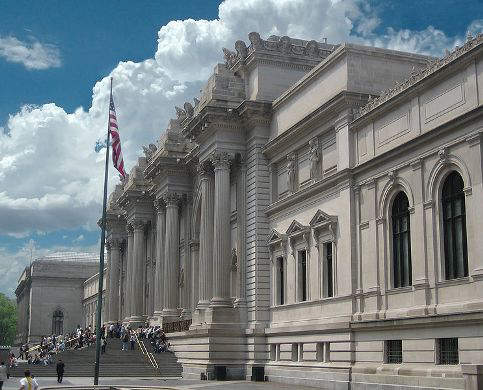
Entrance to the Metropolitan Museum of Art, New York
Photo above, Creative Commons
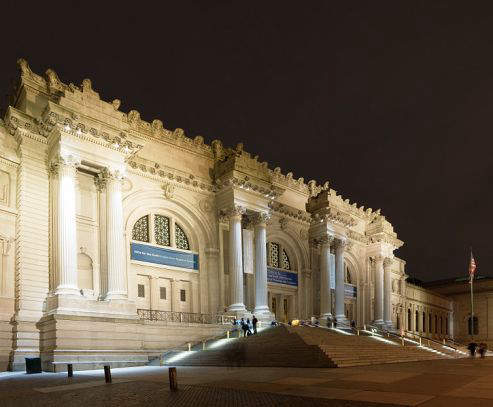
Metropolitan Museum of Art, New York at night
Photo above, Creative Commons
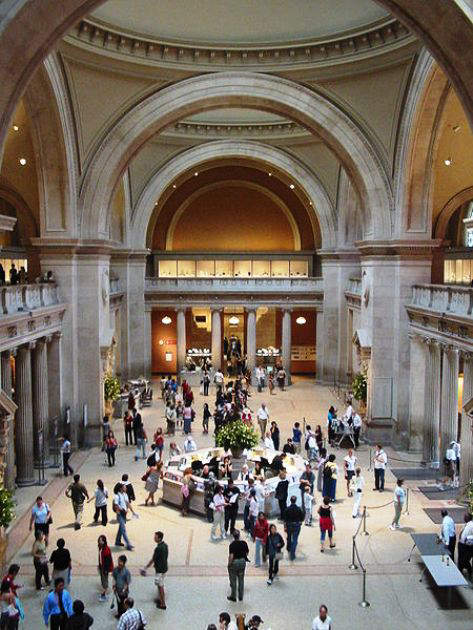
The Great Hall, Metropolitan Museum of Art, New York
Photo above, Creative Commons
The construction of permanent buildings for the museum on the east side of Central Park
The founders of the museum then drew up plans for the construction of permanent buildings to house the expanding collection, on the land allocated for the purpose on the east side of Central Park by the City of New York. The buildings executed in the High Victorian Gothic Style, was designed by American architects Calvert Vaux and Jacob Wrey Mould. Since then the building had undergone drastic alterations, modifications, and expansion, and the original buildings designed by Vaux, became completely surrounded by later additions. Presently, the complex of buildings housing the Metropolitan Museum of Art is around 400 meters long, and covers a floor space of 190,000 square meters (2,000,000 sq.ft.), which is more than 20 times the size of the original building opened in 1880. The museum buildings are owned and maintained by the City of New York, which also provides the utilities, heat etc. The collections in the museum are owned by a private corporation of fellows and benefactors that total around 1630 persons. The governing body of the museum is the Board of Trustees consisting of 41 elected members.
The curatorial departments in the museum
The 17 curatorial departments in the Metropolitan Museum of Art include the following :-
1) American Decorative Arts
2) American Paintings and Sculpture
3) Ancient Near Eastern Art
4) Arms and Armor
5) Asian Art
6) Costume Institute
7) Drawings and Prints
8) Egyptian Art
9) European Paintings
10) European Sculpture and Decorative Arts
11) Greek and Roman Art
12) Islamic Art
13) Lehman Collection
14) Medieval Art
15) Modern Art
16) Musical Instruments
17) Photographs
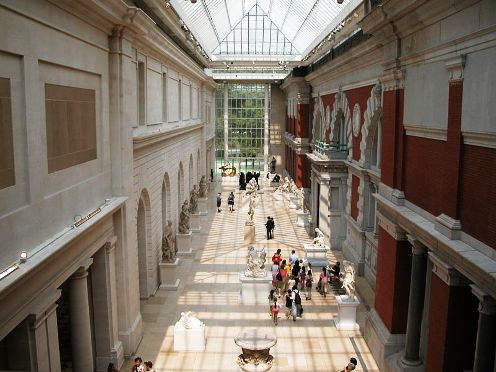
The European Sculpture Court, Metropolitan Museum of Art, New York
Photo above, Creative Commons
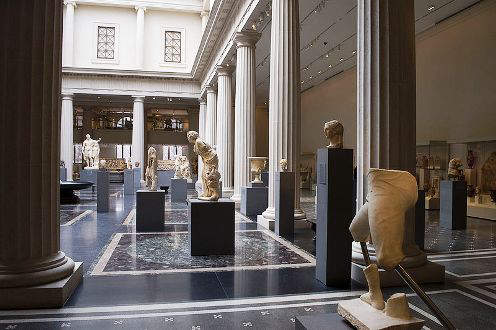
The New Roman Gallery, Metropolitan Museum of Art, New York
Photo above, Creative Commons
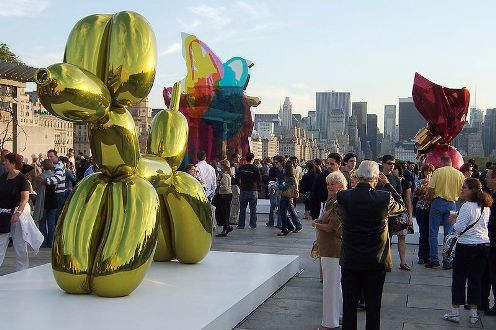
The Roof Top Garden at the Metropolitan Museum of Art, New York
Photo above, Creative Commons
The American Decorative Arts Department that houses the Mary Louisa Brown Seed Pearl Necklace
The Mary Louisa Brown seed pearl necklace is part of the exhibits housed in the American Decorative Arts Department. The American decorative arts collection, consists of 12,000 items, ranging from late 17th to early 20th centuries. The collection was started in 1909, after the donation of a private collection of American decorative arts in 1909 by Margaret Olivia Sage, wife of financier Russell Sage. However a separate department for American decorative arts was established only in 1934. Among the departments current holdings are, an extensive silver collection, including pieces by Paul Revere, and Tiffany & Co.; an extensive collection of American stained glass, including pieces by Louis Comfort Tiffany, Henry E. Sharp, William J. Bolton, and John LaFarge; and furnishings from various periods and designers.
A Short Biography of Howard Potter
Howard Potter, an industrialist, diplomat and successful investment banker
Born to a family of academics in Schenectady, New York, on July 8, 1826, Howard Potter was the second son of Alonso Potter, Professor and later Vice President of Union College, and Maria Nott, the daughter of Dr. Eliphalet Nott, President of Union College, for more than 60 years. Howard Potter entered Union College in 1842, and graduated in 1846. After graduation he remained at Union College, as tutor of Latin and Greek for about an year. He left Union College, and studied law, and was admitted to the bar at New York. However, he never practiced law, but instead took up a business career, becoming the secretary and treasurer of Novelty Iron Works, one of the most notable machine shops in the U.S. at that time. In 1849, he married Mary Louisa Brown, the daughter of Mr. James Brown, the head of the New York branch of the firm, Brown Bros & Co. Soon after his marriage in 1849, Howard Potter was sent as U.S. diplomat to the Court of Berlin in Prussia, in which capacity he served for more than 6 months. In 1859, at the invitation of his father-in-law, James Brown, he joined the firm of Brown Bros. & Co., becoming one of its partners in 1861. He was active in the merchant banking business of Brown Bros. & Co., a firm which he served with dedication until his death. His total commitment and dedication to the Company, raised him to the position of the managing director of Brown Shipley, the British Wing of the Brown merchant banking business. At the time of his death in 1897, Howard Potter, was still working with Brown Shipley in London.
Howard Potter the great humanist and philanthropist
Howard Potter, apart from being an industrialist, diplomat, and successful investment banker, was a notable humanist and philanthropist, who spared no efforts in uplifting the social and living standards of the less fortunate in society. His concern for the poor was clearly demonstrated in his work with "The New York Association for Improving the Condition of the Poor" a charitable organization, of which he was President from 1878 to 1884, and whose members referred to him as one "whose life was one long effort on behalf of the cause of humanity." However, his greatest act of charity was his work as the Trustee of the Children's Aid Society for 40 years from 1857 until his death in 1897, an organization which was his own brainchild, and rendered yeoman's service to poor, abandoned, and friendless children of New York. After his death the Children's Aid Society paid the following tribute to him :-
"There is none who has served our board with more zeal, or for a longer period, than he, and we meet here to record his life and death in our minutes. He became by giving, he has done his utmost to create and sustain the Society. Commanding in presence, gentle in voice, wise in counsel and most persuasive in address, he stood before us as the model of a Christian gentleman." He lived life's full measure and when his time came God's finger touched him and he slept." Therefore, "Resolved, that his name be ever held among us in loving remembrance, and that we place on our records this expression of our affection and gratitude."
Other positions of public trust held by Howard Potter
1) President of the Orthopedic Dispensary from 1878 to 1891.
2) President of the Niagara Park Association.
3) Treasurer of the United States Sanitary Commission during the civil war.
4) One of the managers of St. Luke's Hospital from 1869 to 1886.
5) Treasurer of St, Johnland from 1871 to 1883
6) First Vice-President of the State Charities Aid from 1874 to 1880.
7) A trustee of Union College
8) One of the founders of Metropolitan Museum of Art, and a member of its first board of trustees.
You are welcome to discuss this post/related topics with Dr Shihaan and other experts from around the world in our FORUMS (forums.internetstones.com)
Related :-
1) Mary Lucile Stevens Seed Pearl Parure
External Links :-
1) Maker Unknown American Seed Pearl Necklace - Heilbrunn Timeline of Art History, New York. The Metropolitan Museum of Art. https://www.metmuseum.org/toah/works-of-art/2003.350.2
References :-
1) Maker Unknown American Seed Pearl Necklace - Heilbrunn Timeline of Art History, New York. The Metropolitan Museum of Art. www.metmuseum.org
2) Metropolitan Museum of Art - From Wikipedia, the free encyclopedia.
3) Howard Potter - From Wikipedia, the free encyclopedia.
4) Howard Potter - Alonzo Potter Family Website. www.alonzopotter.com
 Home
Security & Guarantee
How it Works
Technology Partners
Updated Tables
Famous Diamonds
More Famous Diamonds
Famous Pearls
Famous Gemstones
Contact Dr Shihaan Larif
Contact Senior Editor
Famous Jewelry
Reference Database
Forums
Learning Center
Gemstone Gallery
e-mail Notifications
Advertise
Press Release
About Us
Privacy Policy
Contact Us
FAQ'S
Site Map
Staff Mail Login
Staff Documents
Birthstones
History
Minerals
Shows
Live Metal Prices
Jewellery Gallery
News
Marketplace
Marketplace Support
Open Store
Online Auctions
Join Us & Contribute
Directory
Classifieds
List your products
Wholesale Trading
Post Buy Request
Go Green Policy
Site Updates
Upcoming-ToDo List
Latest News
Latest Articles
Latest Blog Updates
Chat Rooms
Job Board
User Gallery
Videos
New Newsletter Archive
Old Newsletter Archive
Jewelry & Mineral Blog
User Blogs & Social Network
Search
Answers (Q & A)
Valuation
Help me find a diamond/jewelry
pin.internetstones.com- Social Pinboard- Sart yours & connect with millions
Invite Friends From Yahoo, Gmail etc-One Click
Home
Security & Guarantee
How it Works
Technology Partners
Updated Tables
Famous Diamonds
More Famous Diamonds
Famous Pearls
Famous Gemstones
Contact Dr Shihaan Larif
Contact Senior Editor
Famous Jewelry
Reference Database
Forums
Learning Center
Gemstone Gallery
e-mail Notifications
Advertise
Press Release
About Us
Privacy Policy
Contact Us
FAQ'S
Site Map
Staff Mail Login
Staff Documents
Birthstones
History
Minerals
Shows
Live Metal Prices
Jewellery Gallery
News
Marketplace
Marketplace Support
Open Store
Online Auctions
Join Us & Contribute
Directory
Classifieds
List your products
Wholesale Trading
Post Buy Request
Go Green Policy
Site Updates
Upcoming-ToDo List
Latest News
Latest Articles
Latest Blog Updates
Chat Rooms
Job Board
User Gallery
Videos
New Newsletter Archive
Old Newsletter Archive
Jewelry & Mineral Blog
User Blogs & Social Network
Search
Answers (Q & A)
Valuation
Help me find a diamond/jewelry
pin.internetstones.com- Social Pinboard- Sart yours & connect with millions
Invite Friends From Yahoo, Gmail etc-One Click




Our Global Jewelry Industry Job Network


Buy & Sell in our Marketplace

Subscribe to our Newsletter

List in our Classifieds

List in our Directory

User Uploaded Gallery

Powered by Ultra Secure
Amazon (USA) Cloud Network

Founder Internet Stones.COM
Register in our Forums

| Featured In
|
|
|
|
|
|
|
|







Blog & Education Feed
Articles Feed
 |
 |
 |

Copyright © .Internet Stones.COM. All rights reserved.