Significant Emeralds discovered in North Carolina
Open FREE Unlimited Store Join Our Newsletter
Gemstone production in North Carolina
North Carolina ranks among the top ten producers of gemstones in the United States, and is perhaps the only state in the United States that had produced all four major gemstones; diamond, ruby, sapphire and emerald. Other gemstones found in North Carolina include hiddenite, aquamarine, garnet etc. The main gem-producing counties in North Carolina are Alexander county, producing mainly emeralds and hiddenite; Macon county, producing rubies, sapphires and garnets, and Mitchell county, producing emeralds and aquamarine. Several dozen commercially operated fee-to-dig collecting localities are open to the public, such as the Crabtree Emerald Mine near Little Switzerland, the Emerald Hollow Mine at Hiddenite.

Emeralds were first discovered in North Carolina in 1875 by J. A. D. Stephenson, who used the services of farmers to look for minerals, Indian relics and other ancient artifacts on their farms, with a promise of reward for success. Subsequently other discoveries were made in the area until five deposits were recognized. These are the Adams, Rist and Ellis mines in Alexander County, the Crabtree mines at Mitchell County, and the Old Plantation Emerald Mine (Turner Mine) at Cleveland County. The Rist and Ellis deposits were combined together in 1969, and the 200-acre parcel of land was controlled by the American Gems Inc. which initially mined portions of the land for emeralds making significant discoveries such as the 1,438 carat "Finger Emerald also known as the "Stephenson Emerald," and the roughs for the "Carolina", "Marie", and June Culp Zeitner" cut emeralds.
All the major emerald deposits in North Carolina had yielded significantly large emeralds, and a list of the first 20 largest emeralds discovered in North Carolina is given below indicating the source or the mine of origin of the emerald. A brief description of the large emerald crystals greater than 1,000 carats in weight follows after the table.
Some of the largest emeralds discovered in North Carolina arranged in descending order of carat weights
S/N |
Name of Emerald | Year of Discovery | Carat Weight | Dimension in cm | Mine of Origin | Present Location |
| 1 | NAEM Emerald | 2003 | 1,869 | 19.5 | NAEM | Houston Museum of Natural Science |
| 2 | LKA Emerald | 1984 | 1,686 | 11.4 x 3.8 | Rist/ NAEM | LKA Collection |
| 3 | Reitzler/ Williams/ Hartwell Twin Emeralds |
1971 | 1,493 | 10.5 x 2.7 | Adams | NMNH, Smithsonian Institution |
| 4 | Finger Emerald-Stephenson Emerald |
1969 | 1,438 | 7.3 x 5.4 | Rist/ NAEM | LKA Collection |
| 5 | Hill Emerald | 2007 | 1,400 | - | NAEM | NAEM Collection, Hiddenite, NC. |
| 6 | Bolick/Arnold Cluster Emerald | 1971 | 1,377 | - | Adams | NMNH, Smithsonian Institution |
| 7 | Hidden Emerald | 1881 | 1,276 | 21.6 | Adams | Stolen from AMNH, New York City |
| 8 | Hidden Emerald | 1886 | 1,270 | 7.0 X 4.1 | Adams | NMNH, Smithsonian Institution |
| 9 | Baltzley Twin Emerald |
1970 | 1,215 | - | Rist/ NAEM | - |
| 10 | Hill Emerald | 2006 | 965 | - | NAEM | Houston Museum of Natural Science |
| 11 | Bolick Twin Emerald | 1971 | 934.9 | 14.0 x 6.5 x 3.5 | Adams | Houston Museum of Natural Science |
| 12 | Reitzler/William/ Hartwell Twin Emeralds |
1971 | 900 | - | Adams | Houston Museum of Natural Science |
| 13 | Empress Caroline | 1998 | 858 | - | NAEM | Southeastern Emerald Consortium Collection |
| 14 | Baltzley Twin Emerald | 1971 | 817.5 | - | Rist/ NAEM | - |
| 15 | Wright Emerald | 1907 | 750 | 5.1 x 3.8 | Adams | - |
| 16 | Bolick Emerald | 1977 | 722.7 | - | Adams | Grandfather Mountain Nature Museum, NC. |
| 17 | Hill Twin Emeralds | 2006 | 591 | - | NAEM | NAEM Collection, Hiddenite, NC. |
| 18 | Ormond Twin on Goethite | 1969 | 467 | 8.9 x 1.4 | Rist/ NAEM | - |
| 19 | Reitzler/Williams /Hartwell Emerald |
1971 | 450 | - | Adams | North Carolina Museum of Natural Sciences, Raleigh NC. |
| 20 | Reitzler/Williams /Hartwell Cluster |
1971 | 433 | - | Adams | AMNH, New York City |
Copyright, Internet Stones.COM
1) The LKA Emerald
The 1,686.3-carat "LKA Emerald" is the 2nd largest emerald ever discovered in North Carolina and was uncovered from the Ritz/Ellis combined mine in Alexander County, in 1984, when the mine was under the control and management of LKA International Inc. a natural resource development company based in Gig Harbor, Washington, and owners of the Golden Wonder Mine, a high-grade gold property, near Lake City, Colorado, and the Ute Ule silver mine and milling facility, also located near Lake City. LKA International Inc. purchased the Rist-Ellis mine from the American Gems Inc. in 1982, and the Geologists and Mining Engineers of the Company undertook feasibility studies and evaluation of the potential emerald-bearing land with a view of determining its commercial viability. The sampling and evaluation took six years and was completed only in 1988. A significant number of emeralds were recovered during this initial period of studies, and the 1,686.3-carat "LKA Emerald" was one of them. However, the feasibility studies indicated that the property did not meet LKA-5 criteria for additional investment, and therefore the company decided to sell the property. The property was thus sold to a South Carolina based company in early 1990, from whom a 94-acre tract that included the old Rist Mine was acquired by Sulphur Springs Properties LLC, and thus passed to the ownership of the Hill and Duncan families.
Photos from North Carolina Emeralds.info
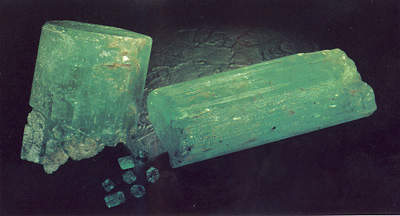
©LKA International Inc.
Left: 1,438 ct Finger Emerald, Right: 1,686 ct LKA Emerald
The "LKA Emerald" when discovered in 1984, was the largest emerald ever discovered in North Carolina as well as the entire North America. The dark-green hexagonal emerald crystal had dimensions of 11.4cm x 3.8cm. The enormous emerald crystal remains part of the LKA collection of gemstones and minerals.
2) Reitzler/Williams/Hartwell Twin Emeralds
The Reitzler/Williams/Hartwell Twin emerald was discovered in 1971 in the Adams mine by Robert N. Reitzel, John Willaims and Jack Harwell, all of Newton, North Carolina. According to the above table the year 1971 seem to have been a prolific year for the production of emeralds in the Adam's Mine, as six of the first twenty significant emeralds ever produced in North Carolina, seem to have been discovered in that year. This phenomenal increase in production is attributed to the mode of operation of the mine in the 1970s, which was a prospect-for-fee operation also known as a dig-for-fee operation, which gave prospectors the opportunity to search for emeralds on the mine on the payment of a fee. Undoubtedly, the determination, enthusiasm, and dedication of the prospectors with the incentive that you can keep what you find, were the driving force that led to notable increases in production during this period. Reitzel, Williams and Hartwell were also motivated and determined prospectors, who were rewarded for their painstaking work.
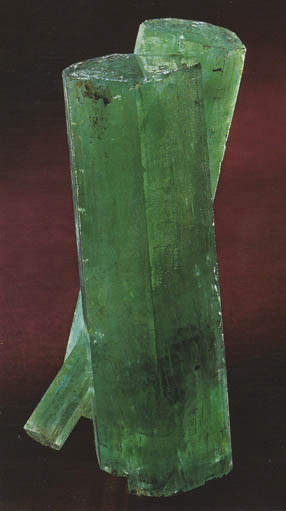
The Reitzler Twin Emerald
The Twin emerald is hexagonal in shape, dark-green in color, with dimensions of 10.5cm X 2.7 cm and weighing 1,493-carats. It is the 3rd largest emerald ever discovered in North America. The unique emerald crystal was acquired by the National Museum of Natural History of the Smithsonian Institution, where it is on display in the Janet Annenberg Hooker Hall of Geology, Gems and Minerals.
3) Finger Emerald or Stephenson Emerald
The 1,438-carat "Finger Emerald" aka. the "Stephenson Emerald" discovered in the Rist/Ellis combined mine in 1969, was at that time the largest ever emerald discovered in North America, but today it has been pushed to the 4th place in the list of largest emeralds produced in North Carolina, arranged in descending order of carat weights. See table above. The emerald is a bi-hexagonal (12-sided), dark-green crystal, with dimensions of 7.3 cm x 5.4 cm.
The first emeralds at the future Rist/NAEM mine were reported as early as 1877, by John Adlai D. Stephenson, a merchant, naturalist and mineral collector, from Statesville, North Carolina. The site situated about 2 miles northeast of the Emerald and Hiddenite mine and belonging to the Miller family had yielded several excellent specimens, two of which were given to J. A. D. Stephenson by I. W. Miller who found the emeralds on his mother's farm. The U. S. Geological Survey also reported on this site in the year 1912. The report stated that beryl crystals had been found in two places on the estate of the Miller heirs, 1½ miles east of Hiddenite on the ridge between Davis Creek and Little Yadkin River. One site is on a deep hillside above Davis Creek, and the other is about 200 yards northwest of the first. Existence of the potential sites had been mentioned again in 1958 by the North Carolina Division of Mineral Resources and in 1968 in the Lapidary Journal. Only 92 years after the discovery of the first emeralds on this site was any attempt made to open up the site for emerald prospecting, in the year 1969, when the property was opened as the Rist Mine as a prospect-for-fee mine. The two mines Rist and Ellis were combined together and operated by the American Gems Inc. from 1971 to 1982. Soon after the opening of the mine for prospecting on a dig-for-fee basis in March 1969, three significant finds were made by fee-paying prospectors.
The first was in 1969 when a 250-carat, 6 in (15.2 cm) emerald was discovered by William Diehl Baltzley, president American Gems Inc. The second significant find was made in July 1969, when Michael Butch Finger discovered the 1,438-carat emerald with dimensions of 7.3 cm x 5.4 cm, which came to be known as the "Finger Emerald," at the time the largest emerald found in North America. The "Finger Emerald" was later re-named as the "Stephenson Emerald" in honor of the pioneer mineral prospector and collector of North Carolina, John Adlai D. Stephenson. The "Stephenson Emerald" was acquired by the LKA International Inc. and is today part of the LKA collection of minerals and gemstones.
The 3rd significant find in the Rist mine after its opening in 1969, was the discovery of a 59-carat gem-quality emerald crystal by Wayne Anthony in August 1970, which was eventually faceted into the first gem-quality emerald ever produced in North Carolina, the 13.14-carat "Carolina Emerald" which was subsequently acquired by Tiffany's of New York, and came to be known as the "Tiffany Emerald.," valued by the prestigious jewelry firm at $100,000.
4) Hill Emerald
The 1,400-carat "Hill Emerald" discovered just recently in the year 2007, by James K. Hill, in the North American Emerald Mine of which he is the founder as well as the president, is the 5th largest emerald ever discovered in North Carolina. The emerald is still owned by the North American Emerald Mines and has not yet been disposed of.
The property in which the North American Emerald Mine is located was known to contain emeralds since the time of J. A. D. Stephenson in 1877, but was opened for prospecting only 92 years later, when part of the property was opened as a prospect-for-fee mine in March 1969, and later came under the control of the American Gems Inc. from 1971 to 1982. Several significant emeralds were discovered during this period. In 1982, LKA International Inc. of Gig Harbor, Washington, took owner the ownership of the mine. More significant discoveries were made during this period, but after conducting feasibility studies to determine the economic viability of the mine, it was determined in 1988, that the mines did not meet the LKA-5 criteria for additional investment. The property was therefore sold by LKA in early 1990 to a South Carolina Firm. In 1995, a 38-hectare (94-acre) tract of the property including the old Rist mine, was acquired by Sulphur Springs Properties, LLC, at a public auction. This 94-acre tract of land became the property of the Hill and Duncan families. James K. Hill Jr. formed the North American Emerald Mines Inc. and began mining portions of this tract and in 1998 came the breakthrough of Hill's mining operations, when he discovered for the first time gem-quality emeralds totaling 3,300 carats from a single pocket; just 12 feet below the surface. Among these cache of emeralds was a remarkable crystal only 71 carats in weight, which when cut yielded two fine emeralds, free of inclusions, with good clarity, transparency and color, that was on par with or surpassed the quality of emeralds produced in the Muzo or Chivor mines. The two emeralds did not require any oil or epoxy treatment to hide fissures in the crystal. The larger emerald the "Carolina Queen" was cut as a pear-shape and weighed 18.8 carats, and is valued at over $1 million. The smaller emerald the "Carolina Prince" with a cushion-cut and weighing 7.85-carats was sold in 1999 for $100,000.
After a suspension of mining activity for about 2 years in order to conform to government requirements, Hill resumed his mining activities in 2003, the year in which the mine produced the largest emerald crystal in North America, the 1, 869-carat NAEM emerald, which is valued at $1 million and is now part of the Houston Museum of Natural Science collection. The open-pit mining operation at the NAEM mines continue and a 2.5 hectare (6-acre) pit has exposed fresh bedrock and emerald-bearing quartz veins. Several gem-quality emeralds were discovered in 2003 and also significantly large emerald crystals in 2006 and 2007, such as the 591-carat "Hill Twin Emerald" in 2006, the 965-carat "Hill Emerald" in 2006, and the 1,400-carat "Hill Emerald" in 2007.
5) Bolick/Arnold Cluster Emerald
Bolick/Arnold Cluster Emerald was discovered by Glenn and Kathleen Bolick of Hickory, North Carolina, and Kenneth and Patricia Arnold of Newton, North Carolina. The 1,377-carat cluster emerald was discovered in the Adams mine in 1971, the year that was noted for prolific production of large emeralds in the Adams mine, producing up to six significantly large emeralds in the above list. The reason for such a sudden increase in production was the dig-for-fee operation method adopted in the Adams mine in the 1970s, coupled with the finders-are-keepers principle. This increased the commitment of the searchers that led to hard and painstaking exploratory activities using only simple hand tools, and the result was indeed phenomenal - six significantly large emeralds in the above list all discovered in the same year 1971.
The cluster emerald is said to be fractured beyond repair, and is presently the property of the National Museum of Natural History of the Smithsonian Institution, Washington DC.
6) The Hidden Emeralds
The two "Hidden Emerald Crystals" one weighing 1,276 carats and the other weighing 1,240 carats were discovered by William E. Hidden in the Adams mine (Warren mine) in the late 19th century, and held the distinction of being North America's largest emeralds for 88 years until the discovery of the 1,438-carat "Finger Emerald" aka 'Stephenson's Emerald" in 1969. The 1,276-carat "Hidden Emerald-1" was an elongated, bi-hexagonal, dark-green twin emerald crystal, with the longest crystal having a length of 21.6 cm, and discovered in 1881. This crystal became the largest ever emerald discovered in North America at that time. The 1,240-carat "Hidden Emerald-2" was a near perfect, hexagonal, dark-green emerald crystal, with dimensions of 7.0 cm x 4.1 cm, and discovered in 1886. This emerald crystal became the second largest emerald ever discovered in North America around that time. Today, "Hidden Emerald-1" and "Hidden Emerald-2" occupy the 7th and 8th positions in the list of largest emeralds discovered in North Carolina arranged in descending order of carat weights. See table above.
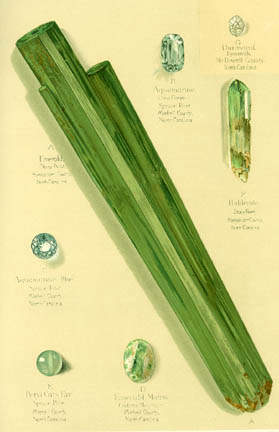
The 1276-carats Hidden Emerald Crystal
J. A. D. Stephenson the pioneer mineral prospector of North Carolina, discovered emeralds in the James Washington Warren farm (later known as the Adams mine) in 1875, and built up a large collection of minerals by adopting a clever scheme, in which he used the local farmers to prospect for the minerals and purchasing their finds based on the quality of the specimens. In September 1879, William E. Hidden the renowned geologist and mineralogist, was in North Carolina on an assignment, having been hired by Thomas Alva Edison to search for potential platinum sources in southeastern United States, to be used as filaments in his new incandescent lamp. While in North Carolina, William E. Hidden visited J. A. D. Stephenson, and was impressed by the latter's extensive collection of North Carolina minerals. He was particularly interested in the green emerald crystals in the collection, and sought more information from his host, about the source of such emeralds. The next day, Stephen took his learned guest to the emerald producing site on the Warren Farm in Alexander County. Hidden seem to be impressed by what he saw, and promised to return in the near future. He did return in 1880, and after acquiring a lease on the farm, began mining operations for emerlds in the same year. He formed a company known as the Emerald and Hiddenite Mining Company, which continued operations on the site until 1888. During this period of 8 years many fine emeralds were produced from this mine, which included the two significantly large emerald crystals, the 1,276-carat Hidden Emerlad-1 and the 1,240-carat Hidden Emerald-2 crystals. It was from this same mine that Hidden discovered significant quantities of a new green-mineral in 1881, which was later identified to be a green variety of the mineral spodumene, by Dr. J Lawrence Smith, who named the new mineral "hiddenite."
The 1,276-carat "Hidden Emerald-1" was acquired by the American Museum of Natural History, based in New York City, where the crystal was displayed in its mineral gallery until 1950, when it was unfortunately stolen from the gallery and never recovered.
The 1,240-carat "Hidden Emerald-2" was acquired by the National Museum of Natural History of the Smithsonian Institution, Washington DC, where it is displayed today in the Janet Annenberg Hooker Hall of Geology, Gems and Minerals.
7) Baltzley Twin Emerald
The Baltzley Twin Emerald was discovered by William Diehl Baltzley in the Rist mine in 1970, when it was operated as a prospect-for-fee mine in 1969 and 1970, before the mine was operated by the American Gems Inc. also headed by William Diehl Baltzley, from 1971 to 1982. The 1,215-carat emerald is a twin emerald crystal occupying the 9th position in the rank table given above. The present whereabouts of the twin emerald crystal however is not known.
You are welcome to discuss this post/related topics with Dr Shihaan and other experts from around the world in our FORUMS (forums.internetstones.com)
Related :-
4) The Duke of Devonshire Emerald
8) Spanish Inquisition Necklace
10) The Carolina Queen Emerald
11) Naem Emerald
References
1.Hiddenite Treasures - Professional Jewelers Magazine, October 1999.
2.North Carolina Emeralds - www.northcarolinaemeralds.info
3.North Carolina Emeralds - NAEM Emerald Mine -www.northcarolinaemeralds.info
4.North Carolina Emeralds - Adams Emerald Mine - northcarolinaemeralds.com
5.Gems in North Carolina - Chapter VI - Kunz
6.Emerald City North Carolina - Professional Jewelers Magazine, April 2002.
7.The Mineral Industry of North Carolina - U.S. Geological Survey and the North Carolina Geological Survey. 8. Emerald Crystal Pockets of the Hiddenite District, Alexander County, North Carolina - Wade Edward Speer, 2008.
 Home
Security & Guarantee
How it Works
Technology Partners
Updated Tables
Famous Diamonds
More Famous Diamonds
Famous Pearls
Famous Gemstones
Contact Dr Shihaan Larif
Contact Senior Editor
Famous Jewelry
Reference Database
Forums
Learning Center
Gemstone Gallery
e-mail Notifications
Advertise
Press Release
About Us
Privacy Policy
Contact Us
FAQ'S
Site Map
Staff Mail Login
Staff Documents
Birthstones
History
Minerals
Shows
Live Metal Prices
Jewellery Gallery
News
Marketplace
Marketplace Support
Open Store
Online Auctions
Join Us & Contribute
Directory
Classifieds
List your products
Wholesale Trading
Post Buy Request
Go Green Policy
Site Updates
Upcoming-ToDo List
Latest News
Latest Articles
Latest Blog Updates
Chat Rooms
Job Board
User Gallery
Videos
New Newsletter Archive
Old Newsletter Archive
Jewelry & Mineral Blog
User Blogs & Social Network
Search
Answers (Q & A)
Valuation
Help me find a diamond/jewelry
pin.internetstones.com- Social Pinboard- Sart yours & connect with millions
Invite Friends From Yahoo, Gmail etc-One Click
Home
Security & Guarantee
How it Works
Technology Partners
Updated Tables
Famous Diamonds
More Famous Diamonds
Famous Pearls
Famous Gemstones
Contact Dr Shihaan Larif
Contact Senior Editor
Famous Jewelry
Reference Database
Forums
Learning Center
Gemstone Gallery
e-mail Notifications
Advertise
Press Release
About Us
Privacy Policy
Contact Us
FAQ'S
Site Map
Staff Mail Login
Staff Documents
Birthstones
History
Minerals
Shows
Live Metal Prices
Jewellery Gallery
News
Marketplace
Marketplace Support
Open Store
Online Auctions
Join Us & Contribute
Directory
Classifieds
List your products
Wholesale Trading
Post Buy Request
Go Green Policy
Site Updates
Upcoming-ToDo List
Latest News
Latest Articles
Latest Blog Updates
Chat Rooms
Job Board
User Gallery
Videos
New Newsletter Archive
Old Newsletter Archive
Jewelry & Mineral Blog
User Blogs & Social Network
Search
Answers (Q & A)
Valuation
Help me find a diamond/jewelry
pin.internetstones.com- Social Pinboard- Sart yours & connect with millions
Invite Friends From Yahoo, Gmail etc-One Click




Our Global Jewelry Industry Job Network


Buy & Sell in our Marketplace

Subscribe to our Newsletter

List in our Classifieds

List in our Directory

User Uploaded Gallery

Powered by Ultra Secure
Amazon (USA) Cloud Network

Founder Internet Stones.COM
Register in our Forums

| Featured In
|
|
|
|
|
|
|
|







Blog & Education Feed
Articles Feed
 |
 |
 |

Copyright © .Internet Stones.COM. All rights reserved.