Emerald Jewelry that once belonged to Empress Catherine the Great
Open FREE Unlimited Store Join Our Newsletter
Catherine the Great, a great patron of the arts, literature and education
Catherine II also known as Catherine the Great, was one of the greatest monarchs in the history of Russia, who ruled for 34 years from 1762 to 1796. Catherine II together with Peter the Great are considered as two of the greatest rulers of the Romanov dynasty, that ruled Russia for more than 300 years from 1613 to 1917. A German-born Princess married into the Romanov royal family, Catherine II became a Romanov only by virtue of her marriage to a Romanov, Peter III. She subsequently ousted Peter III in a coup plotted by her lover Gregory Orlov, and installed herself as the Empress of Russia in 1762. Even though she was not a Romanov by birth, her achievements surpassed that of all other male Romanov Emperors, except perhaps Peter the Great. Her period of rule thus represents a climax in the history of the Russian nobility

Catherine was a great patron of the arts, literature and education. She was a great collector and connoisseur of the arts, and her personal collection of art which she started in 1764, eventually metamorphosed into the Hermitage Museum, in St. Petersburg, one of the largest museums in the world, with 3 million works of art, which holds the Guinness World Record as having the largest collection of paintings. She also extended her patronage to gem and jewelry craftsmen of St. Petersburg, who supplied her court with fabulous pieces of jewelry that embellished her court during her 34-year period of rule. The pieces of emerald jewelry dealt with on this webpage were some of her personal adornments turned out by the court jewelers and used by her during her period of reign.
List of the items of emerald jewelry considered
The list of the items of personal emerald jewelry that once belonged to Catherine the Great's collection, and considered in detail on this webpage are as follows :-
1) Catherine the Great Emerald Cameo.
2) Catherine the Great's Emerald and Diamond Earrings.
3) Catherine the Great's Emerald and Diamond Brooch and Matching Pair of Earings
4) A 19th-century Emerald and Diamond Brooch incorporating a 136.25-carat step-cut rectangular emerald
1) Catherine the Great Emerald Cameo
Common substances used for cameos
Cameos are small sculptures executed in low relief on some substance precious either for its beauty, rarity or hardness. Common substances that had been used for cameos since ancient times are gemstones such as emeralds, turquoise, agate, onyx etc. Such cameos were popular in ancient Greece and ancient Rome as far back as the 6th century B.C. The Greek Ptolemaic double cameo executed on a 11-layered onyx dates back to 278-269 B.C. The famous Gemma Claudia Cameo of Roman origin, made for Emperor Claudius, and executed on a 5-layered onyx dates back to the year 49 A.D. The Romans also used artificial glass as a working material for cameos, and such glass cameos were produced from around 25 B.C. to mid-4th century A.D.
Shells used for cameos during the renaissance period
Since ancient times cameo carving had enjoyed periodic revivals in the history of mankind. During the Renaissance period in the 15th and 16th centuries cameo carving again became popular, but a new material was used for the first time, shells of mussels and cowries. Subsequently in the mid-18th century new shell varieties such as "helmet shells" from the West Indies and the "queen conch shells" from the Bahamas were used in cameo carving, which gave a boost to the production of shell cameos.
Revival of cameos in the neo-classical period
The cameos again saw a revival in the neo-classical period in the late 18th and early 19th centuries, in France, during the period of Napoleon Bonaparte. The special coronation crown made for Napoleon Bonaparte was also decorated with cameos. In Britain the revival of cameos took place first during the rule of King George III (1760-1820), and subsequently during the reign of his grand-daughter Queen Victoria (1837-1901), By the second half of the 19th century cameos were mass produced in Britain due to their popularity.
Emeralds used for cameos after the mid-16th century
Since the discovery of emeralds in Colombia in the mid-16th century, emeralds also became a common precious stone material for cameo carving. Emeralds that were heavily included, with reduced clarity and transparency were often used for such purposes. Some of the finest emerald portrait cameos in existence are those of Queen Elizabeth II in the British Museum.
Description of Catherine the Great emerald cameo
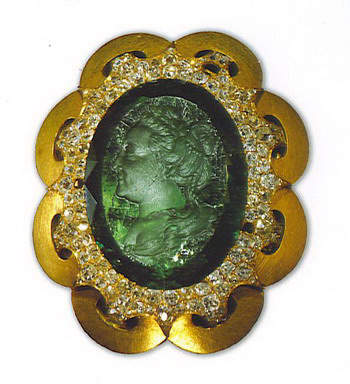
The Catherine the Great emerald cameo is also a portrait cameo executed on an emerald of Colombian origin in the late 18th century, probably during the reign of Catherine the Great between 1762 to 1796. The cameo had been carved by hand, which is one of the most difficult challenges for any gemstone carver, requiring a highly developed artistic ability, skill and several years of experience. The Catherine the Great emerald cameo is a masterpiece in its category that undoubtedly reflects the highly refined artistic skills of the unknown Russian gemstone carver who executed it.
The Catherine the Great portrait cameo is oval in shape and appears to be carved on a two-layered stone consisting of emerald and agate (or onyx). The portrait itself is executed on emerald, which is surrounded by black agate (or onyx). The portrait is surrounded by diamonds set in a gold frame work. Two layers of diamonds are distinguishable, each made up of around 50 small cushion-shaped or round diamonds. The diamond layers are surrounded by a thick, wavy gold or enameled metallic band consisting of eight lobes. The entire setting looks like a flower with eight lobes or petals, and could have been used as a brooch or a pendant to a necklace.
2) Catherine the Great Emerald and Diamond Earrings
Description of the emerald and diamond earrings
The pair of identical emerald and diamond pendant earrings were once worn by Empress Catherine the Great, perhaps as part of a complete emerald suite that consisted of an emerald necklace, emerald brooch, etc. The whereabouts of the other components of this suite are not known, but the pair of earrings are believed to be part of the Imperial Crown Jewels preserved in the Diamond Fund on the ground floor of the Kremlin's Armory Chamber.
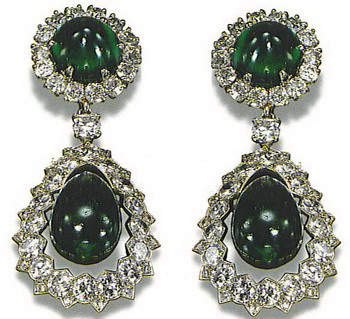
Each earring is made up of two sections, a lower oval or pear-shaped pendant section and an upper round-shaped section that fits on directly to the ear lobe. The pendant section of the earring is loosely hooked to the lower end of the round-shaped section, so that it dangles freely from the ear lobe of the wearer. The framework of the earring appears to be made of silver or platinum.
The centerpiece of the lower section is a large pear-shaped cabochon cut emerald, which is surrounded by a pear-shaped framework with serrated edges and set with 16 round-shaped diamonds. Between the central pear-shaped emerald and the diamond studded framework, there is a gap or space on its lower side.
The most striking features of the earrings
The centerpiece of the round-shaped upper section is a large round dome-shaped cabochon-cut emerald, which is surrounded by a tight fitting framework set with 14 large cushion-shaped diamonds. The most striking feature of this pair of earrings is the color contrast between the central bright vivid green emeralds and the surrounding white dazzling diamonds, a pleasing combination that was used in most of the emerald jewelry creations of this period. Another unique feature of this pair of earrings is the serrated edges of the lower pendant section section of the earrings. Overall the "Catherine the Great Emerald and Diamond Earrings" is a masterpiece in its class belonging to the late 18th century.
3) Catherine the Great's Emerald and Diamond Brooch and Matching Pair of Earrings
Description of the emerald and diamond brooch and earrings
The centerpiece of this brooch was a rectangular-shaped, step-cut, dark green emerald weighing 107.72 carats, and surrounded by two layers of smaller diamonds. The diamonds in the layer immediately outside the emerald are much smaller in size, than the diamonds in the outermost layer which are larger and round-shaped. Triads of diamonds are placed on three sides of this rectangular-shaped brooch, and on the lower side a cross-shaped arrangement of five diamonds are placed, from which arises a pendant loop, with an elongated drop-shaped emerald inside the loop. The loop is also studded with diamonds.
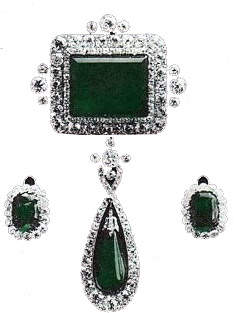
A matching pair of earrings for this brooch has a central cushion-shaped emerald as the centerpiece surrounded by a layer of small round-shaped diamonds. Each earring has a hook on the upper side. The brooch and the pair of earrings were formerly part of the collection of Empress Catherine the Great, and were lying in the Russian Crown Treasury created in 1719 by Peter the Great to house the Crown Jewels and other regalia belonging to the State.
The emerald and diamond brooch and earrings are presented to Grand Duchess Vladimir by Czar Alexander II
In August 1874, when Maria Pavlovna married the Grand Duke Vladimir Alexandrovich, the third son of Czar Alexander II of Russia, she received the emerald and diamond brooch as a gift from Czar Alexander II. The Grand Duchess Maria (Pavlovna) Vladimir Alexandrovich was usually seen wearing the brooch whenever she held court. Grand Duchess Maria and her family finally escaped from the Caucasus in Russia only on February 13, 1920 during the Bolshevik revolution, going down in history as the last Romanov to escape from revolutionary Russia. The Grand Duchess moved to France where she set up permanent residence. The Grand Duchess had a collection of jewelry that was one of the most renowned collections among the nobility of Russia. But, unfortunately as the revolution broke out in 1917, she and her family were forced to leave St. Petersburg at short notice, and she left her valuable collection of jewelry in a secret underground vault in the Vladimir Palace, hoping to return one day after the situation had normalized. Later the family had to seek the assistance of a British intelligence officer, a friend of the family, to retrieve the hidden jewelry from the underground vault, which was smuggled out of Russia in a diplomatic bag.
The emerald and diamond brooch is sold by Grand Duke Boris to Cartier in 1927
The Grand Duchess Vladimir died on August 24, 1920, just six months after she escaped from Russia. Her jewelry collection was inherited by her children. Her son Grand Duke Boris who got most of the emerald jewelry, also became the new owner of the emerald and diamond brooch. Grand Duke Boris sold the emerald and diamond brooch to Cartier in 1927.
The emerald and diamond brooch is set as a pendant to a necklace and sold to John D. Rockefeller Jr.
In the year 1947, Pierre Cartier re-mounted the emerald and diamond brooch as a pendant to an emerald necklace, that Raphael Esmerian, the New York lapidarist and dealer had purchased from the Payne Whitney family. Later in 1954, the rectangular shaped emerald was cut into a pear-shaped emerald to eliminate a natural flaw in the stone, and the weight of the emerald decreased from 107.72 carats to 75.63 carats. Subsequently, in the same year the necklace was purchased by John D. Rockefeller Jr. from Cartier.
4) A 19th-Century Emerald and Diamond Brooch incorporating a 136.25-carat step-cut rectangular emerald
A 19th-century Emerald and Diamond Brooch, whose centerpiece is the 136.25-carat step-cut rectangular emerald, is a significant piece of jewelry in the Russian Diamond Fund in the Kremlin's Armory Chamber. The 136.25-carat step-cut Colombian emerald that dates back to the 16th or 17th century, is one of the seven historical precious stones in the Russian Diamond Fund. The list of the seven historical gemstones in the Diamond Fund are :-
1) The 189.62-carat Orlov diamond
2) The 88.7-carat Shah diamond
3) The 25-carat flat portrait diamond
4) The 398.72-carat Catherine the Great's Ruby (spinel)
5) 260.37-carat blue sapphire
6) 136.25-carat step-cut Colombian emerald (External Link)
7) 192.6-carat olive-green chrysolite
The emerald and diamond brooch set in gold and silver was executed in the second half of the 19th century, possibly during the period of Czar Alexander II (1855-1881) or his successor Czar Alexander III (1881-1894) or the last Czar of the Russian Empire, Czar Nicholas II (1894-1917). The 136.25-carat step-cut rectangular emerald has dimensions of 4.5 x 3.5 cm. The emerald is believed to have originated in Colombia in the 16th or 17th centuries, and thus could have originated in the Muzo or Somondoco (Chivor) emerald mines of Colombia, two of the historic mines that were in full production during this period. But given the dark herbal green color of the emerald it appears that the source of the emerald was the Muzo mines.
The large emerald is the centerpiece of this magnificent brooch, that is surrounded by cut diamonds set in floral-foliage patterns alternating with single large round shaped diamonds. There are six floral-foliage patterns alternating with six large round-shaped diamonds. Again the color contrast between the central dark green emerald and the surrounding white diamonds is very striking. It's a great relief for lovers of art and jewelry worldwide that this unique and historic piece of the Crown Jewels of the Great Russian Empire was able to survive the tumultuous period of the Russian revolution and subsequent attempts to dispose of them, and has thus become a component of the common world heritage.
Related :-
Catherine the Great Emerald and Diamond Necklace
Catherine the Great’s Sapphire
Catherine The Great’s Ruby
Grand Duchess of Vladimir Tiara
References
1. The Diamond Fund - From Wikipedia, the free encyclopedia.
2. Cameo - From Wikipedia, the free encyclopedia.
 Home
Security & Guarantee
How it Works
Technology Partners
Updated Tables
Famous Diamonds
More Famous Diamonds
Famous Pearls
Famous Gemstones
Contact Dr Shihaan Larif
Contact Senior Editor
Famous Jewelry
Reference Database
Forums
Learning Center
Gemstone Gallery
e-mail Notifications
Advertise
Press Release
About Us
Privacy Policy
Contact Us
FAQ'S
Site Map
Staff Mail Login
Staff Documents
Birthstones
History
Minerals
Shows
Live Metal Prices
Jewellery Gallery
News
Marketplace
Marketplace Support
Open Store
Online Auctions
Join Us & Contribute
Directory
Classifieds
List your products
Wholesale Trading
Post Buy Request
Go Green Policy
Site Updates
Upcoming-ToDo List
Latest News
Latest Articles
Latest Blog Updates
Chat Rooms
Job Board
User Gallery
Videos
New Newsletter Archive
Old Newsletter Archive
Jewelry & Mineral Blog
User Blogs & Social Network
Search
Answers (Q & A)
Valuation
Help me find a diamond/jewelry
pin.internetstones.com- Social Pinboard- Sart yours & connect with millions
Invite Friends From Yahoo, Gmail etc-One Click
Home
Security & Guarantee
How it Works
Technology Partners
Updated Tables
Famous Diamonds
More Famous Diamonds
Famous Pearls
Famous Gemstones
Contact Dr Shihaan Larif
Contact Senior Editor
Famous Jewelry
Reference Database
Forums
Learning Center
Gemstone Gallery
e-mail Notifications
Advertise
Press Release
About Us
Privacy Policy
Contact Us
FAQ'S
Site Map
Staff Mail Login
Staff Documents
Birthstones
History
Minerals
Shows
Live Metal Prices
Jewellery Gallery
News
Marketplace
Marketplace Support
Open Store
Online Auctions
Join Us & Contribute
Directory
Classifieds
List your products
Wholesale Trading
Post Buy Request
Go Green Policy
Site Updates
Upcoming-ToDo List
Latest News
Latest Articles
Latest Blog Updates
Chat Rooms
Job Board
User Gallery
Videos
New Newsletter Archive
Old Newsletter Archive
Jewelry & Mineral Blog
User Blogs & Social Network
Search
Answers (Q & A)
Valuation
Help me find a diamond/jewelry
pin.internetstones.com- Social Pinboard- Sart yours & connect with millions
Invite Friends From Yahoo, Gmail etc-One Click




Our Global Jewelry Industry Job Network


Buy & Sell in our Marketplace

Subscribe to our Newsletter

List in our Classifieds

List in our Directory

User Uploaded Gallery

Powered by Ultra Secure
Amazon (USA) Cloud Network

Founder Internet Stones.COM
Register in our Forums

| Featured In
|
|
|
|
|
|
|
|







Blog & Education Feed
Articles Feed
 |
 |
 |

Copyright © .Internet Stones.COM. All rights reserved.