Spanish Inquisition Necklace
Open FREE Unlimited Store Join Our Newsletter
Origin of name
The origin of the name "Spanish Inquisition Necklace" seems to be shrouded in mystery just as much as the origin of the necklace itself. According to Jeffrey Post, the curator of the National Museum of Natural History of the Smithsonian Institution, it was Harry Winston who gave the necklace the interesting name the "Spanish Inquisition Necklace," before he sold it to Mrs. Cora Hubbard Williams of Pittsburgh. What prompted Harry Winston to select such an infamous name for a necklace is far from certain. Perhaps it might have been the legendary association of this necklace with the Spanish royalty at one point in its long history, or the resemblance of the necklace to jewelry produced during this period. But why bring in the controversial name "Inquisition" to a necklace, when it has nothing to do with this infamous period in Spanish history ? Surely, Harry Winston never intended to perpetuate the name "Spanish Inquisition" one of the darkest chapters in the history of mankind, during which the intolerance of mediaeval Christianity towards religious pluralism, led to the persecution of Jews, Muslims and Protestants in pluralistic Spain, that led to at least 2,000 of these innocent souls being burned alive at the stakes.
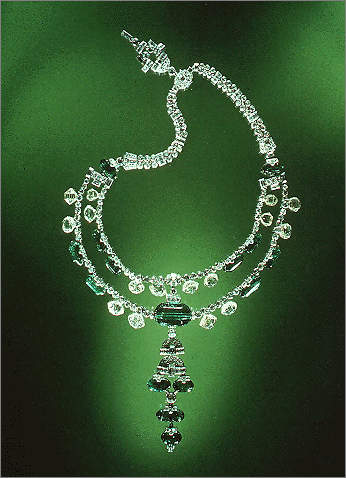
©Smithsonian Institution
However there might be another explanation for the choice of the name "Spanish Inquisition Necklace." During the dark period of the Spanish inquisition that lasted from the 1478 to 1834, most of the Jews who converted themselves to Catholicism out of fear of being persecuted, continued to practice their Jewish faith secretly, and the Jewish women usually wore a necklace with a pendant made up of a row of tiny butterflies, which was then known as a "Butterfly Necklace." Little did their Catholic persecutors know that these so-called butterflies necklaces could be folded and closed to form the sacred symbol of the Jewish faith, the "Star of David." Thus in the midst of persecution the Jews of Spain continued to be close to their religious beliefs by adopting such ingenuous techniques. The "Butterfly Necklaces" subsequently came to be known as the "Spanish Inquisition Necklaces" or the "Star of David Necklaces." Perhaps, Harry Winston in choosing the name "Spanish Inquisition Necklace" was trying to perpetuate the memory of these original Inquisition necklaces, that were symbols of peaceful defiance against the arrogance and intolerance that was the established order of the day.
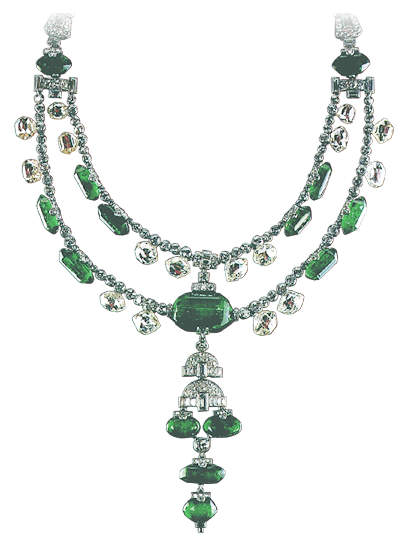
©Smithsonian Institution
Characteristics of the Spanish Inquisition Necklace
The lower-half of the necklace which is double-stranded consists of two concentric semi-circles, made up of smaller diamonds interspersed with pairs of large barrel-shaped diamonds and emeralds, placed symmetrically on the strands. There are eight pairs of larger diamonds and four pairs larger emeralds on these strands. A chandelier-shaped pendant made up of five large emeralds is placed centrally on the double strand, with the largest emerald in the necklace centrally placed on the lower strand.
The upper-half of the necklace is single-stranded made up of smaller diamonds only. At the two points on the necklace where the upper-half and lower-half meet, two large emeralds have been placed. Altogether, there are 15 large emeralds, 16 large diamonds, and around 120 smaller diamonds in the necklace.
The largest emerald in the necklace is an old Indian-cut, 45-carat, barrel-shaped emerald placed centrally in the necklace. According to the Smithsonian, "The rich velveteen color and exceptional clarity place the large emerald among the world's very finest quality emeralds. The shape closely approximates the form of the original elongated hexagonal crystal, suggesting that the crystal faces were simply rounded off to yield the largest possible gem."
History
Source of the emeralds
According to the Smithsonian all 15 emeralds in the "Spanish Inquisition Necklace" are undoubtedly of Colombian origin, and going by the old Indian-cut of the emeralds and diamonds, prevalent during the Moghul period, the stones belong to the 16th or 17th centuries, the period when the Moghul Empire was at the height of its glory. Production in the Muzo and Chivor mines began in the mid-16th century, but the Chivor mines were closed down indefinitely by royal decree in 1675, due to the inhuman and cruel conditions prevailing in the mines. Thus the emeralds in the "Spanish Inquisition Necklace" could have originated in any one of these mines or both. Any emerald in the necklace that has a pure, strong, saturated, dark green color, could possibly have originated in the Muzo mines. Likewise any green emerald which has an overabundance of secondary blue hue, known as a bluish-green emerald, could possibly have originated in the Chivor mines.
The emeralds reach the Mughal Empire of India
The emeralds recovered from the Muzo and Chivor mines in the 16th and 17th centuries eventually reached Spain, from where they were re-exported to the main consuming nations of the period, the rich Moghul Empire in India, the Persian Empire and the Ottoman Empire. This explains why most of the ancient emeralds of this period are found today in the museums of Iran, Turkey and India. The emeralds that reached northern India, were cut and polished by the Indian gemstone cutters of the period , applying the techniques and cutting styles in vogue during that period. This explains the old Indian-cut of the emeralds and diamonds in the necklace.
Period of uncertainty in the history of the necklace
The history of the necklace after the emeralds were cut in India is uncertain. It is not known whether the emeralds and accompanying diamonds were set into a necklace in India or in another country in Asia or Europe. It might well have been set in India under the orders of a Moghul Emperor, and the necklace eventually came into the possession of the Maharajah of Indore in the early 20th century. It is not known from where and how the Maharajah acquired the diamond and emerald necklace. Information concerning details of the early history of the necklace is seriously lacking.
According to a legend at least a part or variation of this necklace was once the property of the Spanish and later the French royalty adorned by the ladies of their courts. But, we are not sure how a necklace set in India eventually reached the Spanish or French courts. It is also possible that though the emeralds and diamonds were cut in India, the necklace was eventually set in one of the European countries and later acquired by the Maharajah of Indore from one of the auction houses like Christie's in the early 20th century. But, what is significant is that when Harry Winston purchased the necklace from the son of the Maharajah of Indore in 1947, it was already set in its present form, and was not subject to any form of modification by him.
Tukoji Rao III - the Maharajah of Indore who acquired the necklace
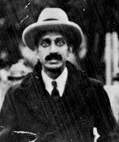
Tukoji Rao III
Indore is one of the four states of the Maratha Confederacy founded by the Holkar Dynasty in 1724. The Princely States of India existed as independent entities during the British colonial period, but were absorbed into the Indian Republic after independence in 1947. Today Indore is part of the Madhya Pradesh State of the Indian Republic. The Maharajah of Indore at the beginning of the 20th century, who purchased the emerald and diamond necklace, was Tukoji Rao III, the same Maharajah who is associated with the renowned "Indore Pears Diamonds" also acquired by Harry Winston in 1946. The Prince had many concubines in his palace, but had a soft corner for a beautiful dancing girl in his court by the name of Mumtaz Begum. However, unfortunately the girl did not reciprocate his advances. The girl was waiting for an opportunity to escape from the clutches of the Maharajah, and she did not have to wait long for such an opportunity. One day when the entourage of the Maharajah was traveling in his private train, Mumtaz Begum, who was part of the entourage, escaped from the train, when it slowed down or stopped at one point during its journey. The girl escaped to Amritsar, from where she eventually reached Bombay. While at Bombay she came under the protection of a rich merchant, probably as his mistress.
Tukoji Rao III, who had contacts in all big cities in India, got information about the whereabouts of his hearts desire, within a matter of days, and sent a team comprising of members of the Indore army and mounted police, to kidnap the girl from Bombay, headed by his Aide-de-Camp. The team studied the movements of the girl in Bombay, and struck one day when she was traveling in a car with a friend, driven by an official of the Bombay Municipal Corporation, somewhere near the Malabar Hill Hanging Gardens of Bombay. They attacked the car and attempted to kidnap the girl, and in the process the driver of the car was killed on the spot. Mumtaz Begum and her friend were seriously injured. Fortunately, some British officers who happened to pass the scene of the crime at the crucial moment, were able to apprehend one of the assailants, whose subsequent interrogation revealed the Maharajah's involvement. Moreover, Mumtaz Begum who recovered from her injuries, told the police that one of the assailants was the Aide-de-Camp to the Maharajah. The British colonial authorities took a serious view of the Maharajah's involvement in the crime, and gave him two options. Either abdicate in favor of his son or appear at the subsequent official inquiry. The Maharajah chose to abdicate in favor of his son.
The necklace is acquired by Harry Winston
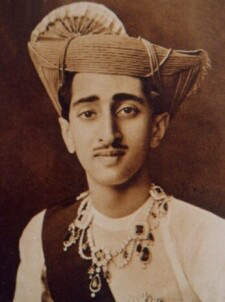
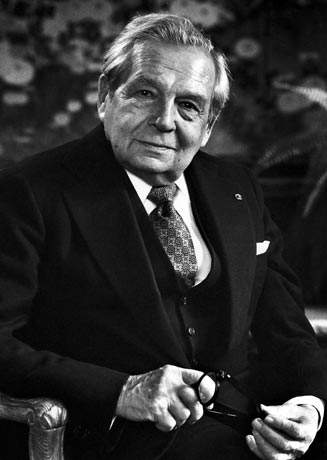
Yashvantrao II
Yashvantrao II, the son of Tukoji Rao III, ascended the throne of Indore in 1926 after the abdication of his father, and inherited the crown jewels including the diamond and emerald necklace. Yashvantrao II ruled Indore until the independence of India in 1947, when he acceded to join the Indian Republic. In 1947, Yashvantrao II disposed of the diamond and emerald necklace to Harry Winston, who had previously in 1946 purchased the Indore Pears from his father Tukoji Rao.
Harry Winston christens the necklace as the "Spanish Inquisition Necklace"
Harry Winston who purchased the necklace christened it the "Spanish Inquisition Necklace" for reasons that can only be conjectured. The necklace then became part of Harry Winston's court of jewels exhibition that traveled round the United States from 1949 to 1953. Other prominent exhibits that were also included in this exhibition were, the Hope diamond, the Portuguese diamond, the Star of the East diamond, and the Eugenie Blue diamond.
Catherine Hepburn wears the "Spanish Inquisition Necklace" for the 1947 Oscars
Catherine Hepburn was an American actress of films, television and stage, and holds the record for the most Best Actress Oscar wins, with four out of 12 nominations. Her acting career lasted more than 70 years, and in 1999, the American Film Institute ranked her as the greatest female star in the history of American cinema.

At the height of her career in 1947, she attended the 19th Annual Oscars held on March 13, 1947, at the Shrine Civic Auditorium, and on this occasion wore the "Spanish Inquisition Necklace," that was just acquired by Harry Winston from the Maharajah of Indore, and lent to her by him. The tradition of lending famous jewelry pieces for the Annual Oscars by leading jewelry houses in America, is still being adhered to on a grand scale, and has become an occasion to showcase their products.
Cora Hubbard Williams purchases the "Spanish Inquisition Necklace" and bequeaths it to the Smithsonian
In 1955, Harry Winston sold the "Spanish Inquisition Necklace" to Mrs. Cora Hubbard Williams of Pittsburgh, who bequeathed the necklace to the National Museum of Natural History of the Smithsonian Institution in 1972. Today, the "Spanish Inquisition Necklace" is displayed in the Janet Annenberg Hooker Hall of Geology, Gems and Minerals of the NMNH of the Smithsonian Institution in Washington DC. The diamonds and emeralds in this necklace are the oldest cut gemstones in the national collection.
Related :-
4) The Duke of Devonshire Emerald
7) The Maximilian Emerald Ring
References
1.Website of the National Museum of Natural History of the Smithsonian Institution.
2.Spanish Inquisition - from Wikipedia, the free encyclopedia.
3.Indore Pears - Web article, internet stones.com
4.Colombian Emerald - Gary Roskin, GG, FGA. -JCK online.com
5.The National Gem Collection - Jeffrey Post
6.The Emerald Deposits of Muzo Colombia - Joseph E. Pogu Ph. D. Transactions of the American Institute of Mining Engineers. Vol LV, 1917.

 Home
Security & Guarantee
How it Works
Technology Partners
Updated Tables
Famous Diamonds
More Famous Diamonds
Famous Pearls
Famous Gemstones
Contact Dr Shihaan Larif
Contact Senior Editor
Famous Jewelry
Reference Database
Forums
Learning Center
Gemstone Gallery
e-mail Notifications
Advertise
Press Release
About Us
Privacy Policy
Contact Us
FAQ'S
Site Map
Staff Mail Login
Staff Documents
Birthstones
History
Minerals
Shows
Live Metal Prices
Jewellery Gallery
News
Marketplace
Marketplace Support
Open Store
Online Auctions
Join Us & Contribute
Directory
Classifieds
List your products
Wholesale Trading
Post Buy Request
Go Green Policy
Site Updates
Upcoming-ToDo List
Latest News
Latest Articles
Latest Blog Updates
Chat Rooms
Job Board
User Gallery
Videos
New Newsletter Archive
Old Newsletter Archive
Jewelry & Mineral Blog
User Blogs & Social Network
Search
Answers (Q & A)
Valuation
Help me find a diamond/jewelry
pin.internetstones.com- Social Pinboard- Sart yours & connect with millions
Invite Friends From Yahoo, Gmail etc-One Click
Home
Security & Guarantee
How it Works
Technology Partners
Updated Tables
Famous Diamonds
More Famous Diamonds
Famous Pearls
Famous Gemstones
Contact Dr Shihaan Larif
Contact Senior Editor
Famous Jewelry
Reference Database
Forums
Learning Center
Gemstone Gallery
e-mail Notifications
Advertise
Press Release
About Us
Privacy Policy
Contact Us
FAQ'S
Site Map
Staff Mail Login
Staff Documents
Birthstones
History
Minerals
Shows
Live Metal Prices
Jewellery Gallery
News
Marketplace
Marketplace Support
Open Store
Online Auctions
Join Us & Contribute
Directory
Classifieds
List your products
Wholesale Trading
Post Buy Request
Go Green Policy
Site Updates
Upcoming-ToDo List
Latest News
Latest Articles
Latest Blog Updates
Chat Rooms
Job Board
User Gallery
Videos
New Newsletter Archive
Old Newsletter Archive
Jewelry & Mineral Blog
User Blogs & Social Network
Search
Answers (Q & A)
Valuation
Help me find a diamond/jewelry
pin.internetstones.com- Social Pinboard- Sart yours & connect with millions
Invite Friends From Yahoo, Gmail etc-One Click




Our Global Jewelry Industry Job Network


Buy & Sell in our Marketplace

Subscribe to our Newsletter

List in our Classifieds

List in our Directory

User Uploaded Gallery

Powered by Ultra Secure
Amazon (USA) Cloud Network

Founder Internet Stones.COM
Register in our Forums

| Featured In
|
|
|
|
|
|
|
|







Blog & Education Feed
Articles Feed
 |
 |
 |

Copyright © .Internet Stones.COM. All rights reserved.