Spirit of de Grisogono Diamond
Open FREE Unlimited Store Join Our Newsletter
Origin of Name
This rare and unique black diamond gets it's name from de Grisogono the famous Swiss jeweler and cutter of diamonds, who together with Fawaz Gruosi another famous Swiss jeweler had been responsible for creating the current enthusiasm for black diamond jewelry. De Grisogono, the world renowned black diamond cutting specialist, was responsible for cutting the diamond in the style of an old Moghul-cut diamond, and it was in his honor the diamond was subsequently named as "the Spirit of de Grisogono." The name de Grisogono today represent the Geneva-based Swiss luxury jewelry company founded by Fawaz Gruosi in 1996, specializing in high-end jewelry, time pieces and accessories, and grown into a popular international brand name with a network of 140 sales outlets around the world. Fawaz Gruosi launched the de Grisogono brand name in 1996, by opening the first de Grisogono boutique on rue du Rhone, Geneva. It might even be possible that the diamond was given the name "the Spirit of de Grisogono" to mark the launching of the brand name and the opening of the first boutique in Geneva.

Characteristics of the diamond
The Spirit of de Grisogono rough diamond is perhaps the 18th largest rough diamond discovered in the world so far
The Spirit of de Grisogono rough diamond when first discovered in the Central African Republic - one of only two countries in the world where black alluvial diamonds are commonly found - had a weight of 587 carats. Being a polycrystalline carbonado, it may not be appropriate to list this diamond with other conventional diamonds. Yet, when it so listed with other extraordinarily large rough diamonds, discovered in diamond producing countries of the world, such as India, Brazil, South Africa etc. the Spirit of de Grisogono rough diamond, becomes the 18th largest rough diamond discovered in the world so far. See table below.
List of largest gem-quality rough diamonds discovered in the world as at year 2011
Name |
Country of discovery | Year of discovery | Carat Weight | Color | Position |
| Cullinan | South Africa | 1905 | 3,106 | Colorless/White | 1 |
| Excelsior | South Africa | 1893 | 995 | Colorless /White | 2 |
| Star of Sierra Leone | Sierra Leone | 1972 | 969.80 | Colorless/White | 3 |
| Incomparable | Zaire | 1984 | 890 | Brownish-yellow | 4 |
| Great Mogul | India | 1650 | 787 | Colorless/White | 5 |
| Millennium Star | Zaire | 1990 | 777 | Colorless/White | 6 |
| Woyie River | Sierra Leone | 1945 | 770 | Colorless/White | 7 |
| Golden Jubilee | South Africa | 1985 | 755 | Yellowish-brown | 8 |
| President Vargas | Brazil | 1938 | 726.60 | Colorless/White | 9 |
| Jonker | South Africa | 1934 | 726 | Colorless/White | 10 |
| Jubilee-Reitz | South Africa | 1895 | 650.80 | Colorless/White | 11 |
| Unnamed | South Africa | 1984 | 620.14 | 12 | |
| Sefadu | Sierra Leone | 1970 | 620 | Colorless/White | 13 |
| Kimberley Octahedral | South Africa | 1964 | 616 | Yellow | 14 |
| Lesotho Promise | Lesotho | 2006 | 603 | Colorless/White | 15 |
| Lesotho Brown | Lesotho | 1967 | 601 | Brown | 16 |
| Centenary | South Africa | 1986 | 599 | Colorless/White | 17 |
| De Grisogono | Central Africa | Probably in the 1950s | 587 | Black | 18 |
| Letseng Star | Lesotho | 2011 | 553 | Colorless/White | 19 |
| Letseng Legacy | Lesotho | 2007 | 493 | Colorless/White | 20 |
| Light of Letseng | Lesotho | 2008 | 478 | Colorless/White | 21 |
| Jacob-Victoria | South Africa | 1884 | 457.50 | Colorless/White | 22 |
| Zale light of peace | Sierra Leone | 1969 | 435 | Colorless/white | 23 |
| De Beers | South Africa | 1888 | 428.50 | Yellow | 24 |
| Niarchos | South Africa | 1954 | 426.50 | Colorless/White | 25 |
©internetstones.com
Please do not copy our tables without our permission. We may be compelled to inform the search engines if our content and tables are plagiarised.
The old Moghul-cut 312.24-carat Spirit of de Grisogono diamond is the second largest faceted black diamond in the world
De Grisogono transformed the 587-carat rough black diamond, into a 312.24-carat, old Moghul-cut, breathtaking, faceted diamond after more than one year of painstaking work. The 312.24-carat finished diamond is the second largest faceted black diamond in the world, after the 489.07-carat rectangular-cut unnamed black diamond that sold at an auction in 2001. See table below
List of Famous Black Diamonds
S/N |
Name | Country/Period of Origin | Weight of Rough Diamond | Carat weight after cutting | Cut/Shape | Price realized at last sale or auction |
| 1 | Unnamed black diamond | 489.07 | Rectangular-cut | US$1.7 million | ||
| 2 | The Spirit of Grisogono | Central African Republic | 587.00 | 312.24 | Old Moghul-cut | Stone remains with original owner Fawaz Gruosi |
| 3 | The Black Star of Africa | Central African Republic | 202.00 | Seen for the last time in Tokyo in 1971 |
||
| 4 | The Table of Islam | Central African Republic | 160.18 | Emerald cut | ||
| 5 | Gruosi Diamond | India | 300.12 | 115.34 | Heart-shaped | Stone remains with original owner Fawaz Gruosi |
| 6 | Korloff Noir Diamond | Russia | 421.00 | 88.00 | Round brilliant-cut with standard 57 facets | Property of Korloff Jewelers France |
| 7 | Black Orlov Diamond | India or Russia | 195.00 | 67.50 | Cushion-cut | US$360,000 Christie's NY. Oct.2006 |
| 8 | Amsterdam Diamond | South Africa - 1972 | 55.85 | 33.74 | Pear-shaped | US$352,000 Christie's Geneva. Nov |
©internetstones.com
The Spirit of de Grisogono is the 6th largest faceted diamond in this world
The following table is a comprehensive list of 68 known faceted famous diamonds in the world greater than 100 carats arranged in descending order of weights. The table was painstakingly collated by our staff after collecting all available information. The list may not be entirely comprehensive as some diamonds might have been inadvertently omitted or due to lack of precise information. We have tried our best to make the list all inclusive. The list will be revised as more information on other new diamonds are received.
According to this table, the largest faceted diamond in the world is the 545.67-carat, cushion-cut Golden Jubilee diamond, followed by the 530.20-carat Cullinan I diamond. The 3rd largest faceted diamond is the 489.07-carat, rectangular-cut, unnamed black diamond, that was sold at an auction in 2001. The 407.48-carat, shield-shaped Incomparable diamond and the 317.40-carat, cushion-cut, Cullinan II, occupy respectively, the 4th and 5th positions on the table. Next comes the 312.24-carat, Spirit of de Grisogono, the subject of this webpage, which is the 6th largest faceted diamond in this world.
List of Famous Diamonds Greater than 100 carats in weight arranged in descending order of weights
S/N |
Name | carat weight | shape/cut | color |
| 1 | Golden Jubilee | 545.67 | cushion | fancy yellow-brown |
| 2 | Cullinan I | 530.20 | pear | colorless/white |
| 3 | Unnamed Black Diamond | 489.07 | rectangular-cut | black |
| 4 | Incomparable | 407.48 | shield shaped | fancy brownish yellow |
| 5 | Cullinan II | 317.40 | cushion | colorless/white |
| 6 | Spirit of de Grisogono | 312.24 | old moghul-cut | black |
| 7 | Centenary | 273.85 | modified-heart | colorless/white |
| 8 | Oppenheimer | 253.70 | natural octahedral | yellow |
| 9 | Jubilee | 245.35 | cushion | colorless/white |
| 10 | De Beers | 234.65 | cushion | light yellow |
| 11 | Red Cross | 205.07 | cushion | canary yellow |
| 12 | Millennium Star | 203.04 | pear | colorless/white |
| 13 | Unnamed | 200.87 | pear | yellow |
| 14 | La Luna | 200.07 | heart-shaped | colorless/white |
| 15 | Orlov | 189.62 | rose-cut | colorless/white |
| 16 | Darya-i-Nur | 186 | table-cut | light pink |
| 17 | Jacob-Victoria | 184.50 | oval | colorless/white |
| 18 | Moon | 183 | round | pale yellow |
| 19 | Unnamed | 180.85 | briolette | yellow |
| 20 | Star of Peace | 170.49 | pear | brownish-yellow |
| 21 | Table of Islam | 160.18 | emerald-cut | black |
| 22 | Unnamed | 150.00 | emerald | yellow |
| 23 | Regent | 140.64 | cushion | colorless/white |
| 24 | Paragon | 137.82 | 7-sided | colorless/white |
| 25 | Florentine | 137.27 | double rose-cut | light yellow |
| 26 | Premier Rose | 137.02 | pear | colorless/white |
| 27 | Algeiba Star | 135.03 | square-brilliant | yellow |
| 28 | Sarah | 132.43 | cushion | fancy vivid yellow |
| 29 | Golden Hue | 132.42 | cushion | yellow |
| 30 | Tiffany Yellow | 128.54 | cushion |
canary yellow |
| 31 | Star of the South | 128.48 | cushion | fancy light pinkish-brown |
| 32 | Niarchos | 128.25 | pear | colorless/white |
| 33 | Portuguese | 127.02 | asscher | colorless/white |
| 34 | Jonker | 125.35 | emerald | colorless/white |
| 35 | Stewart | 123.00 | round-brilliant | yellow |
| 36 | Delaire Sunrise | 118.08 | square emerald-cut | fancy vivid yellow |
| 37 | Meister | 118.00 | cushion | yellow |
| 38 | Vainer Briolette | 116.60 | briolette | fancy light yellow |
| 39 | Hope of Africa | 115.91 | cushion | fancy vivid yellow |
| 40 | Al-Nader | 115.83 | pear | colorless/white |
| 41 | Gruosi Diamond | 115.34 | heart-shaped | black |
| 42 | Taj-i-Mah | 115.06 | moghul-cut | colorless/white |
| 43 | Edna Star | 115.0 | emerald | colorless/white |
| 44 | Unnamed | 114.64 | briolette | yellow |
| 45 | Unnamed | 114.03 | cushion | yellow |
| 46 | Mouna | 112.50 | cushion | fancy intense yellow |
| 47 | African Yellow | 112.00 | yellow | |
| 48 | Earth Star | 111.59 | pear | brown |
| 49 | Cross of Asia | 109.26 | radiant | light brown |
| 50 | Koh-i-Noor | 108.93 | oval | colorless/white |
| 51 | Mouawad Magic | 108.81 | emerald | colorless/white |
| 52 | Anon | 108.04 | emerald | yellow |
| 53 | Rojtman | 107.46 | cushion | yellow |
| 54 | Cartier | 107.07 | pear | colorless/white |
| 55 | Golden Sun | 105.54 | emerald | yellow |
| 56 | Star of Egypt | 105.51 | emerald | colorless/white |
| 57 | Golden Door | 104.95 | pear | yellow |
| 58 | Geat Chrysanthemum | 104.61 | pear | fancy brown |
| 59 | Graff Constellation | 102.79 | round brilliant | colorless/white |
| 60 | Ashberg | 102.48 | cushion | dark orange yellow/amber |
| 61 | Mouawad Splendour | 101.84 | pear | colorless/white |
| 62 | The Alnatt | 101.29 | cushion | fancy vivid yellow |
| 63 | The Golden Star | 101.28 | cushion | fancy vivid yellow |
| 64 | Star of America | 100.57 | asscher | colorless/white |
| 65 | Sunrise | 100.52 | emerald | yellow |
| 66 | Star of Happiness | 100.36 | radiant | colorless/white |
| 67 | Star of the Season | 100.10 | pear | colorless/white |
| 68 | Graff Vivid Yellow | 100.09 | cushion | fancy vivid yellow |
©internetstones.com
History
Early History of the diamond
The original rough diamond that weighed 587 carats was mined from the alluvial deposits of the Central African Republic, one of two countries in the world, where alluvial black diamonds have been discovered, the other being Brazil in South America. Other details of the diamond such as the date of discovery, the mine of discovery, original owners of the diamond etc. are not known.
Difficulties involved in the cutting of the diamond
The massive black rough stone arrived in Switzerland after it's purchase by Fawaz Gruosi, the famous Swiss jeweler. The diamond was cut by the world renowned black diamond cutting specialist, de Grisogono, in whose name the diamond was subsequently named. De Grisogono was also responsible for the cutting of the heart-shaped Gruosi diamond in 1998, another black diamond owned by Fawaz Gruosi.
The cut employed on the stone was a modified old Moghul-cut, an appropriate design selected by the experienced cutter, to suit the shape of the rough stone. The old Moghul-cut can be seen in many of the historic diamonds that originated in India, during the Moghul period, such as the Orlov diamond, the Taj-i-Mah diamond, and a number of diamonds in the Iranian Crown Jewels. The planning of the cutting and the actual cutting process took more than one year. This is not surprising because black diamonds are usually extremely hard, and the hardness is not evenly spread, with pockets of softer areas within the rough stone, making it difficult to work with. This unusual property of black diamonds is due to their polycrystalline, porous nature, and diamond cutters are not quite sure which diamond shape they will end up with, as they have been forced to change form and shape, when meeting with softer areas in the middle of the stone. The fact that de Grisogono was able to produce a final product, which is the most perfectly cut old moghul-cut diamond in the world, despite the difficult material with which he worked, speaks volumes about his capabilties as a skilled and experienced cutter.
The 587-carat rough diamond was eventually converted to a 312.24-carat old moghul-cut finished diamond, resulting in a loss of 274.76 carats during the transformation. This is equivalent to a percentage loss of 47%, which is attributed to the polycrystalline nature of the diamond.
The breathtaking ring setting of the Spirit of de Grisogono diamond
The old Moghul-cut Spirit of de Grisogono black diamond was set by the expert jewelry craftsmen of the Swiss jewelry company de Grisogono, on a white gold ring mounting, studded with 702 white round brilliant-cut diamonds, with a total weight of 36.69 carats. This spectacular black and white diamond setting, laid the foundation for Fawaz Gruosi's successful experiment in popularizing black diamond incorporated jewelry, diamonds previously rejected as mine bort or carbonado, considered fit for crushing only for industrial purposes.
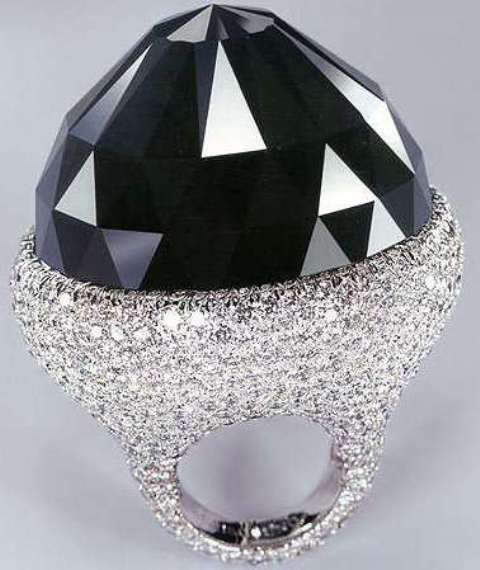
Spirit of de Grisogono black diamond on its spectacular white gold ring mounting set with white diamonds
Sale of the Spirit of de Grisogono diamond ring?
It has been reported that the Spirit of de Grisogono diamond ring has been sold by its owner Fawaz Gruosi to an anonymous client for an undisclosed sum. However, this report has never been confirmed.
Other famous old Moghul-cut diamonds
The Moghul-cut being an old cut developed during the classic Moghul period of India from 1556 to 1707, ie the period from the time of ascension of Emperor Akbar till the death of the last great Mughal Emperor Aurangzeb, is found in many diamonds originating from this period. Some of the famous diamonds that originated during this period and show this ancient form of cutting developed in India, are :-the Orlov diamond preserved in the treasury of the Kremlin Diamond Fund in Russia; the long-lost Great Mogul diamond described by Tavernier in his book "The Six Voyages of Jean Baptiste Tavernier" with the aid of a sketch; the Taj-i-Mah diamond and other Moghul-cut diamonds of the Iranian Crown Jewels, preserved in the Museum of the Treasury of National Iranian Jewels in the Central Bank of Iran,Teheran.
1) The Orlov Diamond
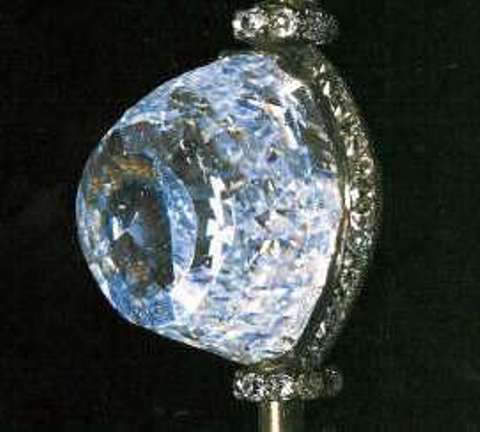
The 189.62-carat, old Moghul-cut, Orlov diamond mounted on the Imperial Scepter of the Romanov rulers of Russia, preserved in the Kremlin Diamond Fund
2) Taj-i-Mah Diamond
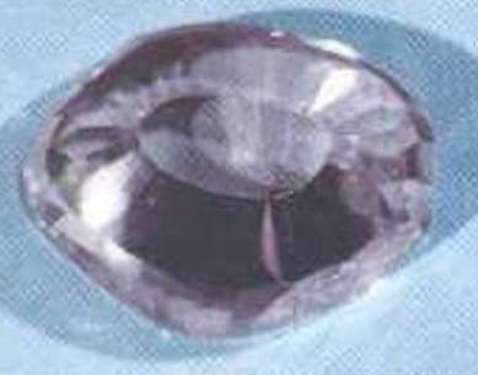
115.06-carat old moghul-cut Taj-i-Mah diamond from the Iranian Crown Jewels
3) Mughal-cut diamonds from the Iranian Crown Jewels
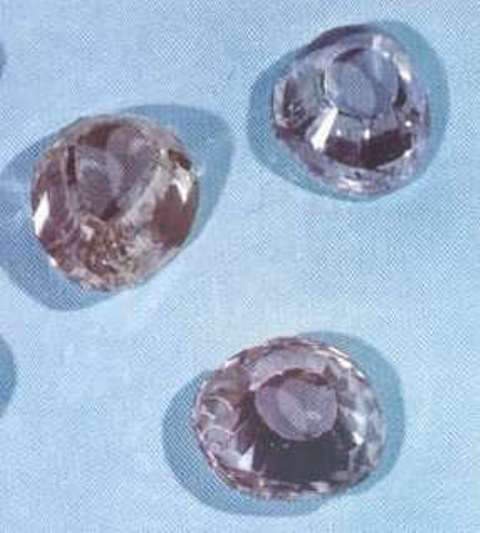
Three more old Mughal-cut diamonds from the Iranian Crown Jewels
Replica of the long-lost Great Mogul Diamond
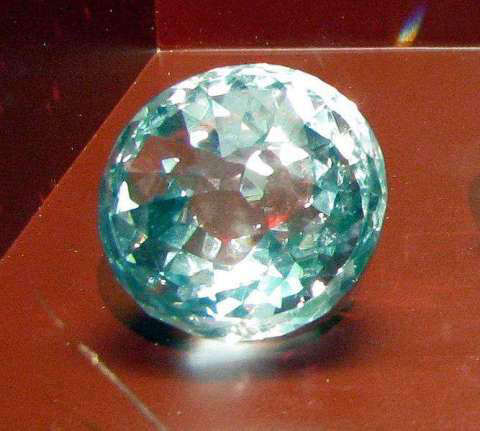
Replica of the long-lost, Mughal-cut, Great Mogul Diamond created from the drawings and descriptions of the diamond by Tavernier

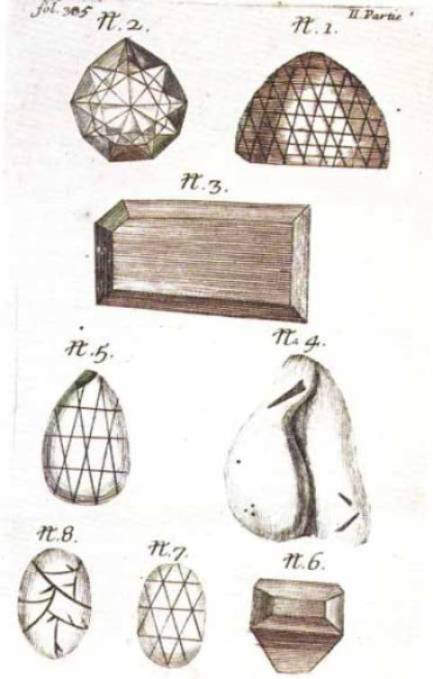
Sketches of some famous diamonds seen by Tavernier in India
The above sketches, are from Chapter XXII of Part 2 of Tavernier's book, "The Six Voyages of Jean Baptiste Tavernier." Sketch No.1 is a depiction of the Great Moghul Diamond, which according to Tavernier weighed 280 carats and was cut from a larger rough stone that weighed 787 carats. Some historians believe that the Orlov Diamond is actually the long-lost great Mughal Diamond. There is strong evidene to support this view, but it is yet to gain universal acceptance. Please read Orlov Diamond for more information. Sketches 2 & 3 are respectively the Florentine diamond and the Great Table diamond. Sketches 4 & 5 represent respectively the Ahmedabad rough diamond and the pear-shaped Ahmedabad diamond after cutting.
Geology of Black Diamonds
Black diamonds, also known as Carbonodo have long been a puzzle for Geologists. There has been a controversy about the origin and the distribution of naturally occurring black diamonds in the world today. A comparison of the characteristics of black diamonds as against conventional diamonds can be very informative and interesting.
Comparison of the characteristics of black diamonds and conventional diamonds
S/N |
Black Diamonds |
Conventionl Diamonds |
|---|---|---|
1 |
Black diamonds are porous, like pumice formed from larva of volcanoes. They appear to be composed of millions of minute diamond crystals stuck together. They are polycrystalline. |
Conventional diamonds are non-porous and exist as large crystals, with a classic crystal structure. They are monocrystalline. |
2 |
The porous material is full of bubbles that appear to result from gases present when the diamonds were formed. Gases found are mainly hydrogen and nitrogen. The presence of hydrogen is a evidence for the stellar origin of carbonados. |
Conventional diamonds were formed deep within the earth's crust where the high pressure does not allow gases to exist |
3 |
Black diamonds are found in alluvial deposits, and never found in Kimberlite pipes, indicating that black diamonds were not formed inside the earth's crust. |
Conventional diamonds are found in Kimberlite and Lamproite pipes as well as nearby alluvial deposits, which indicate they were formed deep inside the earth's crust, and later brought up to the surface. |
| 4 | Mantle mineral inclusions are not found in carbonado | Conventional diamonds contain inclusions of common mantle minerals such as pyrope and forsterite |
| 5 | Exhibit strong luminescence induced by nitrogen and by vacancies in the crystal lattice | Less luminescent than black diamonds |
| 6 | Low carbon isotope values compared to conventional diamonds | Higher carbon isotope values |
| 7 | Carbonado are older than 3.8 billion years | The age of conventional diamonds vary from 100 million to 1 billion years |
| 8 | Carbonados are found mainly in alluvial deposits in Brazil and the Central African Republic | Conventional diamonds are found in kimberlite and lamproite pipes and in alluvial deposits closeby, in many countries around the world, such as India, Indonesia, Brazil, African countries such as South Africa, Zaire, Angola etc. Russia, Canada and Australia |
9 |
Black diamond are extremely hard and difficult to cut and polish. The hardness of black diamonds exceeds that of conventional diamonds |
Conventional diamonds are the hardest substances known, but they are less hard than the harder black diamonds. |
10 |
The extreme hardness of black diamonds is attributed to lack of crystal planes along which cleavage can occur. |
Conventional diamonds cleave along crystal planes |
11 |
Black diamond are more suitable for industrial uses such as grinding and drilling and less suitable for ornamental purposes. |
Conventional diamonds are more suitable for ornamental purposes. |
©internetstones.com
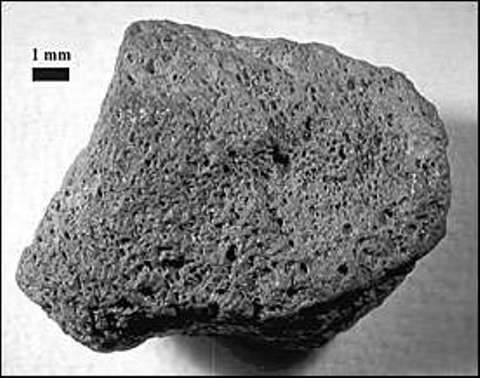
Black Carbonado diamond - From the Brookhaven National Laboratory website
Photocredit - Steve Haggerty
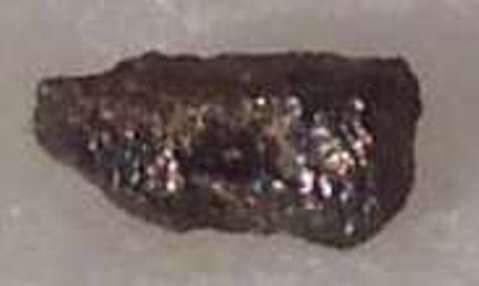
A Carbonado Sample
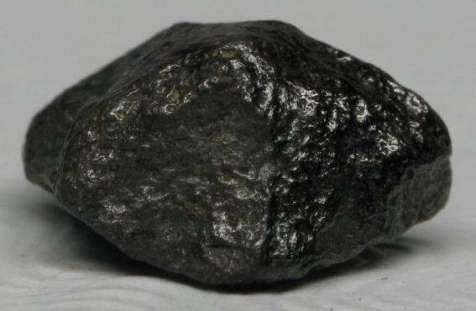
Single alluvial black diamond crystal from Bangui region of the Central African Republic. From the website www.earthphysicsteaching.homestead.com
Photocredit - Michael P. Klimetz
The hypothesis for an extra-terrestrial origin for black diamonds put forward by a team of geologists from the Florida International University
Today the only important sources of black diamonds in the world are Brazil and Central African Republic. Not one black diamond has ever been produced in the conventional diamond mines of South Africa, Russia, Australia and Canada, the main sources of the approximately 600 tons of conventional diamonds produced in the last century. The two main black diamond locations in the world are isolated and separate from the conventional diamond locations. This coupled with the fact that black diamonds are only found as alluvial deposits has given rise to the speculation that black diamonds came from outer space, and have a extra-terrestrial origin. A team of Geologists from the Florida International University, has proposed that an asteroid of about half a mile in diameter impacted the earth billions of years ago, when South-America and Africa were once connected land masses. The deposit of black diamonds are today thousands of miles apart because of the continental drift, that occurred afterwards.
The usage of possible stellar origins of black diamonds as a marketing theme to popularize black diamonds
The possible stellar origins of black diamonds, may in the future become a marketing theme to popularize black diamond jewelry, as diamond shoppers would no doubt be interested in owning a diamond that originated in outer space
You are welcome to discuss this post/related topics with Dr Shihaan and other experts from around the world in our FORUMS (forums.internetstones.com)
Related :-
References :-
1) Fancy Colored Black Diamonds - Diamond Source of Virginia, Inc. www.diamondourceva.com
2) Diamond properties, geology, exploration, mining - Part III. www.minelinks.com/alluvial/diamonds
3) Fawaz Gruosi - www.worldtempus.com
4) De Grisogono - www.degrisogono.com
5) Carbonado - From Wikipedia, the free encyclopedia
6) Mystery Diamonds - Geoscientists Investigate Rare Carbon Formation - Science Daily, June 1, 2007. www.sciencedaily.com
7) Diamonds from Outer Space : Geologists Discover Origin of Earth's Mysterious Black Diamonds - January 10, 2007. Brookehaven National Laboratory News. www.bnl.gov
8) The Regents Earth Science and Regents Physics Web Resource for Students and Teachers- created and maintained by Michael P. Klimetz, Science Department, John Dewey High School, Brooklyn, New York.
 Home
Security & Guarantee
How it Works
Technology Partners
Updated Tables
Famous Diamonds
More Famous Diamonds
Famous Pearls
Famous Gemstones
Contact Dr Shihaan Larif
Contact Senior Editor
Famous Jewelry
Reference Database
Forums
Learning Center
Gemstone Gallery
e-mail Notifications
Advertise
Press Release
About Us
Privacy Policy
Contact Us
FAQ'S
Site Map
Staff Mail Login
Staff Documents
Birthstones
History
Minerals
Shows
Live Metal Prices
Jewellery Gallery
News
Marketplace
Marketplace Support
Open Store
Online Auctions
Join Us & Contribute
Directory
Classifieds
List your products
Wholesale Trading
Post Buy Request
Go Green Policy
Site Updates
Upcoming-ToDo List
Latest News
Latest Articles
Latest Blog Updates
Chat Rooms
Job Board
User Gallery
Videos
New Newsletter Archive
Old Newsletter Archive
Jewelry & Mineral Blog
User Blogs & Social Network
Search
Answers (Q & A)
Valuation
Help me find a diamond/jewelry
pin.internetstones.com- Social Pinboard- Sart yours & connect with millions
Invite Friends From Yahoo, Gmail etc-One Click
Home
Security & Guarantee
How it Works
Technology Partners
Updated Tables
Famous Diamonds
More Famous Diamonds
Famous Pearls
Famous Gemstones
Contact Dr Shihaan Larif
Contact Senior Editor
Famous Jewelry
Reference Database
Forums
Learning Center
Gemstone Gallery
e-mail Notifications
Advertise
Press Release
About Us
Privacy Policy
Contact Us
FAQ'S
Site Map
Staff Mail Login
Staff Documents
Birthstones
History
Minerals
Shows
Live Metal Prices
Jewellery Gallery
News
Marketplace
Marketplace Support
Open Store
Online Auctions
Join Us & Contribute
Directory
Classifieds
List your products
Wholesale Trading
Post Buy Request
Go Green Policy
Site Updates
Upcoming-ToDo List
Latest News
Latest Articles
Latest Blog Updates
Chat Rooms
Job Board
User Gallery
Videos
New Newsletter Archive
Old Newsletter Archive
Jewelry & Mineral Blog
User Blogs & Social Network
Search
Answers (Q & A)
Valuation
Help me find a diamond/jewelry
pin.internetstones.com- Social Pinboard- Sart yours & connect with millions
Invite Friends From Yahoo, Gmail etc-One Click




Our Global Jewelry Industry Job Network


Buy & Sell in our Marketplace

Subscribe to our Newsletter

List in our Classifieds

List in our Directory

User Uploaded Gallery

Powered by Ultra Secure
Amazon (USA) Cloud Network

Founder Internet Stones.COM
Register in our Forums

| Featured In
|
|
|
|
|
|
|
|







Blog & Education Feed
Articles Feed
 |
 |
 |

Copyright © .Internet Stones.COM. All rights reserved.