History of Internet Stones.COM Media & The Gem Trade in Sri Lanka
The co-founders of Internet Stones.COM Media are from Galle, the capital of southern Sri Lanka.
Founded in 2005, Internet Stones.COM Media has become an authoritative media portal for the gemstone, jewelry and mineral industry. It attracts over 1 000 000 unique visitors per annum or over 10 000 000 hits- See about us for details.
Galle is the ancient port city of Sri Lanka (Ceylon), with a history dating back to probably two millennia. Sir Emerson Tennent thought that the city of Galle in Sri Lanka was the Biblical Tarshish from which King Solomon obtained Ivory, Apes and Peacoks. Arabian Travellers called the city Kalah which was a seaport lying between China and Persia, and was a great emporium of trade in the East. Ships of all nations met there and exchanged commodities. The Arab traders exchanged cotton, silk, gold and silver for ivory, precious and semi-precious stones (Gems) and spices, which were abundantly found in Sri Lanka. Arab traders settled in Sri Lanka in the 8th century-AD.
The port of Galle was much frequented in the middle ages too. It was the chief landmark of eastern navigators. There is an area called China Garden in Galle where Chinese traders once resided, and a Chinese inscription was discovered in Galle which recorded the dealings of the Chinese in Sri Lanka .Ibn Batuta the famous Arab traveller visited Sri Lanka in 1344,and in Galle he found a well established Moor Community engaged in the trading of spices, ivory, gems and jewelry. It is from the port city of Galle that Ibn Batuta embarked on an ancient ship that took him to the Maldives a group of atolls situated about 500km South West from Sri Lanka
|
Galle in 1650 |
|
|
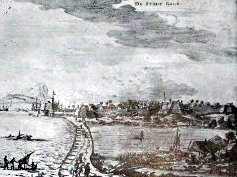
|
Galle as seen from the Harbout,1744 |
|
|
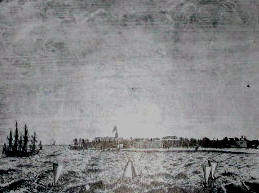
|
Church Street, Galle Fort,1744 |
|
|
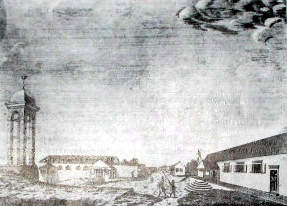
The Portuguese landed in Galle Sri Lanka in the year 1505 and built a fortress. It is from Galle,they extended their colonization to cover the maritime areas of Sri Lanka.
The Dutch captured the Fort of Galle from the Portuguese in1640 and ousted the Portuguese from the other parts of the Island. They held the port city of Galle which they referred to as Point de Galle for 155 years. The Dutch rebuilt the Galle Fort immediately after its capture from the Portuguese. Considerable improvements were also made to the Fort in the years 1641,1661 and 1668.The Dutch Fort as it stands today is the same Fort which was completed in the year 1668
The British captured the Port City of Galle from the Dutch in 1795 and set up their Headquarters for the whole of Sri Lanka (Ceylon) in the well fortified Dutch Fort of Galle.
The Port City of Galle was the capital of Sri Lanka (Ceylon) during the Portuguese period, Dutch period and part of the British period. The British shifted the capital to Colombo in 1868.
In 1948 the British granted independence to Sri Lanka (Ceylon) after ruling the country for a period of 150 years.
The Dutch Fort in Galle, Sri Lanka which still stands today as it was in the year 1668,was declared a World Heritage Site by UNESCO in 1988
|
Present day Galle City, as seen from the top of the Dutch Fort |
|
|
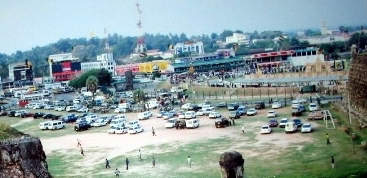
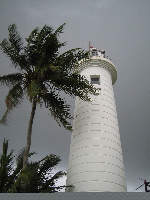
New Light House ,Galle Fort |
|
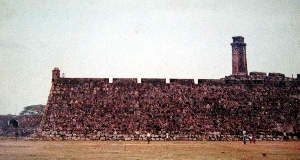
Dutch Fort Galle, built 1667,Declared UNESCO World Heritage site,1988. Photo Taken,1984. |
|
|
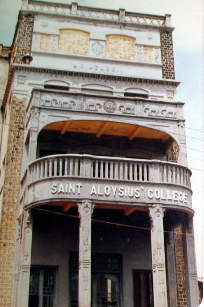
Saint Aloysius' College(1895), a leading Christian School in Galle, Sri Lanka |
|
|
|
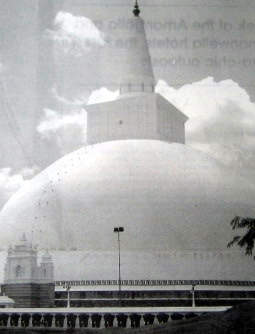
Restored Buddhist Dagoba at Anuradhapura, Sri Lanka,built 200 BC |
|
|
|
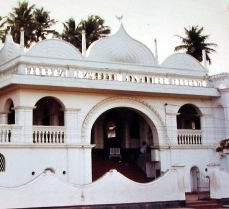
A Muslim mosque at Kandewatte, Galle Built,1850 |
|
|
|
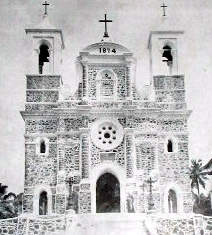
Saint Mary's Cathedral Galle, Built 1874 by Fr. Benedict Martin a Spanish Missionary. Photo taken 1927. |
|
|
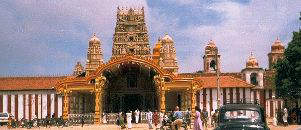
Nallur Kandaswamy Hindu Temple, Jaffna. Built in 1749 |
|
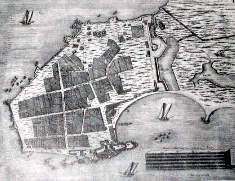
Map of Galle Fort and Harbour,1744 |
|
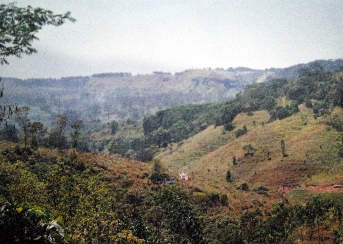
One of the gem mining areas of Sri Lanka |
|
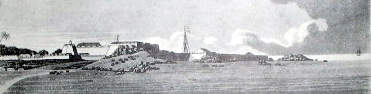
Point de Galle from north west,1796 |
|
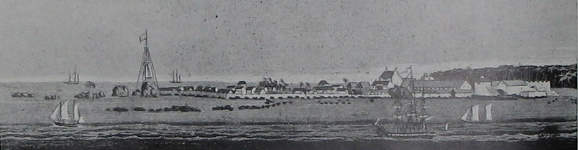
Point de Galle from Watering Point(1796) |
|
The People of Sri Lanka
Sri Lankan society is multi-ethnic, multi-cultural and multi-religious. There are five main ethnic groups in the country-The Sinhalese, Tamils, Moors, Burghers and Malays. The Sinhalese constitute the major ethnic group in Sri Lanka. The followers of the four major religions in the world are found in Sri Lanka-Buddhists, Hindus, Muslims and Christians, but Buddhists constitute the major religious group in Sri Lanka. The Sinhalese, who are mainly Buddhists have a recorded history of over 2500 years.
The source of the Gem stones in Sri Lanka are from mines in the traditional Gem mining districts of Ratnapura (City of Gems) Elahera, Pelmadulla, Rakwana, Eheliyagoda, Deniyaya Morawaka ,Okkanpitiya and the recently discovered mines at Kantale, Horana, Ragala, Bogawantalawa and Hatton.
Gemstone dealers in Sri Lanka also travel to major gem producing areas of the world in search of high quality facetable rough gem stones.
They also import high grade facetable gem stones from many countries.
These countries include:
Congo, Ethiopia, Kenya, Madagascar, Malawi, Mozambique, Tajikistan (indirectly) through Pakistan, Pakistan, Afghanistan, Russia, Australia, China, Vitenam, Thailand , Burma (Myammar) , India, South America (Indirectly), Zambia, Tanzania and Nigeria.
Sri Lanka has been in the international gem trade for several centuries and gem mining has been taking place for over a thousand years. The technical know-how of the trade such as identification of rough gem stones, cutting and polishing of gem stones has been faithfully passed down from generation to generation, and we are fortunate to be the proud recipients of such an ancient heritage.
Our Sri Lankan gemstone cutters and jewelry craftsmen have combined this valuable ancient knowledge with modern scientific advancements in Gemmology.
Galle city is an ancient centre of the hand made jewelry industry and large concentrations of jewelry craftsmen are settled in and around the city even up to this day. If Ratnapura is known as the Gem City of Sri Lanka, Galle can be referred to as the Jeweler's city of Sri Lanka.
 Home
Security & Guarantee
How it Works
Technology Partners
Updated Tables
Famous Diamonds
More Famous Diamonds
Famous Pearls
Famous Gemstones
Contact Dr Shihaan Larif
Contact Senior Editor
Famous Jewelry
Reference Database
Forums
Learning Center
Gemstone Gallery
e-mail Notifications
Advertise
Press Release
About Us
Privacy Policy
Contact Us
FAQ'S
Site Map
Staff Mail Login
Staff Documents
Birthstones
History
Minerals
Shows
Live Metal Prices
Jewellery Gallery
News
Marketplace
Marketplace Support
Open Store
Online Auctions
Join Us & Contribute
Directory
Classifieds
List your products
Wholesale Trading
Post Buy Request
Go Green Policy
Site Updates
Upcoming-ToDo List
Latest News
Latest Articles
Latest Blog Updates
Chat Rooms
Job Board
User Gallery
Videos
New Newsletter Archive
Old Newsletter Archive
Jewelry & Mineral Blog
User Blogs & Social Network
Search
Answers (Q & A)
Valuation
Help me find a diamond/jewelry
pin.internetstones.com- Social Pinboard- Sart yours & connect with millions
Invite Friends From Yahoo, Gmail etc-One Click
Home
Security & Guarantee
How it Works
Technology Partners
Updated Tables
Famous Diamonds
More Famous Diamonds
Famous Pearls
Famous Gemstones
Contact Dr Shihaan Larif
Contact Senior Editor
Famous Jewelry
Reference Database
Forums
Learning Center
Gemstone Gallery
e-mail Notifications
Advertise
Press Release
About Us
Privacy Policy
Contact Us
FAQ'S
Site Map
Staff Mail Login
Staff Documents
Birthstones
History
Minerals
Shows
Live Metal Prices
Jewellery Gallery
News
Marketplace
Marketplace Support
Open Store
Online Auctions
Join Us & Contribute
Directory
Classifieds
List your products
Wholesale Trading
Post Buy Request
Go Green Policy
Site Updates
Upcoming-ToDo List
Latest News
Latest Articles
Latest Blog Updates
Chat Rooms
Job Board
User Gallery
Videos
New Newsletter Archive
Old Newsletter Archive
Jewelry & Mineral Blog
User Blogs & Social Network
Search
Answers (Q & A)
Valuation
Help me find a diamond/jewelry
pin.internetstones.com- Social Pinboard- Sart yours & connect with millions
Invite Friends From Yahoo, Gmail etc-One Click




Our Global Jewelry Industry Job Network


Buy & Sell in our Marketplace

Subscribe to our Newsletter

List in our Classifieds
List in our Directory

User Uploaded Gallery
Powered by Ultra Secure
Amazon (USA) Cloud Network
Founder Internet Stones.COM
Register in our Forums

| Featured In
|
|
|
|
|
|
|
|







Blog & Education Feed
Articles Feed
 |
 |
 |

Copyright © .Internet Stones.COM. All rights reserved.