Star of the South Diamond
Open FREE Unlimited Store Join Our Newsletter
Origin of Name
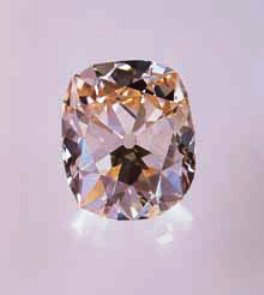
The diamond was named "Estrella do Sud"(Star of the South), in French after a syndicate of diamond merchants in Paris led by Halphen &Associates, purchased it in the early 1860s.

Star of the South Diamond
Characteristics of the diamond
The diamond is a 128.48-carat, cushion-shaped stone, with a clarity of VS2, and color grading of fancy light pinkish brown. It is a type 11a diamond. The dimensions of the stone are 35 x 29 x 19 mm.
Early History
The diamond that was discovered accidentally by a woman slave worker, in the mines of the province of Minas-Geraes, in Brazil , in July 1853, has gone down in history as the first Brazilian diamond to receive international acclaim.
Star of the South Diamond
The rough diamond weighed 254.5 carats and was unique in that it was a naturally formed rhombic dodecahedral crystal having 24 natural facets. There was a deep depression on one of the facets, with a shape that probably could have accommodated another octahedral crystal. A few black inclusions were also seen in the stone that could have been caused either by volcanic sand or titanic iron.
For the Negress who discovered the diamond and subsequently surrendered the stone to her master Casimiro de Tal, the discovery came as a great blessing, for the master rewarded her with her freedom, according to the usual practice in Brazil, and granted her a pension for life, in recognition of the exceptional size and value of her find. But the magnanimity of her master towards her was not equally rewarded by the person who purchased the diamond from him. Casimiro de Tal was tricked into parting his diamond for a mere £3,000. The purchaser in turn deposited it in the Bank of Rio de Janeiro, receiving an advance of no less than £30,000 on it's security alone.
The stone then passed in it's rough state through several hands until it was sold in the rough to Mr. Coster's Establishment in Amsterdam, for £35,000. Mr. Coster entrusted the cutting of the diamond, to his cutter Mr. Voorsanger, who after an extensive study of the rough diamond, cut it into an elegant oval form of 128.48 carats, with a loss of almost half of it's original weight. The cutting cost of the diamond was £500. The cutting of the diamond appears to have been handled with great judgment, although the best possible advantage has not perhaps been taken of it's natural form. The reflected light is perfectly white, but the refracted light gives the stone a rose tint. The unique phenomenon is attributed to the peculiar prismatic form imparted to the crystal, perhaps unconsciously, by the cutter.
Star of the South Diamond
After the intrinsic beauty of the stone was revealed following the delicate cutting process, the diamond was cold by Coster to a syndicate of diamond merchants in Paris led by Messrs. Halphen, who named the stone "Estrella do Sud"or the "Star of the South."The syndicate then exhibited the stone on two occasions, one in 1862 at the London Exhibition, and the other in 1867 at the Paris Exhibition. On both occasions the stone attracted the greatest attention, and it's fame spread far and wide. The stone was then forwarded to a diamond dealing house in India, who negotiated a bid of £110,000,on behalf of an Indian Maharajah, but unfortunately the transaction fell through, as the parties were not able to agree on the terms. The stone was then returned to representatives of the syndicate Messrs. Halphen.
During the period of the diamond's stay in India, the elite of the Indian Society had an opportunity to examine the rare and beautiful stone, and glowing accounts of it's rare size and beauty reached the Gaekwar of Baroda, Mulhar Rao. The prince instructed Mr. E. H. Dresden of London and Paris, to negotiate the purchase of the diamond from the Paris syndicate, on his behalf for eight lakhs of rupees, equivalent to £80,000. Accordingly Mr. Dresden negotiated with the syndicate and purchased the diamond for £80,000, on behalf of the Prince. According to Mr. Dresden, it was the same Maharajah of Baroda, who purchased the famous collection of diamonds belonging to the Empress of Napoleon 111,, through the firm Smith, Fleming &Co.
Later history
The Maratha Prince of Gaekwar who purchased the Star of the South, was later involved in a sensational case, in which he was charged with the murder of some of his subjects, by poisoning with diamond dust. He was arrested after having tried to eliminate the British resident of Baroda, Colonel Phayre by similar means. The Gaekwar was subsequently arraigned before a specially constituted tribunal, found guilty and deposed from his throne.
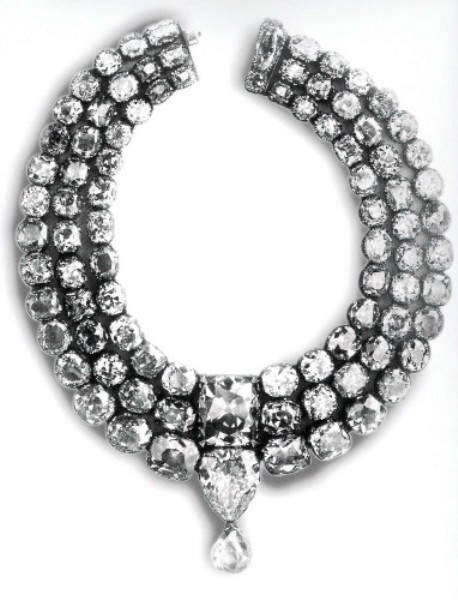
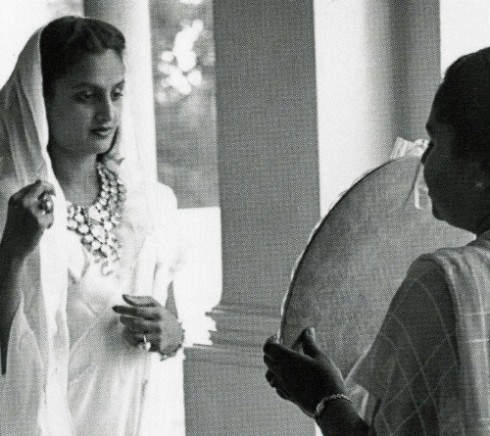
The "Star of the South"diamond remained with the Gaekwar family probably until the end of the 20th century. The "Star of the South "diamond was mounted on a special necklace together with the 78.5-carat English Dresden in 1880. Later the necklace was slightly modified by adding more diamonds and in 1948 , the Maharani of Baroda Sita Devi was photographed wearing the modified version, at her husband's birthday party. The last recorded presence of the diamond in India was in 2002, when Cartier bought it from Rustomjee Jamsetjee of Mumbai.
Last transaction and present owners of the diamond
The last known transaction of the diamond was in the year 2002, when Cartier purchased the stone from Rustomjee Jamsetjee of Mumbai. It is not known whether the diamond is still with Cartier or whether it has been disposed of subsequently.
Chemistry of the diamond
The "Star of the South"diamond is a pinkish-brown diamond. Pink and brown are two colors that can show up in colorless diamonds (type 11a diamonds), as a result of plastic deformation of the crystal caused by twisting and bending of the tetrahedral crystal units, as the diamond rose to the surface of the earth after it's formation in the earth's mantle, at least 200 Km below the surface of the earth. The whole process from the formation of the crystals until they reach the surface of the earth took about 3 billion years.
Plastically deformed areas of the crystal absorb light in different regions of the visible spectrum imparting colors such as pink, red, purple, orange, and brown.
Therefore, the "Star of the South"diamond is a plastically deformed type 11a diamond.
Back to Famous Diamonds,Gemstones and Pearls
 Home
Security & Guarantee
How it Works
Technology Partners
Updated Tables
Famous Diamonds
More Famous Diamonds
Famous Pearls
Famous Gemstones
Contact Dr Shihaan Larif
Contact Senior Editor
Famous Jewelry
Reference Database
Forums
Learning Center
Gemstone Gallery
e-mail Notifications
Advertise
Press Release
About Us
Privacy Policy
Contact Us
FAQ'S
Site Map
Staff Mail Login
Staff Documents
Birthstones
History
Minerals
Shows
Live Metal Prices
Jewellery Gallery
News
Marketplace
Marketplace Support
Open Store
Online Auctions
Join Us & Contribute
Directory
Classifieds
List your products
Wholesale Trading
Post Buy Request
Go Green Policy
Site Updates
Upcoming-ToDo List
Latest News
Latest Articles
Latest Blog Updates
Chat Rooms
Job Board
User Gallery
Videos
New Newsletter Archive
Old Newsletter Archive
Jewelry & Mineral Blog
User Blogs & Social Network
Search
Answers (Q & A)
Valuation
Help me find a diamond/jewelry
pin.internetstones.com- Social Pinboard- Sart yours & connect with millions
Invite Friends From Yahoo, Gmail etc-One Click
Home
Security & Guarantee
How it Works
Technology Partners
Updated Tables
Famous Diamonds
More Famous Diamonds
Famous Pearls
Famous Gemstones
Contact Dr Shihaan Larif
Contact Senior Editor
Famous Jewelry
Reference Database
Forums
Learning Center
Gemstone Gallery
e-mail Notifications
Advertise
Press Release
About Us
Privacy Policy
Contact Us
FAQ'S
Site Map
Staff Mail Login
Staff Documents
Birthstones
History
Minerals
Shows
Live Metal Prices
Jewellery Gallery
News
Marketplace
Marketplace Support
Open Store
Online Auctions
Join Us & Contribute
Directory
Classifieds
List your products
Wholesale Trading
Post Buy Request
Go Green Policy
Site Updates
Upcoming-ToDo List
Latest News
Latest Articles
Latest Blog Updates
Chat Rooms
Job Board
User Gallery
Videos
New Newsletter Archive
Old Newsletter Archive
Jewelry & Mineral Blog
User Blogs & Social Network
Search
Answers (Q & A)
Valuation
Help me find a diamond/jewelry
pin.internetstones.com- Social Pinboard- Sart yours & connect with millions
Invite Friends From Yahoo, Gmail etc-One Click




Our Global Jewelry Industry Job Network


Buy & Sell in our Marketplace

Subscribe to our Newsletter

List in our Classifieds

List in our Directory

User Uploaded Gallery

Powered by Ultra Secure
Amazon (USA) Cloud Network

Founder Internet Stones.COM
Register in our Forums

| Featured In
|
|
|
|
|
|
|
|







Blog & Education Feed
Articles Feed
 |
 |
 |

Copyright © .Internet Stones.COM. All rights reserved.