Survival Pearl
Open FREE Unlimited Store Join Our Newsletter
Origin of name
The 90.35-carat, natural, freshwater pearl, considered as the largest documented baroque pearl in a snail-like formation, is believed to have originated inside a freshwater mussel species in the Tennessee river, which was invaded by a snail parasite. The reaction of the mussel was to inactivate the parasitic snail and render it harmless, by laying down layer after layer of nacre in the form of alternating layers of conchiolin and aragonite around the snail, a natural response of the freshwater mussel for its survival. It has been estimated that the freshwater mollusk lived for 50-70 years even after invasion by the parasite, and thus the snail-like pearl formation would have grown inside the mussel for that period of time. Thus the name "survival" given to this pearl, is undoubtedly the most appropriate name that could have been given to a pearl of this caliber and rarity, which clearly reflects its genesis inside the mussel, whose "survival" was ensured by its formation.
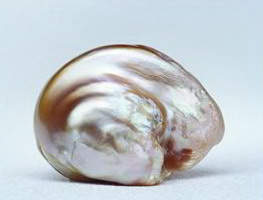
© Smithsonian Institution, photo by Chip Clark
Characteristics of the pearl
The "Survival Pearl" falls under the category of baroque pearls, having an irregular shape, but yet has a recognizable shape in the form of a snail, believed to have been formed naturally around a snail parasite that invaded the mussel, which acted as the nucleus of the developing pearl. The pearl has dimensions of 30.5 x 25.2 x 17.15 mm and a weight of 18.07 grams equivalent to 90.35 carats or 361.40 grains. The color of the pearl is a beautiful lavender-pink, a color most sought-after in pearls, and whose occurrence is less than 5% of all natural freshwater pearls. The extraordinary combination of size, unusual baroque shape, and rare lavender-pink color, makes the "Survival Pearl" one of the rarest and most famous pearls in the world.
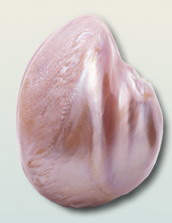
© Smithsonian Institution, photo by Chip Clark
History of the pearl
North America, the natural home of the world's richest and most diverse assemblage of freshwater mussel species found anywhere on earth
Freshwater mussels have a worldwide distribution found in all continents except Antarctica. They live on the bottoms of freshwater rivers, streams and lakes, and around 1,000 species of freshwater mussels have been identified worldwide. Of these nearly 300 species (30%) are indigenous to North America alone, making this region the natural home of the world's richest and most diverse assemblage of freshwater mussel species, found anywhere on the earth. Out of the 300 North American freshwater mussel species, 127 species (42%) are found in one large ecosystem in the United States, the rivers and streams of the Ohio River Basin. This includes rivers and streams in 13 States, Virginia, Tennessee, West Virginia, Pennsylvania, Ohio, Indiana, Illinois, New York, North Carolina, Georgia, Mississippi, Kentucky and Alabama. The Ohio River Basin is the world's single largest ecosystem that supports the largest number of species of freshwater mussels.
Mussels are found in unpolluted waters, either standing or flowing, that are rich in oxygen, calcium and suspended food particles such as algae, bacteria and other organic matter. They are commonly found in large river systems like the Tennessee, Ohio, and Mississippi, but also occur in smaller rivers and streams with suitable water quality, bottom substrate and food particles. Most species of mussels tend to inhabit rivers and streams, where the continuously flowing currents of water, supply abundant oxygen and food particles, conducive to their growth and reproduction. However, certain species of mussels have also adapted themselves to living in standing bodies of water, such as ponds, lakes and reservoirs.
Use of freshwater mussel shells and pearls by ancient Indians
Archaeological evidence in the form of enormous shell deposits abound at sites along the Tennessee River, Illinois river, Mississippi River and other bodies of water in the Eastern, Southern and Central United States, that point to the extensive harvesting of freshwater mussels by native Indians in the past, some dating back to several millennia. Freshwater mussels were primarily harvested by the native Indians as a source of food, particularly during the winter months when other sources of food was scarce. The discarded mussel shells were carved and shaped into useful tools and utensils such as spoons, scrapers and hoes. The colorful and iridescent mother-of-pearl, the interior of the shells, was transformed into pieces of ornamental jewelry. Another important use of the shells was in the pottery manufacture. Crushed shells were mixed with the clay used in pottery, as tempering, to strengthen the clay when fired. Certain native Indian tribes also used mussel shells as currency for trading purposes. The occasional freshwater pearls found inside the mussels were also used for ornamental purposes.
The discovery of the first freshwater pearl in 1857, triggers a "pearl mania" in New Jersey
The first freshwater pearl discovered in the United States since the time of the ancient Indians, was the 93-grain pink pearl discovered by a carpenter named Jacob Quackenbush, in 1857, in the streams of Notch Brook, near Paterson City, New Jersey, that came to be known as the Paterson Pearl, which was purchased by Charles L. Tiffany of Tiffany & Co. New York City, for $1,500, and subsequently sold in Paris to a French gem dealer for $2,500, who in turn sold it to Empress Eugenie de Montijo, the Queen consort of Emperor Napoleon III, and thus came to be known as the "Queen Pearl." The discovery of the "Paterson Pearl" in 1857, triggered a "pearl mania" in Paterson City, in which hundreds joined in the search, farmers, mechanics, residents of neighboring villages and towns, and even students, who scoured the shallow streams of Notch Brook, bringing out mussels that were pried open eagerly with the expectation of finding a valuable pearl. It was reported that in the year 1857, the New York City market, received about $15,000 worth of pearls from the waters of Notch Brook. As the "pearl fever" spread all freshwater bodies in the counties of New Jersey were searched, and some high quality pearls were recovered from other brooks such as Rock Road Brook, the Godwinville Brook, and Cherry Lane Brook. However, within a short period of time, the freshwater mussel populations were almost decimated, due to overexploitation.
Exploitation of freshwater mussel resources to supply the button manufacturing industry
The "pearl mania" that originated in New Jersey spread to other neighboring states, and bodies of freshwater such as lakes, rivers and streams were searched for freshwater mussels that could possibly contain a pearl. Pearls were discovered in New York, Ohio, Texas, Arkansas, Wisconsin, Mississippi, Kentucky, Illinois, Tennessee and other states. However, the seemingly endless supply of freshwater mussel shells, from the rivers and lakes of southern, eastern and central United States, attracted the attention in 1887, of a German pearl-button maker named J. F. Boepple, who had immigrated to the United States. He set up the first pearl-button manufacturing factory in the United States, that made use of the freshwater mussel shells. In the year 1912, around 200 button manufacturing plants had been set up in the United States, that made use of the valves of fresh water mussels as raw material. Most of the button factories were situated along the banks of major rivers, and thousands of tons of mussels were gathered by mussel hunters, loaded onto barges, and transported to these factories. The mother-of-pearl button manufacturing industry, became a multimillion-dollar industry, that thrived until World War II when plastic buttons displaced shell buttons, that heralded the demise of the mother-of-pearl button manufacturing industry in the United States. The badly depleted freshwater mussel resources of the United States, were thus given a chance to recover.
Alternative use for the U. S. mussel shells in the Japanese cultured pearl industry
In the early 1950s Japanese research scientists found that the United States freshwater mussel shells were ideally suited for producing bead nucleus for the Japanese cultured pearl industry. This finding led to the importation of freshwater mussel shells from the United States to Japan, and the freshwater mussel fishery that remained dormant since World War II, was once again revived to supply the needs of the Japanese pearl culturists. In 1954, John Latendresse founded the Tennessee Shell Company, together with a Japanese partner. This company soon became the world's primary supplier of mussel shells, for the cultured pearl industry. During the 1990s the value of U.S. mussel shell exports to Japan stood at around $50 million annually. Freshwater pearls were actually a byproduct of this mussel shell industry.
The "Survival Pearl" is part of the collection of natural pearls belonging to John Latendresse
John Latendresse, "the father of American cultured freshwater pearls," used to buy pearls in his young days, while traveling up and down the Mississippi, from pearl harvesters and fisherman, and then selling them to brokers. This was after World War II, during which he spent 38 months in the South Pacific, as a U.S. marine. But, he found that the main activity taking place along the Mississippi river at this time, was the buying and selling of mussel shells to brokers, who exported them to Japan, where the shells were used to create pearl nuclei, that formed the core of cultured pearls. The buying and selling of mussel shells appeared to be more lucrative than the buying and selling of freshwater pearls. Thus, in 1954, John Latendresse founded the Tennessee Shell Company, together with a Japanese partner. This company soon became the world's primary supplier of mussel shells for the cultured pearl industry.
While engaging in the mussel shell business, whose by product was occasional natural freshwater pearls, he also maintained his interest in purchasing whatever natural freshwater pearls that came his way through pearl harvesters and fisherman. He founded the American Pearl Company in 1961, in Camden, Tennessee, which expanded to Nashville, Tennessee, in 1991. His company specializes in both natural and cultured pearls from the United States. In an interview given to the Aquaculture Magazine, September-October 1991 issue, he claimed that his collection of natural pearls is the largest in the world, which was collected over a long period of almost 50 years, from the rivers and lakes of America. The 90.35-carat, lavender-pink, snail-like, baroque pearl is also part of this enormous collection.
For more information on John Latendresse's pioneering work on the culturing of American freshwater pearls, please click here.
Some of the most prolific species of freshwater mussels
Freshwater shell and pearl mussels belong to the family Unionidae, under the Phylum Mollusca and Class Bivalvia. Out of about 130 different species of freshwater mussels found in the Ohio River basin, about 20 species are commercially harvested. Some of the most prolific species among them include the ebony shell (Fusconaia ebena), washboard (Megalonaias nervosa), heel splitter (Potamilus alatus), pimple back (Quadrula pustulosa), elephant ear (Elliptio crassidens), maple leaf (Quadrula quadrula), three-ridge pig toe (Amblema plicata), pistol grip (Tritogonia verrucosa), and butterfly (Ellipsaroa lineolata). Peak commercial fishing of freshwater mussels takes place from April to September, and is carried out mainly by independent divers operating in the rivers, streams and lakes of Eastern, Southern and Central United States.
Freshwater mussel fisheries from the late 19th to the 20th centuries
The freshwater mussel fishery supported a large shell button industry from 1887 until World War II, when plastic buttons displaced the shell buttons. The fishery then almost ceased, until the early 1950s, when the U.S. freshwater mussel shells were found to be ideally suited as bead nucleus for the Japanese pearl culture industry. This led to the revival of the mussel fishery and during the 1990s U.S. mussel shell exports to Japan stood at $50 million annually. From 1887 to the 1990s while the freshwater mussel shells supported the shell button industry, followed by the bead nucleus industry, a main by product of these industries was the natural freshwater pearls occasionally discovered from the mussels. Due to the pioneering work carried out by John Latendresse from 1963 to 1983, a successful freshwater cultured pearl industry has been set up in several states of the U.S. such as Tennessee, Louisiana, Texas and California.
Structure of freshwater mussels
External structure and characteristics of the shell
Freshwater mussels are also bivalve mollusks like saltwater oysters and clams, and have a similar structure and appearance. The soft body of the mussel is protected by the two shells that enclose it, and are connected by a ligament. The shell provides some protection to the mussels from predators such as muskrats, raccoons, fish and herons. Characteristics of the shell such as size, shape, color and markings are used to differentiate between various species of mussels. The color of the shells vary from yellow or green to brown or black. The shell surfaces may also contain features such as ridges, rays, bumps and other textures. Growth rings appearing on the surface of the shell can be used to determine the age of the mollusk. It is the number of growth rings that appeared on the shell of the mollusk that harbored the "survival pearl" that gave an indication about its age, which was about 50-70 years.
Colors of the nacre and variety of colors and shapes of any pearls produced
The inner surface of the shell is lined by the pearly nacre, that varies in color from pure white to shades of pink, salmon, gray and purple. The occasional pearl that develops inside the mussels may thus assume any one of these colors. White is the most common color, but the most desirable colors are pinks, roses, lavenders and purples. Other colors in which freshwater pearls may occur are cream, yellow, green, blue, brown, and red. The shape of natural freshwater pearls are more often baroque, slugs or wings. A perfectly round or near round pearl is an extreme rarity.
Internal structure, feeding, locomotion, and growth
The soft body of freshwater mussels like other mollusks, consists of gills for breathing, a digestive tract for digesting food, a large muscular foot for locomotion, and a mantle tissue that secretes the shell.
Mussels are filter feeders that feed on microscopic particles such as algae, bacteria and other organic particles, suspended in the water, that enters through the incurrent siphon. As the water passes over the mucous-covered gills, the tiny food particles are trapped, and transferred to the mouth. Unpalatable items and waste matter are flushed out through an excurrent siphon. Thus mussels have the ability to improve water quality of freshwater lakes and streams, by filtering out suspended particles, including impurities.
Mussels are found in flowing or standing waters rich in oxygen, calcium, and suspended food particles. They lead a passive life, lying burrowed in the sand and gravel substrates of streams and lakes, with only a small part of their shells and siphons exposed. They remain sedentary and move only short distances during their life time if necessary. They move slowly by extending and contracting their large muscular foot. Disturbances caused by flooding, drought, poor water quality and predators, may induce the muscles to move to safer places. Their slow movement leaves footprints or tracks, that appear as furrows on the soft mud and sand, along the margins of shallow streams or lake bottoms.
With abundant supplies of oxygen, calcium and suspended food particles in the water, young mussels grow rapidly, and their shell increases in length and thickness. In older mussels growth slows down. As the mussel grows annual growth rings are laid down on the shell, like growth rings on tree trunks. The age of the mussel can be estimated by counting the growth rings under a microscope. Mussels tend to live long, as long as humans, with an average age of 60 years or more. Large species of mussels such as "washboard mussel" can grow up to a length of 12 inches (30 cm), and weigh as much as 4 pounds ( 1.8 kg).
Reproduction and life cycle of freshwater mussels
In freshwater mussels the sexes are separate. The mature male mussel releases sperms into the surrounding water. The sperms enter the female mussel with the incurrent siphon, and fertilize the eggs. The larvae develop within the female, and may be retained inside the female from 1 to 10 months. The larvae known as glochidia are released from the female in spring and early summer, between April and July. The glochidia drift in the water seeking for a suitable fish host. If they find a suitable host their survival is ensured, if not they die off. Freshwater mussels require a fish host to complete their life cycle, unlike saltwater oysters and clams. Some mussels may depend on a single fish species, whereas others can parasitize many different species. The glochidia are dependent on the fish for their nutrition during this short period of their life cycle. The glochidia attach to the gills or fins of the host fish, and remain so for 1 to 4 weeks, while they transform into juvenile mussels. The free-living juvenile mussels drop off the fish, and begin their free-living life style, and later develop into an adult mussels.
Ecological importance of freshwater mussels
Source of food for humans and valuable wildlife
Fresh water mussels had been an important source of food for humans in ancient times, particularly during the winter months when other sources of food were very scarce. However, today mussel meat is not recommended for human or animal consumption, because they accumulate and store toxic metals and other water pollutants in their tissues. In unpolluted water bodies where mussels do exist, they are an important link in the food chain, being a source of food for valuable wildlife such as muskrats, otters and raccoons. Besides this young mussels are eaten by ducks, herons and sport fish.
Ability to improve water quality by filtering
Mussel are filter feeders and have the ability to filter large quantities of water. Large mussels can filter several gallons of water in a day. They improve water quality by straining out suspended particles and pollutants. Thus mussels are considered as natural water purifiers in rivers and lakes. They are very effective in removing algae and suspended organic particles, in organically enriched waters around waste water facilities and in fish farm effluents.
Used as biological monitors of the environment
Mussels are useful biological monitors of environmental conditions, and the quality of water in rivers and lakes. A sudden death of freshwater mussels in flowing or standing waters, is a reliable indicator of toxic contamination. The drastic decrease of freshwater mussel populations in rivers and lakes, is a clear indication of chronic water pollution. Environmental scientists can determine the type and extent of water pollution in rivers and lakes by analyzing mussel tissue to determine the type and quantity of pollutants.
Possible bio-medical uses of freshwater mussels
Research work is being carried out on the possible bio-medical uses of freshwater mussels. Evidences seem to suggest that some mussels may be resistant to certain types of cancer. Thus the extraction of cancer-curing drugs from mollusks might be feasible in the future.
Reasons for the rapid decline in the numbers and diversity of mussels in North America
There had been a rapid decline in the numbers and diversity of mussels in the rivers, streams and lakes in the Eastern, Southern and Central United States. Over harvesting by commercial shellers to meet the increase in demand for U.S. freshwater mussel shells by the cultured pearl industry overseas, had been given as a major contributory factor for this rapid decline, coupled with the spread of mussel diseases. However, ecological studies conducted to determine the major contributory factors for this rapid decline have indicated, that, while over harvesting and disease might have contributed marginally towards this alarming situation, other human activities that had a direct bearing on the degradation of the mussel habitat, and disruption of the life cycle of mussels were directly responsible.
Human activities that lead to the degradation of the mussel habitats
Some of the human activities that can lead to the degradation of mussel habitats can be listed as follows :-
1) Construction of dams and impoundments
2) Dredging and channelization
3) Sedimentation
1) Most mussel species inhabit free-flowing streams and rivers, that are usually rich in oxygen, calcium and suspended food particles. The construction of dams and impoundments across streams and rivers, created artificial lakes and reservoirs, with increased depths, reduced water currents and temperatures, and modified algal and fish communities, all of which were not conducive, to mussel populations living in free-flowing waters rich in oxygen. Dam construction can also eliminate fish hosts that are needed by the mussels to complete their life cycle.
2) Dredging of rivers and streams for gravel and sand or channeling to straighten streams, lead to the direct destruction of mussel populations as they are crushed or removed from the streams and rivers. Such activities permanently destroys the stream-bottom habitat of the mussels.
3) Sedimentation caused by the erosion of top soil from agricultural lands, construction projects, and areas where mining operations and logging had been taking place, can lead to the destruction of mussel habitats in rivers and lakes.
Factors that can destroy mussel populations directly or disrupt their life cycle
Factors that can destroy mussel populations directly or disrupt their life cycle can be listed as follows :-
1) Water pollution
2) Destruction of host fish
3) Introduction of non-native species from Europe and Asia
1) The contamination of rivers and lakes with toxic chemicals from industrial effluents, and agricultural chemicals, can be detrimental to adult and young mussels and their host fish. Such chemicals can kill young mussels immediately, but adult mussels have the ability to close their shells (clam up) for a short time to avoid poisonous chemicals that flow downstream. However multiple spills can kill the entire population. Water pollution not only kills mussels directly, but also can kill the fish hosts on which the mussels depend to complete their life cycle.
2) Mussels depend on the presence of the right species of host fish to complete their life cycle. The larvae known as Gloichidia that are released by the female mussels, cannot survive, if they do not cling on to the gills or fins of a suitable fish host, on which they are parasitic for about 1 to 4 weeks, while they transform into juvenile mussels. Thus the presence of the right species of host fish is crucial for the successful completion of the life cycle of mussels. Because of this close interdependence between mussel and fish, any threat to the survival of the host fish can also jeopardize the survival of the mussels. Dams that block the migration of fish and water pollution are some factors that can threaten the survival of host fish species, and therefore threaten the long term survival of mussel populations.
3) The accidental introduction of two species of freshwater mussels from Europe (Dreissena polymorpha) and Asia (Corbicula fluminea), into the waters of the United States, have posed a serious threat to the continued survival of the native freshwater mussels. The small shellfish species known as the "Zebra mussel" (Dreissena polymorpha) introduced accidentally from Europe, have spread rapidly throughout the United States. These mussels are not only voracious feeders but also reproduce fast. Thus the native mussels have to compete with these invaders for food and space. Besides this, the zebra mussels also attach themselves to the shells of the native freshwater mussels in large numbers, that they interfere with the nutrition and respiration of the native mussels. Thus the continued survival of native freshwater mussels is dependent on controlling the spread of zebra mussels, and stopping the invasion of other exotic mussel species.
Related :-
1) Queen Pearl - Paterson Pearl
4) Hope Pearl
7) Drexel Pearl
External Links :-
1) Sustaining America's Aquatic Biodiversity, Freshwater Mussel Biodiversity and Conservation - Louis A. Helfrich, Richard J. Neves and Hilary Chapman - Virginia Tech, publication number 420-523
2) Pearls - Unites States Geological Survey -www.usgs.gov
References
1.GIA Events & Trade Shows - The Allure of Pearls Exhibition at the Smithsonian's NMNH, Washington D.C.
2.Pearls - USGS - www.usgs.gov
3.Sustaining America's Aquatic Biodiversity, Freshwater Mussel Biodiversity and Conservation - Louis A. Helfrich, Richard J. Neves and Hilary Chapman - Virginia Tech, publication number 420-523
4.Mussel Bound in Minnesota - July-August 2000 - by Dan Kelner, Minnesota Department of Natural Resources.
5.Mussels of Illinois - Human Uses of Freshwater Mussels - Robert E. Warren
6.Tennessee Freshwater Mussels - Treasures Past and Present, The University of Tennessee, Frank H. McClung Museum
7.Mineral Sciences Exhibitions - Department of Mineral Sciences, www.mnh.si.edu

 Home
Security & Guarantee
How it Works
Technology Partners
Updated Tables
Famous Diamonds
More Famous Diamonds
Famous Pearls
Famous Gemstones
Contact Dr Shihaan Larif
Contact Senior Editor
Famous Jewelry
Reference Database
Forums
Learning Center
Gemstone Gallery
e-mail Notifications
Advertise
Press Release
About Us
Privacy Policy
Contact Us
FAQ'S
Site Map
Staff Mail Login
Staff Documents
Birthstones
History
Minerals
Shows
Live Metal Prices
Jewellery Gallery
News
Marketplace
Marketplace Support
Open Store
Online Auctions
Join Us & Contribute
Directory
Classifieds
List your products
Wholesale Trading
Post Buy Request
Go Green Policy
Site Updates
Upcoming-ToDo List
Latest News
Latest Articles
Latest Blog Updates
Chat Rooms
Job Board
User Gallery
Videos
New Newsletter Archive
Old Newsletter Archive
Jewelry & Mineral Blog
User Blogs & Social Network
Search
Answers (Q & A)
Valuation
Help me find a diamond/jewelry
pin.internetstones.com- Social Pinboard- Sart yours & connect with millions
Invite Friends From Yahoo, Gmail etc-One Click
Home
Security & Guarantee
How it Works
Technology Partners
Updated Tables
Famous Diamonds
More Famous Diamonds
Famous Pearls
Famous Gemstones
Contact Dr Shihaan Larif
Contact Senior Editor
Famous Jewelry
Reference Database
Forums
Learning Center
Gemstone Gallery
e-mail Notifications
Advertise
Press Release
About Us
Privacy Policy
Contact Us
FAQ'S
Site Map
Staff Mail Login
Staff Documents
Birthstones
History
Minerals
Shows
Live Metal Prices
Jewellery Gallery
News
Marketplace
Marketplace Support
Open Store
Online Auctions
Join Us & Contribute
Directory
Classifieds
List your products
Wholesale Trading
Post Buy Request
Go Green Policy
Site Updates
Upcoming-ToDo List
Latest News
Latest Articles
Latest Blog Updates
Chat Rooms
Job Board
User Gallery
Videos
New Newsletter Archive
Old Newsletter Archive
Jewelry & Mineral Blog
User Blogs & Social Network
Search
Answers (Q & A)
Valuation
Help me find a diamond/jewelry
pin.internetstones.com- Social Pinboard- Sart yours & connect with millions
Invite Friends From Yahoo, Gmail etc-One Click




Our Global Jewelry Industry Job Network


Buy & Sell in our Marketplace

Subscribe to our Newsletter

List in our Classifieds

List in our Directory

User Uploaded Gallery

Powered by Ultra Secure
Amazon (USA) Cloud Network

Founder Internet Stones.COM
Register in our Forums

| Featured In
|
|
|
|
|
|
|
|







Blog & Education Feed
Articles Feed
 |
 |
 |

Copyright © .Internet Stones.COM. All rights reserved.