Sutherland Pearl Diamond and Ruby Zigzag Necklace Incorporating Marie Antoinette's Pearls
Open FREE Unlimited Store Join Our Newsletter
Origin of Name :-
The name refers to an historic zigzag, pearl, diamonds and ruby necklace designed in 1849 for the Sutherland family, incorporating a collection of fabulous pearls that once belonged to Queen Marie Antoinette of France (1755-1793), which was given by the unfortunate queen for safe keeping, to her friend Lady Sutherland, wife of the British Ambassador for France, at the time of the French Revolution. The necklace that remained in the Sutherland family for over 200 years, mostly in the safe and secure environment of a bank vault, and had never been offered at an auction before, came up for sale in London, on December 12, 2007 at a Christie's Magnificent Jewelry Sale. A pre-sale estimate of £350,000 to £400,000 ($716,000 to $818,000) was placed on this unique necklace of ancient historical provenance, but was withdrawn from the sale after it failed to realize the minimum price set by the seller. Surprisingly nine years earlier in 1999, a single-strand pearl necklace consisting of 44 graduated pearls and believed to have belonged to Queen Marie Antoinette, and later Woolworth heiress Barbara Hutton, was sold for a record $1.47 million, at a Christie's sale in Geneva, the highest price ever paid for a natural pearl necklace at an auction.

Characteristics of the Pearl Necklace
Features of the ruby-collar
The necklace has a characteristic zigzag design, consisting of a ruby-set collar, and a diamond-set ribbon that intertwines the ruby-collar, and imparts the characteristic zigzag shape to the necklace. The collar is set with 12 button-shaped grey natural pearls, mounted in gold. The interval between two button-shaped pearls on the collar are mounted with seven old-cushion cut rubies. There are 11 such intervals between the 12 button-shaped pearls. Thus altogether there are 77 rubies on the collar.
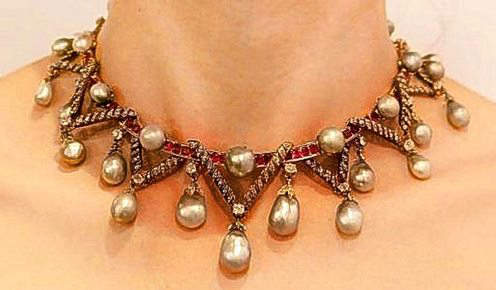
Sutherland Pearl Diamond and Ruby Zigzag Necklace incorporating Marie Antoinette's Pearls
©Christie's
Features of the diamond-set zigzag ribbon
The diamond-set zigzag ribbon that intertwines the ruby-collar, is also made of gold and is set with old European-cut diamonds. There are approximately 16 diamonds on each V-shaped portion of the zigzag necklace. There are 10 such V-shaped portions on the necklace making a total of approximately 160 diamonds. Each V-shaped trough corresponds with a button-shaped pearl on the ruby-collar. Except for the two button-shaped pearls at the extreme ends of the necklace, each of the other 10 button-shaped pearls corresponds with a V-shaped trough.
Arrangement of the 21 drop-shaped grey natural pearls on the necklace
On this zigzag design there are 21 corners or bends - 10 troughs, 9 crests, and the 2 ends of the zigzag design. At each of these 21 corners or bends, a drop-shaped grey natural pearl is suspended, by an old-cut diamond collet surmount, attached to the diamond-set intertwining ribbon. Thus, there are 21 drop-shaped grey natural pearls on the necklace. Not all the drop-shaped pearls are perfect drop-shaped. Some of the pearls, particularly around the middle of the necklace, are larger than the other pearls and pear-shaped, while others are more oval shaped. Thus, altogether there are 33 pearls (12 + 21) on this zigzag necklace.
The Characteristics of the pearls on the necklace
The color, overtone, orient and luster of the pearls
The pearls that belong to the latter half of the 18th century (approximately 1780) appear to be from the same source, having the same tone of color, silver-gray and a luster and orient characteristic of saltwater nacreous pearls. The gray color of the pearls is caused by melanin pigments associated with the protein part of nacre, conchiolin, while the non-protein part, aragonite remains colorless. Silver is an overtone color produced by refraction, as light passes through successive layers of aragonite and conchiolin. Orient or iridescence is also caused in this manner. The brilliance or luster of the pearl is caused by reflection of light from the surface and just below the surface of the pearl. Color, overtone, orient and luster of the pearl are all properties that depend on the thickness of the nacre, and in this case, they are optimum, as the pearls are all natural, and composed entirely of nacre. This explains why these optical properties and color are still maintained in these natural pearls, despite the fact that the pearls are nearly 230 years old. It is doubtful, whether such optical properties can be maintained in modern cultured pearls too, for several centuries, in which the nacre is less than 1 mm thick, and sometimes as low as 0.4 mm.
The shape, size and surface-quality of the pearls
The shape of the 12 pearls on the ruby-collar are described as button-shaped. These pearls appear to be spherical on the exposed side, but slightly flattened on the mounted lower side. The remaining 21 pearls suspended from the diamond-set zigzag ribbon are drop-shaped pearls, but they are of different drop-shapes. Some of the larger drop-shaped pearls in the center are pear-shaped drop pearls. Some are of course perfect drop-shapes, but there are also oval-shaped drops and slightly baroque-shaped drops.
The size of the pearls, both in terms of dimensions and weight are not given, but the pearls appear to be average sized. Giving approximate average dimensions and weights for the pearls just by examining photographs would be an exercise in conjecture and therefore not attempted.
The surface quality of the pearls appear to be quite good, however it is important to remember that among pearls, whether natural or cultured, you cannot have a pearl which is 100% blemish-free. Such a category of pearl does not exist in nature. Even if a pearl appears to be blemish-free to the naked eyes, some blemishes would appear under a magnifying glass or a microscope.
History of the Pearl Necklace
The species of pearl oyster from which the grey pearls would have originated
The species of saltwater oyster from which grey and black pearls, usually originate is Pinctada margaritifera, commonly known as black-lipped pearl oyster, whose geographic range extend from the Persian Gulf, through the Indian Ocean and the South Sea to the Pacific Ocean, up to the Gulf of California, in Mexico. In the Pacific Ocean, the northern limit of its range is around the islands of Japan, and the southern limit around the French Polynesian Islands in the southern Pacific, where the species reaches its greatest abundance. The species is conspicuously absent in the Atlantic Ocean. Another species of pearl oyster from which black and grey pearls could originate is the La Paz pearl oyster, Pinctada mazatlantica, a species closely related to Pinctada margaritifera and possibly evolved from it, also found in the Gulf of California and the Rainbow-lipped pearl oyster, Pteria sterna, found in the eastern Pacific, between Baja California and Peru.
Was Baja California the possible source of these grey pearls?
The pearls belong to the latter half of the 18th-century to the period around the year 1780. Using this information we can find out the possible sources of these pearls, by studying the history of the source of natural black pearls throughout the ages. The Persian Gulf was the most ancient source of black pearls, where Pinctada margaritifera existed together with Pinctada radiata, even though the latter was the most predominant species and the main source of white pearls in the world. Later from the 16th-century to the early 19th-century, the main source of black pearls in the world was Baja California, after the Spanish conquistadors discovered black pearls in the Gulf of California or "Sea of Cortez"in Mexico. During this period most of the black pearls that entered the European pearl markets originated in Baja California. Beginning from the early 19th-century, there were two main sources of black pearls in the world. While Baja California, continued to produce black pearls for the world's pearl markets, the French Polynesian Islands in the southern Pacific, also became an alternative source of natural black pearls, that came to be known as the black Tahitian pearls. The black Tahitian natural pearls were actually a by-product of the exploitation of the shells of the black-lipped pearl oyster, to feed the international shell-button industry. However, due to over exploitation the oyster resources in French Polynesia were depleted by the end of the 19th-century, and the industry was abandoned. Baja California, continued to produce black pearls, until the early 20th-century, when the dual factors of overexploitation and the introduction of cultured pearls by Mikimoto, in the 1920s and 1930s, dealt a final death blow to the natural pearl industry around the world, including that of Baja California.
Thus, during the latter-half of 18th-century, the only source of black pearls in the world, was Baja California, in Mexico. Hence, the most probable source of the Marie Antoinette pearls incorporated in the Sutherland Necklace, is Baja California, in Mexico.
Marie Antoinette - A short biography
Her birth and early life
Marie Antoinette, who was born on November 2, 1755, at the Hofburg Palace in Vienna, Austria, was the youngest daughter, and the 15th out of 16 children, born to Empress Maria Theresa, Queen of Hungary and Bohemia and ruler of the Habsburg dominions, and the Holy Roman Emperor Francis I. She and her elder sister Maria Carolina, the two youngest girls in the family, grew up together in the Schönbrunn Palace, under the care of the same governess, and became very close to each other. The environment in which she grew up, the Austrian court, was considered to be one of the most progressive courts in Europe at that time, that introduced several innovations, and basic changes in court life.
Empress Maria Theresa's dream of forging closer ties with her allies in the seven years war by giving her daughters in marriage to members of the royalty of these nations
Following the end of the seven years war, that lasted from 1756 to 1763, a major military conflict that involved all the major European powers, that pitted an alliance of Austria, France, Russia, Sweden, Spain and Saxony against Great Britain, Prussia, Portugal and a coalition of smaller German states, a peace treaty was signed in Paris in 1763. Empress Maria Theresa who had entered into several complex alliances during the war with other duchies and kingdoms such as Parma, Naples, Russia, France etc. planned to cement these alliances by giving her daughters in marriage to the ruling families of these kingdoms. However, during a small pox outbreak in Austria in 1767, that also hit the royal family, two of her daughters, and a son died. Empress Maria Theresa and another daughter Maria Elisabeth, contracted the disease but survived. Marie Antoinette was immune to the disease and survived. Empress Maria Theresa's dream of forging closer ties with France, Austria's traditional enemy was finally realized, when the two governments agreed to the marriage of Marie Antoinette to the Dauphin Louis-Auguste, the son of King Louis XV and heir to the French throne. Historians believe that such a marriage would never have materialized, if not for the brief period of unity achieved between the traditional enemies, at the time of the seven years war. Little did Empress Maria Theresa realize, that by giving her daughter in marriage to a monarch of a nation, whose subjects had for generations hated the Austrian nation and its people, she was jeopardizing her beloved daughter's entire future, that would eventually lead to her death by execution at the guillotine, on mostly concocted charges without any foundation.
Marie Antoinette's marriage to Dauphin Louis-Auguste was initially popular among the people but unpopular with the elder members of the French court right from the beginning
The marriage of Marie Antoinette to Dauphin Louis-Auguste took place on May 16, 1770, at the Palace of Versailles. She was 14 years old at the time of her marriage and the Dauphin Louis-Auguste was 16. Marie Antoinette was referred to as the Dauphine of France after her marriage to Louis-Auguste. As was the custom those days consummation of the marriage normally took place on the wedding night, but this did not take place in this case. Perhaps, the couple were too young to involve themselves in serious sex life. Whatever, might have been the reason for this, no consummation of marriage took place until seven years after the marriage. The people of France initially welcomed the marriage, and Marie Antoinette was given a rousing reception by over 50,000 people, when she first appeared in Paris at the Tuileries in June 1773. The people were proud of their future queen, with a charming personality, tall and beautiful, with blonde hair, fair skin and deep blue eyes. However, right from the beginning, the marriage was unpopular among members of the French court, especially among the older ladies, due to the longstanding tensions between the France and Austria. They began calling her names behind her back, such as "l'Autrichienne - the Austrian woman."Marie Antoinette established very friendly relations with her in-laws, the brothers and sisters of her husband, and perhaps under the influence of her sisters-in-law, refused to acknowledge King Louis XV's favorite and mistress Madame du Barry. However, eventually she made up with Madame du Barry, under pressure from her mother, and the Austrian minister, Mercy Argenteau. an action that pleased King Louis XV. Marie Antoinette also established close relationships with several ladies in her retinue, such as Countess Yolande Gabrielle de Polignac, whom she subsequently appoints as the Governess of the royal children, Princess Marie Therese de Lamballe, whom she later appoints as the Superintendent of her household.
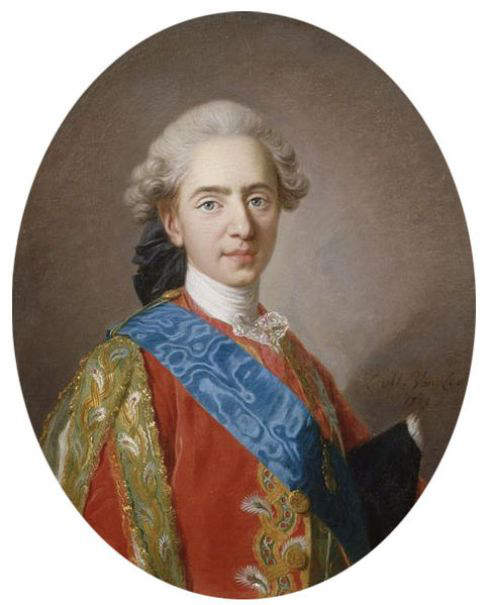
Louis Auguste- Dauphin of France. Portrait by Louis-Michel Van Loo (1769).
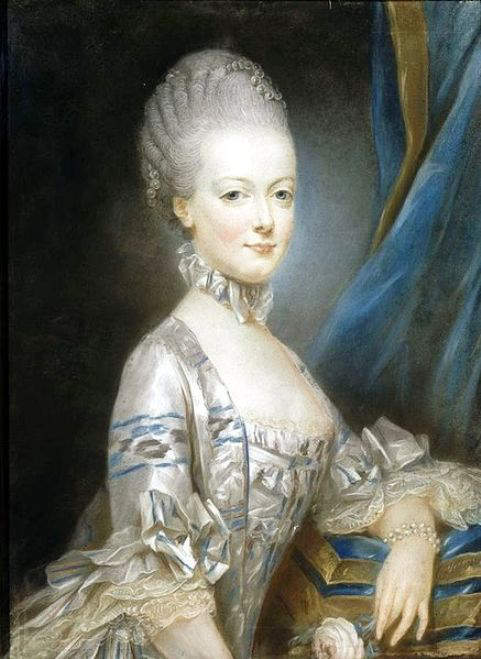
Marie Antoinette at the age of 13 years- Portrait by Joseph Ducreux
Louis-Auguste ascends the throne as King Louis XVI and Marie Antoinette becomes the new Queen of France
On April 27, 1774, King Louis XV contracted small pox, and two weeks after this, on May 10, 1774, he died of the disease at the age of 64. During the period of his illness the king was pressurized to send Madame du Barry away from Marseilles, which he did on May 4, 1774. Following the death of the king, Louis-Auguste ascended the throne as King Louis XVI of France, and was crowned on June 11, 1775, at the Cathedral of Rheims. Marie Antoinette thus became the new Queen of France, but was totally excluded from exerting any political influence by her husband and two of his important ministers, the prime minister and the foreign minister, all three of whom were anti-Austrian, and feared the potential political repercussions of allowing her, and through her the Austrian empire, to have any say in French policy.
Queen Marie Antoinette's frustrations that led her to engage in costly pastimes that alienated her from her poor subjects
It was now 5 years since her marriage, which was yet to be consummated, and the king still showed a lack of interest in her, which led to rumours of his impotence and the queen searching for sexual relief elsewhere. In order to make up for the King's lack of interest in her, she engaged in other costly pastimes such as, gambling, including horseracing, frequent visits to the city to buy new clothing, shoes and jewelry, that made Madame Bertin her miliner famous in France, and the construction of buildings to suit her own tastes. The King gifted her the "Petit Trianon", which she set about modifying with the King's approval to suit her own tastes. She also transformed its garden from an arboretum to a horticultural paradise. Little did the queen realize that her engagement in costly pastimes would be used by her enemies and critics to alienate her from her subjects and portray her as an extravagant spender, who would care less for her poorer subjects, and being a daughter of one of France's traditional enemies, was all out to destroy the country. Her critics even circulated rumours that she plastered the walls of the "Petit Trianon"with gold and diamonds.
Emperor Joseph's intervention that helped to consummate the marriage, and paved the way for the king and queen to lead a normal sex life, blessed with children
Finally, to put an end to the queen's frustrations generated by the king's behaviour towards her, Emperor Joseph of Austria, the queen's brother was forced to intervene, and paid a personal visit to France on April 18, 1777, in order to sort out any differences between them and to facilitate in the consummation of the marriage. Emperor Joseph's intervention was helpful, and finally the marriage was consummated in August 1777, seven years after it was contracted. Since then the king and queen led a normal sex life, and soon she became pregnant, and her first child, a daughter Marie-Therese Charlote, was born on December 19, 1778. After the birth of the first child, the king's affection towards Maire Antoinette increased, which was reflected in the queen being given an increase in role in reorganizing the court, with the king's approval, and some of the candidates sponsored by her being accepted by the king for appointment, such as the Minister of the Navy and Minister of War.
Birth of a son and successor to the throne brings relief and joy to the king and queen
Empress Maria Theresa died in Vienna, on November 29, 1780, that caused a lot of worry to Queen Marie Antoinette, fearing that the Franco-Austrian alliance would be jeopardized. Soon after this Marie Antoinette became pregnant again, and Emperor Joseph visited France for a second time, to reassure her sister that the Franco-Austrian alliance would continue. Enemies of the Queen saw this as another opportunity to taint her name, and created a rumour that the visit was aimed at Marie Antoinette's plan to siphon treasury money to her brother. The birth of Marie Antoinette's second child, a son, brought great joy and happinnes, and a sense of relief to her and the King, as France was now assured of a successor. The young prince was named Louis Joseph Xavier Francois, and was given the title Duc de Bretagne. Despite the increase in affection of the king towards her after the birth of the Dauphin, she was still excluded from any political leverage, and could not influence her husband in favour of her brother Joseph in his attempt to claim Bavaria, or to assist him in the so called "kettle war"to open up the Scheldt River for naval passage. However in other matters the king still supported his queen, as for instance, in the controversial appointment of her favorite, the Duchess de Polignac as the governess for the royal children.
Her third pregnancy ends in a miscarriage. Her other interests to keep herself busy during her spare time
Marie Antoinette was again pregnant in June 1783, but this pregnancy unfortunately ended in a miscarriage in November 1783. During the period that followed she engaged herself in the creation of a model hamlet in the Garden of the "Petit Trianon"known as the "Hameau de la reine"complete with farmhouse, dairy, mill and 12 cottages, based on another far grander "model village"built in 1774 for Prince de Conde on his estate at Chantilly. Her critics now got another opportunity to tarnish her image, by finding fault with her for her extravagance, by deliberately inflating the costs involved in the project. To keep herself busy during her spare time Marie Antoinette engaged herself in other interests and activities, such as reading historical novels, studying Rousseau's philosophy, and ancient cultures such as that of the Incas of Peru, taking an interest in science, and the study of the English Language. She even developed a friendship with the Duchess of Devonshire, and the Duke of Dorset, who was the British Ambassador to France.
The birth of a second and stronger son brings relief to the king and queen as the Dauphin was not expected to survive into adulthood
However, in spite of all these other interests, her main concern became the health of her son, the Dauphin, which was beginning to fail, as the child had been weak since the time of his birth. It was widely believed that the child would not live into adulthood, and the king and queen were attempting to have another child. Marie Antoinette was again pregnant in July 1784, and on March 27, 1785, she gave birth to her second son, Louis Charles. This child was visibly stronger than the sickly Dauphin, and appeared to solve the problem of succession, in case of the death of the Dauphin.
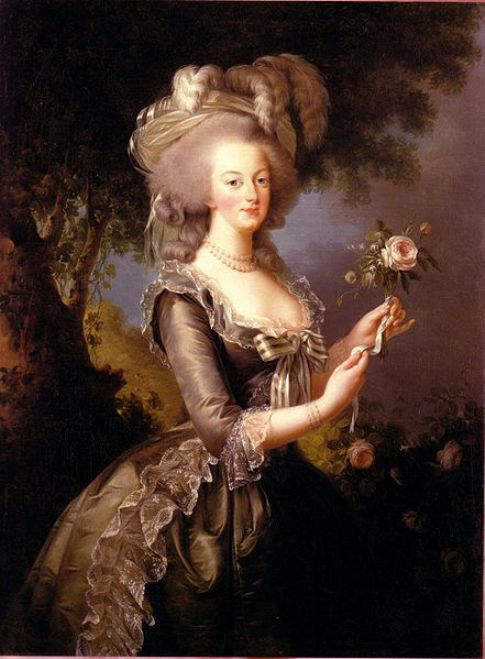
Queen Marie Antoinette of France- "Marie Antoinette la Rose"portrait by lisabeth Vig ©e-Lebrun.
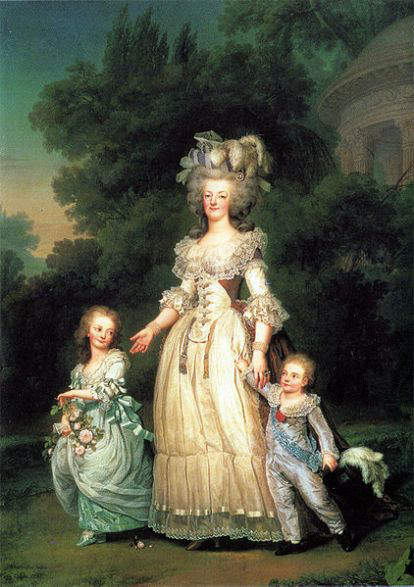
Queen Marie Antoinette of France with her children, Princess Marie Therese and Dauphin Louis Joseph (1785)
The purchase of Chateau de Saint-Cloud that further alienates public opinion against her
Marie Antoinette then purchased the Chateau de Saint-Cloud from the Duc d'Orleans, with the intention of leaving it as inheritance to her younger children. This acquisition became highly unpopular among her critics in the French nobility and the general population, not only because of the enormous costs involved in purchasing and refurbishing the chateau, but also because the people of France could not reconcile themselves to a novel situation, that raised the possibility of a French queen owning her private residence independent of the king. This transaction further aggravated her already dented reputation as a frivolous and extravagant queen. Moreover the continued publication of the "Libelles,"the political pamphlets that slanders the monarchy, that was highly critical of the royal family and particularly of the queen, portraying her as a woman of questionable character, raising doubts as to the legitimacy of her children, served to consolidate public opinion against her, as a licentious, spendthrift and empty-headed foreign queen, unfit to rule over France.
Queen Marie Antoinette's unpopularity made her a convenient scapegoat for the ills of the French nation
In 1787, the financial situation of the country deteriorated causing untold hardship and misery around the country, due to increase in prices of foodstuffs, including bread. The actual factors that contributed to this crisis, were too many expensive wars in which the country was directly involved;the maintenance of a large extended royal family, whose large frivolous expenditure far exceeded those of the immediate royal family, the king, queen and the children;the unwillingness on the part of the large aristocracy to help defray the costs of the government by paying higher taxes. Unfortunately, for Queen Marie Antoinette, her unpopularity in the country, and the fact that she came from a country that was a traditional enemy of France, made her a convenient scapegoat for all the ills of France, and the general public perceived her as single-handedly responsible for ruining the finances of the nation.
The conflict between the king and parliament that delayed attempts to reverse the financial crisis
The king made desperate attempts to reverse the trend, as the Parliament refused to co-operate with the king in introducing reforms. Ignoring the Parliament, the king with the help of the finance minister, summoned the "Assembly of Notables"after a lapse of 160 years, to push through reforms, needed to alleviate the financial situation. The Assembly of Notables met beginning from February 22, 1787, but failed to pass any reforms as requested by the king. Instead, like the Parliament, the Assembly too defied the king, demanding its own reforms and that the king should acquiesce to the Parliament. The king then dismissed the finance minister Calonne, and withdrew from all decision making processes, as he went into a bout of serious depression, caused by the heavy pressures placed on him, by the financial crisis. Queen Marie Antoinette was then forced to take the place of the king and take decisions on his behalf.
Marie Antoinette was forced to act for the king for a short period, during his period of depression, and tried her best to heal the rift between the king and the assembly
Marie Antoinette in her new role, acting for her husband, tried her best to heal the rift between the "Assembly of Notables"and the king. She dismissed the controversial Duchess de Polignac, whose role involved unnecessary expenditure for the Crown. She introduced several measures to curtail the expenditure of the royal court. On her recommendation, the king appointed the archbishop of Toulouse, Etienne Charles de Brienne as the finance minister, who introduced further cutbacks at the royal court. However, Brienne too failed to reverse the financial crisis, and the failure of the "Assembly of Notables"to take action, led to its dissolution on May 25, 1787. The inability to find a viable solution, was again blamed on Queen Marie Antoinette. In the midst of this crisis in June 1787, the queen lost her youngest child Sophie Helen Beatrice, who was just one-year old. The king who was recovering from his depression, then exiled Parliament in November 1787, and tried to force through new legislation by edict, which was opposed by his cousin the Duc d'Orleans, who too was exiled. The edicts issued on May 8, 1788, came to be known as the May Edicts, which too was opposed by the public. The king then summoned the Estates General another traditional elected legislature, which had not convened since 1614.
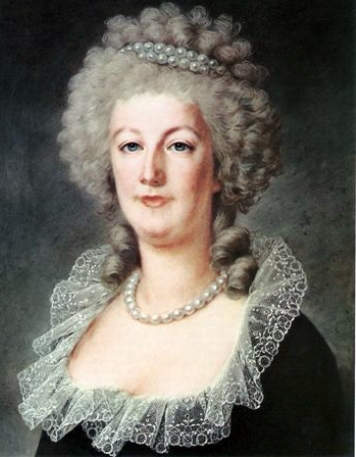
Queen Marie Antoinette of France just before the onset of the French revolution- Portrait by Alexandre Kucharsky
Death of the Dauphin that plunges the royal family into a state of mourning, but largely ignored by the French people, sending a clear signal to the royal family, as what lay in store for them in the future
During these tumultuous days, the health of the Dauphin began to deteriorate, as he was suffering from tuberculosis, and Marie Antoinette time was mostly occupied caring for her sick child. The child was moved to a chateau in the countryside, at Meudon, in the hope that the fresh country air would facilitate his recovery. However, she was still present at important state functions, as for instance during the visit of Tippu Sahib of Mysore to Versailles, seeking French help against the British. She also prevailed on the king to recall Jacques Necker as finance minister, a move that was supported by the people. But unfortunately, Jacques Nacker could not do much, as the severe winter of 1788/89, caused bread prices to rise again. Riots broke out in Paris in April 1789, and at the same time the Dauphin's condition also worsened. In the month of May 1789, the Estates General split into two factions, the democratic Third Estate, consisting of the bourgeoisie and radical nobility and the Second Estate, consisting of the royalist nobility. The Dauphin's condition now worsened, and the seven-year old boy finally passed away peacefully at Meudon on June 4, 1789, with his caring mother at his side, and driving the queen and the royal family into a state of shock and mourning. The mood of the nation was put to the test by this royal death, which under normal circumstances would have been mourned nationally, but this time was virtually ignored by the French people. The writing on the wall was now very clear. The king, queen and the rest of the royal family would have undoubtedly known what lay in store for them in the future.
The Third Estate declares itself a National Assembly. Storming of the Bastille on July 14, 1789 signals the beginning of the French revolution
The Third Estate comprising of the bourgeoisie and the radical nobility, now took the law into its own hands, and declared itself a National Assembly, setting itself on a confrontational course with the king. Attempts by the king to suppress the Third Estate resulted in failure, and the king retaliated by dismissing Jacques Necker, which led to riots in Paris and storming of the Bastille on July 14, 1789, signaling the beginning of the French revolution. The National Assembly now took control of the country, and began conscripting men to serve in the Garde Nationale. Most of the royalist nobility, including the comte d'Artois and the duchess de Polignac, fled the country, fearing assassination. But, Queen Marie Antoinette, whose life was the most in danger, due to her unpopularity, decided to stay behind with the king to help him promote stability, with the hope that the situation would calm down. Steps were now taken by the National Assembly for the creation of a constitutional monarchy in France, which adopted the "Declaration of the Rights of Man and the Citizen,"by the end of August.
The royal family is moved from the palace at Versailles to the Tuileries palace in Paris, where they are placed under house arrest
Then on October 5, 1789, a revolutionary mob from Paris moved to the royal palace at Versailles, and forced the royal family, along with the comte de Provence, his wife and Madame Elisabeth, to move to Paris, where they were installed in the Tuileries Palace, and placed under surveillance. During this period, the king and queen were still asked to attend certain ceremonial and charitable functions, including religious ceremonies. However, despite being under surveillance in the Tuileries Palace, where she devoted most of her time to her children, the libelles continued the false accusations against Marie Antoinette, defaming her character, and maliciously accusing her of committing adultery, lesbianism, incest and host of other charges of sexual depravation. Little did she realize, that the false stories that were being written about her in the libelles, were the ones that would be used subsequently to justify her execution.
The royal family escapes from Paris on June 21, 1791, but are captured after 24 hours and brought back to Paris
During their house arrest in the Tuileries palace, friends of the royal family drew up many plots to help them escape from Paris and enter the royalist strongholds. All such plans required the fullest co-operation of the escapees themselves for successful execution. While at times Queen Marie Antoinette refused to leave alone with her son, leaving the king and the rest of the family back, during other instances, the king himself hesitated, unable to decide who should be included in the escape, the timing of the escape and the exact route to be taken. Eventually, after several delays caused by the hesitation and indecisiveness of the king, the royal family consented to a plan drawn up by Count Axel von Fersen and Baron de Breteuil, to escape to the royalist stronghold of Montmedy, which required some members of the royal family to pose as servants of a wealthy Russian baroness. The escape finally took place on June 21, 1791, but due to its poor execution was destined to be a failure. Just 24 hours after the escape, the entire royal family was captured at Varennes, and taken back to Paris, jeered by the crowds who insulted the queen calling her "the Austrian."
Austria and Prussia declare war on France, that lead to domestic repercussions in France, and the imprisonment of the royal family in the Tower of the Temple on charges of treason
Marie Antoinette's only hope was now the intervention of her brother the new Emperor of Austria Leopold II, whom she believed would find some way to defeat the revolutionaries and save their lives and possibly restore the monarchy. She also sought aid from her sister, the queen of Naples, and other European leaders. Austria and Prussia then declared war on France, and the perception of Marie Antoinette in the eyes of the French people worsened. She was viewed as an enemy, and the situation was further aggravated when the French forces were badly defeated by the Austrians in several engagements. The antagonism of the French people towards the royal family, and particularly Marie Antoinette increased. On August 10, 1792, an armed and unruly mob try to force its way into the Tuileries Palace, and the royal family sought refuge in the Legislative Assembly. After some time the mob invaded the palace and massacred the Swiss palace guards. On August 13, the royal family was moved to the Tower of the Temple in the Marais, and imprisoned on charges of treason.
The September massacres that saw the beheading of Marie Lambelle, whose head was fixed on a pike and paraded outside Marie Antoinette's prison window to warn her of the fate that would befall her in the near future
In the following week most of the attendants of the royal family who served them faithfully, were arrested and taken in for questioning by the Paris Commune. Among them was Princess Marie Therese de Lambelle, Marie Antoinette's close friend and associate and the superintendent of her household. Eventually, she became one of the victims of the September massacres, carried out on the 3rd of September. The head of Princess Lambelle was fixed on a pike and paraded through the city, and particularly in front of Marie Antoinette's prison window, as if to warn her of the fate that would befall her in the near future. Marie Antoinette did not see the head of her friend paraded outside her window, but when she was eventually informed about it, fainted inside her cell.
The National Convention declares the First French Republic, puts Louis XVI on trial, find him guilty of treason, and sentence him to death by execution on the guillotine
After the intense anti-royalist feelings generated by the declaration of war by Austria and Prussia, the National Constituent Assembly that previously opted for a constitutional monarchy, underwent a change of heart, and decided to abolish the monarchy completely, and go in for a republican constitution. They adopted the constitution of the First French Republic on September 14, 1792. On September 21, 1792, the National Convention announced the fall of the monarchy, and assumed the role of the sole legal authority of France. The National Convention then decided to put Louis XVI on trial on charges of undermining the First French Republic. He was separated from his family, and tried in December 1792, by the National Convention, which found him guilty and sentenced him to death by beheading on the guillotine. A suggestion to keep the ex-king as a hostage in exchange for French prisoners held by the Austrians, was rejected by the Jacobins who were calling the shots in the aftermath of the revolution. The sentence however was carried out only one month afterwards. Louis XVI was finally executed by beheading on the guillotine, on January 21, 1793, at the age of 38 years, ending a long line of Bourbon monarchs who ruled France, since the 16th century, beginning with Henry IV in 1589. The Bourbon monarchy was restored for a short period after the defeat of Napoleon Bonaparte in 1814, until the July revolution of 1830.
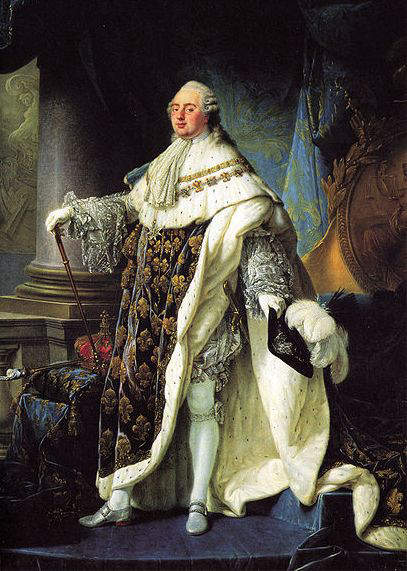
King Louis the XVI of France
The news of Louis XVI's death devastates Marie Antoinette who goes into deep mourning, refusing food and drink, and eventually contracts tuberculosis
News of Louis XVI's death eventually reached Marie Antoinette, who was devastated by the sad news of the death of her beloved husband. She went into deep mourning, and refused to eat or drink or take exercises. The mental and physical agony she was subjected to in prison, led to the rapid deterioration of her health, in the following months. She contracted tuberculosis, due to lack of proper nutrition and fresh air while confined to the prison cell. It is said that she also possibly suffered from uterine cancer, that caused her to bleed frequently from the uterus.
Marie Antoinette's trial on concocted charges, by a revolutionary tribunal, which found her guilty and sentenced her to execution by guillotine on October 16, 1793
The main issue that faced the National Convention after the death of Louis XVI, was the fate of Marie Antoinette and how to deal with the ailing former queen. While some members of the Convention were sympathetic and requested to spare her life, advocating either exile to America, or exchanging her for either French prisoners-of-war or for a ransom from the Holy Roman Emperor, other hardliners wanted her to be put on trial and executed like her husband, holding her equally responsible for all the woes and ills of the French nation. Finally, the hardliners had their way, and the ex-queen was moved out of the Tower into the Conciergerie as a prisoner, bearing No. 280. Even at this late stage attempts were made, by sympathetic individuals, to get her out of prison, but she refused to co-operate in any plot to escape, resigning herself to her fate and determined to join her husband very soon. She was finally tried by a so-called revolutionary tribunal on October 14, 1793. The trial was a sham and lasted only two days. She was accused of a number of concocted charges, such as adultery, lesbianism, incest, organizing sexual orgies in Versailles, and other acts of sexual depravation, none of which could be supported by reliable evidence, but appeared to be based on stories created by libelles. Other concocted charges include, sending millions of livres of treasury money to Austria;plotting to kill the Duc d'Orleans;declaring her son to be the new king of France after the death of Louis XVI;orchestrating the massacre of the Swiss Guards at the Tuileries Palace in 1792;and conniving with the enemies of France, at a time when the country was at war with Austria and Prussia. After a short trial, she was declared guilty of treason, early in the morning of October 16, 1793, and sentenced to death by execution on the guillotine. Unlike the king's execution, which was postponed by a month, Marie Antoinette's execution was to take place immediately. Thus, on October 16, 1793, at 12.15 p.m. just a few weeks before her 38th birthday, Marie Antoinette, who was wearing a simple white dress, was executed by guillotine at the "Place de la Revolution."
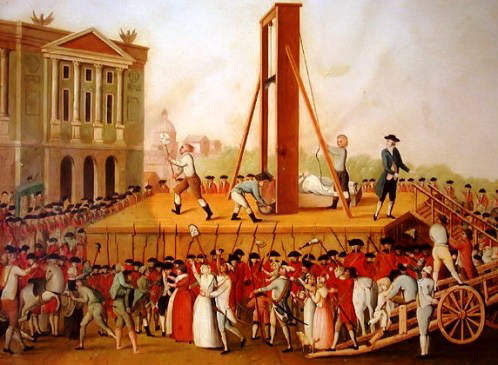
Execution of Marie Antoinette of France on 16th October 1793
Marie Antoinette - A historical re-assessment
Marie Antoinette a symbol of womanhood, motherhood and a dutiful wife. History vindicates her innocence and places her among the greatest queens in the history of Europe
Her famous last words were addressed to the executioner, Sanson, "Pardon me Sir, I meant not to do it,"when she accidentally stepped on his foot, before he carried out the execution. At her dying moment if she could be so generous to her executioner, does it not speak well of her disposition when she was the queen of France, despite all the negative propaganda about her extravagance? She might have been extravagant, but she was never arrogant as a queen. She loved her subjects and liked to take part in charitable events to help the poor. She was a queen, but she was also a dutiful wife to her husband, always ready to stand by his side in his most difficult moments, and never willing to abandon him, even when she had so many chances to escape with her children to the safety of friendly territories. She loved her husband so much, that she refused even her last chances of escape, and decided to remain in France, and sacrifice her life as her husband did, and experience the same mode of death as her husband. She faced death bravely, which even most men would not be prepared to do. She was a queen, but she was also a loving and caring mother, taking care of her sick and dying children until their last moments. When the pressure of work and the never ending problems in the country, drove the king into a bout of depression, she had the courage and the nerve to carry on, acting on behalf of the king, trying to find solutions to problems facing the country and heal the rift between the king and the assembly. Her only weak point was her nationality, being an Austrian, a country that was a traditional enemy of France. Thus, she became a scapegoat for all the woes and ills of the French nation, though the blame for much of these ills lay elsewhere. Thus she was a victim of circumstances. A right queen, but in a wrong country. History has vindicated her innocence and has granted her the rightful place as one of the greatest queens in the history of Europe.
How the Marie Antoinette pearls came into the possession of the Duke of Sutherland's family ?
The Duke of Dorset was the British Ambassador to France at the time the French revolution broke out, but was soon replaced by Lord George Granville Leveson-Gower in 1790
The British Ambassador to France, at the height of the French revolution was Lord George Granville Leveson-Gower, the 1st Duke of Sutherland, the British politician, landowner and patron of the arts, who was appointed as Ambassador to France in 1790 after the outbreak of the French revolution, and was withdrawn in August 1792, when the situation in France worsened, anarchy reigning supreme and mobs going on the rampage, particularly in Paris and Versailles. Lord George Granville Leveson-Gower replaced the Duke of Dorset, the famous cricketer and one of the founders of the Marylebone Cricket Club, as Ambassador, who served as diplomat in France from 1783 to 1789, in the lead up to the French revolution. Marie Antoinette established close relationship with the families of foreign Ambassadors living in France, including the family of the Duke of Dorset. In 1789, when the French revolution began, with the storming of the Bastilles in Paris, on July 14, the Duke of Dorset was in England organizing an international cricket tour to be held in August 1789 at Paris. The English team, that also included the renowned cricketer William Yalden, congregated at the port city of Dover, in Kent, in Southeast England on August 10, before crossing over to France. However, reports reaching Dover from France, across the English Channel was not favorable, and the Duke of Dorset decided to cancel the tour of France. Thus, what might have become the first international cricket tour in cricketing history, was cancelled for political reasons, the uncertain conditions that prevailed during the French revolution. The Duke of Dorset did not return to France as ambassador, and was replaced by Lord George Granville Leveson-Gower, who took up residence in Versailles in 1790, despite the uncertain conditions in the country.
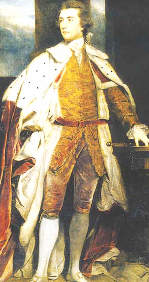
John Sackville 3rd Duke of Dorset, British Ambassador to France
At the time Lord George Granville Leveson-Gower took up residence in France, the royal family were already under house arrest in the Tuileries Palace, though yet under less stringent conditions
Thus, at the time Lord George Granville Leveson-Gower and his wife Lady Elizabeth Leveson-Gower took up residence in France, King Louis XVI and his family were already under house arrest in the Tuileries Palace, after a revolutionary mob from Paris arrested them on October 5, 1789, at the Versailles Palace, and later transferred them to Tuileries Palace. Under the circumstances Lord George Granville Leveson-Gower and Lady Elizabeth Leveson-Gower did not get the chance to get to know the Royal family so closely as the Duke of Dorset. Yet conditions under which the King and the Queen were kept at the Tuileries was not yet so stringent, as they were still asked to attend certain ceremonial and charitable functions, including religious ceremonies. However, being diplomats, both Lord George and Lady Elizabeth, were still granted the privilege of meeting the royal family.
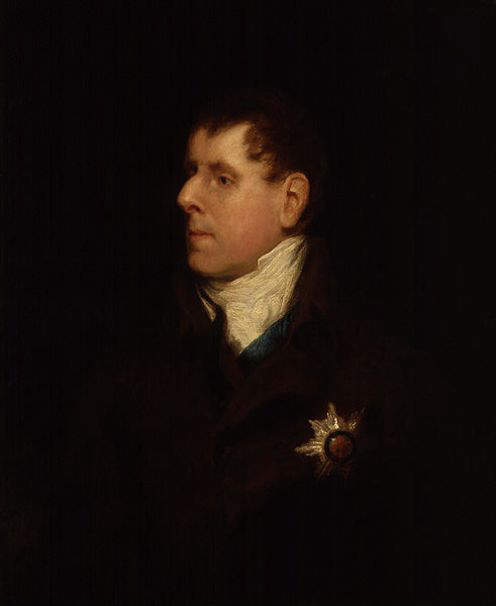
George Granville Leveson-Gower, the first Duke of Sutherland, British Ambassador to France.
Queen Marie Antoinette entrusts a collection of diamonds and pearls to Lady Elizabeth Leveson-Gower for safe-keeping until the situation normalized
It is believed, that it was during one of these visits to the Tuileries Palace, Marie Antoinette entrusted a collection of diamonds and pearls to Lady Elizabeth for safe keeping until the situation normalized in the country. Lady Elizabeth agreed to help the queen, and took charge of the diamonds and pearls, which she carried to safety of her residence in Paris. It is also believed that it was Lady Elizabeth who was used by the planners of the plot - to help the royal family escape from Paris, to the royalist strongholds - to carry disguises to the royal family to facilitate their escape. Unfortunately, just as the mission was about to be accomplished, the royal family were identified and captured at Varennes, about 320 km away from Paris, and brought back to Tuileries, amidst the jeers of the crowds.
Britain breaks off diplomatic relations with France in August 1792, and Ambassador George Leveson-Gower and his wife Elizabeth Leveson-Gower leave Paris for England, carrying Marie Antoinette's collection of diamonds and pearls with them
Subsequently, after Austria and Prussia declared war on France, the entire royal family was moved on August 13, 1792, to the Tower of the Temple in Marais, and imprisoned under more stringent conditions than the Tuileries Palace. This was not only to safeguard the royal family from attacking mobs, but also to thwart any future escape attempts, and perhaps to prevent an invading army of Austrians and Prussians from rescuing the royal family. Around the same time Britain decided to break off diplomatic relations with France, and Ambassador George Granville Leveson-Gower and Lady Elizabeth Gower were recalled to England. The Ambassador and his wife left Paris for England in August 1792, and Lady Elizabeth is believed to have carried the collection of diamonds and pearls, entrusted to her for safe-keeping by Marie Antoinette, to England. Enjoying diplomatic immunity, the ambassador and his wife were not subjected to any search by the ruthless republican guards, and the diamonds and pearls were carried safely to England.
The Marie Antoinette collection of pearls had remained with the Sutherland family for over 200 years, and the pearls were incorporated into the zigzag necklace in 1849
The Marie Antoinette collection of diamonds and pearls had remained with the Sutherland family for over 200 years, ever since they were handed over by the unfortunate queen to Lady Elizabeth Gower in 1792. After Marie Antoinette's death, the collection of diamonds were incorporated into a necklace, that came to be known as the Sutherland Diamond Necklace. The collection of pearls that included the 12 button-shaped pearls and 21 drop-shaped pearls were incorporated into the exquisitely designed zigzag necklace, consisting of a ruby-set collar and a diamond set intertwining ribbon, that is the subject of this webpage. This necklace was designed in 1849, 160 years ago, on the occasion of the marriage between Lady Elizabeth's grandson, George Granville William Sutherland Leveson-Gower and Anne Hay-Mckenzie, which took place on June 20, 1849. Ever since, the necklace had remained with the descendants of the Sutherland family and had never been put up for sale. Being a valuable family possession, the necklace was always kept in the safe vault of a bank, and was rarely used by any members of the family.
The Sutherland Pearl, Diamond and Ruby necklace comes up for sale at a Christie's London, Magnificent Jewelry Sale, on December 12, 2007
Based on historical provenance and the auction performance of another single-strand pearl necklace attributed to Marie Antoinette, the auction house set a pre-sale estimate of USD 700,000 to 800,000 for the necklace
The necklace, now known as the Sutherland pearl, diamond and ruby necklace, was put up for sale at a Christie's London, Magnificent Jewelry Sale, held on Wednesday, December 12, 2007.The identity of the descendant of the Sutherland family who put it up for auction, was withheld by the auction firm. The extraordinary provenance of the pearl necklace, incorporating pearls that once belonged to the unfortunate Queen of France, Marie Antoinette, supported by documents and other sources of evidence, was expected to significantly enhance the value of the necklace. Raymond Sancroft Baker, Senior Director of Christie's Jewelry, London, said, “It is exceptionally rare to be able to offer jewels that belonged to Marie Antoinette and which are completely fresh to the market. The story behind the pearls and their integral incorporation into this necklace for the Sutherland-Leveson-Gower family wedding in 1849 adds to the fascinating history of this necklace,”Continuing further he said, "You are buying a piece of history and a fine necklace."
Katrina Warner, from Surrey, England, who viewed the necklace at a pre-sale exhibition, held at Christie's London, said, "Even if you leave Marie Antoinette out, it's a very nice necklace,"and predicted that the necklace would sell for more than a million dollars. Her prediction was not far from the truth based on the performance of another piece of jewelry, that once belonged to Marie Antoinette and subsequently Barbara Hutton, a single-strand pearl necklace consisting of 44 graduated natural pearls, ranging in size from 8.7 to 16.3 mm, with a total weight of 1,816.68 grains, that was sold at a Christie's sale in Geneva, in November 1999, for a record breaking price of 1.47 million dollars, the highest price ever recorded for a natural pearl necklace at an auction, at that time.
The Sutherland Pearl Diamond and Ruby Necklace fail to realize the reserve price at the auction and is withdrawn from the sale
The auction house placed a pre-sale estimate of £350,000 to £400,000 on the necklace, equivalent to $700,000 to $800,000. However, to the utter astonishment of the auction house as well as observers of the natural pearl market in the world, the pearl necklace failed to realize the reserve price set by its owners, and was therefore withdrawn from the sale. The low price recorded was probably due to the recession, but it now appears that it had more due to the venue of the sale, rather than any fall in demand for natural pearls or lack of solid historic provenance. Had the necklace been put for sale at a Middle Eastern venue like Dubai or Qatar, where there is a strong auction market for natural pearls, it would have undoubtedly registered the target predicted by the auction house or even a substantially higher sale price.
A comparison of prices recorded by natural pearls and pearl jewelry at public auctions conducted by international auction houses between 1969 and 2009
The following table gives a list of famous natural pearls and pearl jewelry, that were sold at public auctions, conducted by international auction houses, during the period 1969 to 2009, showing strong auction demand developing for old natural pearls beginning from around 1987. The highest price ever realized for a natural pearl necklace, was approximately USD 7.1 million, for the two-strand Baroda Pearl Necklace, that was sold in April 2007, at a Christie's auction in New York. The second highest price realized for a natural pearl necklace was approximately USD 3.6 million, registered by the single-strand Duchess of Windsor pearl necklace in December 2007, at a Sotheby's Magnificent Jewels Auction also held in New York. Ironically, both these natural pearl necklaces were sold in the same year as the Sutherland Pearl, Diamond and Ruby necklace was put up for sale in London. The Pearl Carpet of Baroda was sold at a Sotheby's auction held at Doha, Qatar for a record USD 5.5 million in March, 2009. The Gulf Pearl Parure, designed by Harry Winston, was sold for a record USD 4.1 million in November 2006, at a Christie's auction held in Geneva.
Table of some famous natural pearls/pearl jewelry sold at public auctions conducted by international auction houses, giving the date of auction and the prices realized, during the period 1970 to 2009
| S/N | Name of pearl/pearl jewelry | Probable period of origin | weight | date of auction | Price realized |
| 1 | La Peregrina | 1513 | 203.84 grains | 1969 | USD 37,000 |
| 2 | Mancini pearls | 1500-1600 | 400 grains | Oct.1979 | USD 253,000 |
| 3 | Mona Bismarck 2-strand pearl necklace | 1920-1930 | Double-strand of 70 pearls | May 1986 | USD 410,000 |
| 4 | Duchess of Windsor pearl necklace | 1910-1936 | Single-strand of 28 natural pearls. Total weight 1266.33 grains | April 1987 Dec 2007 | USD 733,333 3,625,000 |
| 5 | Empress Eugenie tiara | 1853 | 212 pearls, 2,520 grains | Nov 1992 | USD 650,000 |
| 6 | Nina Dyer black pearl necklace | 1950s | 151 natural black pearls | Nov 1997 | USD 913,320 |
| 7 | Barbara Hutton pearls | 1600-1666 | 44 natural pearls, total weight of 1,816.68 grains | May 1992 Nov 1999 | USD 580,000 USD 1,470,000 |
| 8 | Unidentified natural pearl necklace by Cartier | Historical provenance not revealed | Double-strand necklace with 88 natural pearls | Nov 2004 | USD 3,100,000 |
| 9 | La Regente | 1811 | 302.68 grains | Nov 2005 | USD 2,483,968 |
| 10 | Gulf pearl parure designed by Harry Winston | 1932-1978 | Nov 2006 | USD 4,100,000 | |
| 11 | Baroda pearl necklace | 1856-1870 | Double-strand with 68 natural pearls from the original 7-strand necklace | April 2007 | USD 7,096,000 |
| 12 | Umm Kulthum pearl necklace | 1880 | nine-stranded necklace with 1,888 pearls | April 2008 | USD 1,390,000 |
| 13 | Pearl necklace from an unidentified notable collection | Historical provenance not revealed | Single-strand necklace with 41 natural pearls | Nov 2008 | USD 1,321,110 |
| 14 | Unidentified pearl and diamond festoon necklace | Historical provenance not revealed | Nine-strand pearl and diamond festoon necklace. Length 645mm to 1060mm | Nov 2008 | USD 946,610 |
| 15 | Pearl Carpet of Baroda | 1860 | 1.5-2.0 million natural seed pearls | March 2009 | USD 5,500,000 |
You are welcome to discuss this post/related topics with Dr Shihaan and other experts from around the world in our FORUMS (forums.internetstones.com)
Related :-
1) Barbara Hutton/Marie Antoinette Pearl Necklace
External Links :-
1) The Royal Splendor of Marie Antoinette's Pearls at Christie's in December - Press release by Christie's, Thursday, 27th September 2007 (PDF). www.christies.com
References :-
1) The Royal Splendor of Marie Antoinette's Pearls at Christie's in December - Press release by Christie's, Thursday, 27th September 2007. www.christies.com
2) The extraordinary story behind the £1 m auction of Marie Antoinette's pearls - Tony Rennell. www.dailymail.co.uk
3) Marie Antoinette's pearls up for auction - Monday, December 10, 2007. www.nydailynews.com
4) Marie Antoinette Biography - www.ladyreading.net
5) Marie Antoinette - Queen of France, 1755 - 1793. www.lucidcafe.com
6) Marie Antoinette - From Wikipedia, the free encyclopedia
7) Did you know? Mexico was once the world's major source of pearls. - www.mexconnect.com
8) Cortez Pearls - Pearl-Guide.com - www.pearl-guide.com
9) John Sackville - 3rd Duke of Dorset. From Wikipedia, the free encyclopedia
10) George Leveson-Gower, 1st Duke of Sutherland - From Wikipedia, the free encyclopedia
 Home
Security & Guarantee
How it Works
Technology Partners
Updated Tables
Famous Diamonds
More Famous Diamonds
Famous Pearls
Famous Gemstones
Contact Dr Shihaan Larif
Contact Senior Editor
Famous Jewelry
Reference Database
Forums
Learning Center
Gemstone Gallery
e-mail Notifications
Advertise
Press Release
About Us
Privacy Policy
Contact Us
FAQ'S
Site Map
Staff Mail Login
Staff Documents
Birthstones
History
Minerals
Shows
Live Metal Prices
Jewellery Gallery
News
Marketplace
Marketplace Support
Open Store
Online Auctions
Join Us & Contribute
Directory
Classifieds
List your products
Wholesale Trading
Post Buy Request
Go Green Policy
Site Updates
Upcoming-ToDo List
Latest News
Latest Articles
Latest Blog Updates
Chat Rooms
Job Board
User Gallery
Videos
New Newsletter Archive
Old Newsletter Archive
Jewelry & Mineral Blog
User Blogs & Social Network
Search
Answers (Q & A)
Valuation
Help me find a diamond/jewelry
pin.internetstones.com- Social Pinboard- Sart yours & connect with millions
Invite Friends From Yahoo, Gmail etc-One Click
Home
Security & Guarantee
How it Works
Technology Partners
Updated Tables
Famous Diamonds
More Famous Diamonds
Famous Pearls
Famous Gemstones
Contact Dr Shihaan Larif
Contact Senior Editor
Famous Jewelry
Reference Database
Forums
Learning Center
Gemstone Gallery
e-mail Notifications
Advertise
Press Release
About Us
Privacy Policy
Contact Us
FAQ'S
Site Map
Staff Mail Login
Staff Documents
Birthstones
History
Minerals
Shows
Live Metal Prices
Jewellery Gallery
News
Marketplace
Marketplace Support
Open Store
Online Auctions
Join Us & Contribute
Directory
Classifieds
List your products
Wholesale Trading
Post Buy Request
Go Green Policy
Site Updates
Upcoming-ToDo List
Latest News
Latest Articles
Latest Blog Updates
Chat Rooms
Job Board
User Gallery
Videos
New Newsletter Archive
Old Newsletter Archive
Jewelry & Mineral Blog
User Blogs & Social Network
Search
Answers (Q & A)
Valuation
Help me find a diamond/jewelry
pin.internetstones.com- Social Pinboard- Sart yours & connect with millions
Invite Friends From Yahoo, Gmail etc-One Click




Our Global Jewelry Industry Job Network


Buy & Sell in our Marketplace

Subscribe to our Newsletter

List in our Classifieds

List in our Directory

User Uploaded Gallery

Powered by Ultra Secure
Amazon (USA) Cloud Network

Founder Internet Stones.COM
Register in our Forums

| Featured In
|
|
|
|
|
|
|
|







Blog & Education Feed
Articles Feed
 |
 |
 |

Copyright © .Internet Stones.COM. All rights reserved.