The Topkapi Emerald Dagger at the Topkapi Museum
Open FREE Unlimited Store Join Our Newsletter
Origin of name
The Topkapi Emerald Dagger is the renowned jewel-studded dagger of mid-18th century origin, preserved and displayed for public viewing at the treasury of the Topkapi Palace Museum, in Istanbul, Turkey. One side of the handle of the dagger is set with three large Colombian emeralds of good color and clarity whose size and prominence undoubtedly gave the dagger its popular name. The exquisitely crafted jewel-studded dagger was actually one of several other valuable gifts that was carried by an embassy of Sultan Mahmud I (1730-54) to Iran, to be gifted to the mighty Iranian conqueror Nadir Shah, but unfortunately was not delivered as Nadir Shah was assassinated, when the embassy just crossed the borders of the Ottoman Empire into Iranian territory. The gifts including the jewel-studded dagger were then returned to the treasury at Istanbul, and eventually became one of the most celebrated treasures in the treasury of the Topkapi Palace Museum. The popularity of the dagger, as well as the museum that holds it, were given a major boost worldwide, when it was made the subject of a popular Hollywood heist film in 1964, based on Eric Ambler's novel "The Light of Day."
Characteristics of the emerald dagger
The three emeralds on the handle are large, deep green stones with good clarity and transparency. The emeralds are mounted on the handle on one side. The upper and lower emeralds have an identical pear-shaped cut, with almost identical sizes and set with their pointed ends facing each other. The middle emerald is a rectangular cushion-cut stone, whose width is slightly less than the width of the pear-shaped stones. The outline of this vertical arrangement of emeralds seem to coincide with the conventional biconcave shape of a dagger, which gives a firm grip on its handle. The emeralds are interspersed with smaller diamonds placed at the four corners of the rectangle in the middle and the four corners of the trapezia situated above and below the rectangle. At the end of the handle is an octagonal-shaped emerald, set as a cover, which when opened revealed a small watch. Around this cover and the sides of the handle are rows of smaller diamonds, the smallest on the dagger. The backside of the handle is done in enamel and mother-of-pearls.
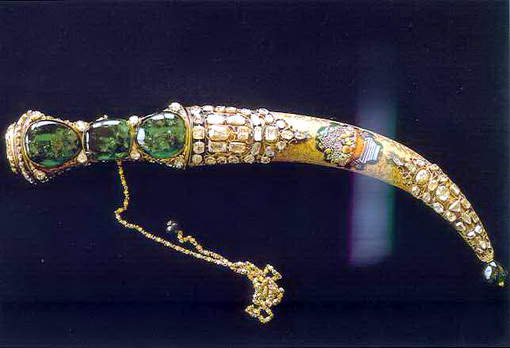
The entire length of the dagger is about 35 cm, inclusive of its handle. The curved blade of the dagger alone may be just over two-thirds of its length, and closely fits into curved sheath. The sheath is made out of gold with enameled flower motifs and encrusted with diamonds. The enameled flower motif at the center of the sheath represents a bouquet of flowers placed in a vase. The diamonds encrusted on the sheath also form a design on either side of the enameled flower motif, one towards the base and the other towards the tip of the sheath. The diamond motif at the base of the sheath consists of 31 diamonds, mostly rectangular in shape arranged in a symmetrical pattern. The other diamond motif towards the tip of the sheath is made up of 21 diamonds, also placed symmetrically. The tip of the curved sheath is occupied by a large emerald.
Overall the emerald dagger and its enclosing sheath represent a masterpiece of the highest artistic traditions, and the art of jewelry making, that reached a highly refined status in the 17th century Ottoman Empire. A diamond-studded gold chain attached to the handle of the dagger enhances the ornamental value of this artistic creation.
History of the Emerald Dagger
Source of the emeralds
The source of the emeralds mounted on items of jewelry, daggers, jewel-encrusted ornaments, the peacock throne etc. which were gifts of ambassadors, enthronement gifts and purchases of the Sultans themselves, and are presently exhibited in the treasury of the Topkapi Museum, are said to be the ancient Muzo and Somondoco (Chivor) mines of Colombia. The Muzo mines which were discovered by the Spanish in 1594 continued production until the mid-18th century, when a disastrous fire stopped all mining activity, and the mine had to be abandoned. Production in the Muzo mines resumed again only after the Colombia had gained its independence from the Spanish in 1819. The Somondoco (Chivor) mines which started production in the mid-16th century, remained in production only for about 125 years, and in the year 1675, was closed down permanently, by royal decree issued by King Charles II, due to the cruel and and barbaric treatment meted out to the indigenous Indian working population. The mines that were overgrown with jungle were rediscovered only in the year 1896 and production resumed in 1911. Thus any emeralds that reached Istanbul, the capital of Ottoman Turkey before 1675, would have either originated in the Muzo or Somondoco emerald mines. However, those emeralds that reached Istanbul after 1675, until around the year 1750, must necessarily have originated in the Muzo mines of Colombia.
How the emeralds from Colombia reached the Ottoman Empire ?
The emeralds from Colombia were loaded into the Spanish galleons at the port city of Cartagena, from where the Galleons sailed to Havana in Cuba directly if they had already called previously at the port of Portobello in Panama, or sailed to Portobello first before sailing to Havana, in Cuba. At Portobello the Spanish Galleons were loaded with silver and gold that originated in Peru, and was transported to Panama City by the Pacific fleet. From Panama City on the Pacific coast the silver and gold were transported to Portobello on the Atlantic coast by mule train. The treasure laden Spanish galleons, containing gold and silver from Peru and Mexico, emeralds and gold from Colombia, Pearls from Venezuela, and agricultural produce such as tobacco, coffee etc. then sailed from the port of Havana, before the onset of hurricanes in late July, and through the Straits of Florida sailed across the Atlantic to Spain. From Spain after the Royalty had collected a fifth of the production of emeralds as its share, the remaining emeralds were re-exported to countries in Europe, the middle east and Asia, where the green emeralds were in great demand, and snapped up by the royal families of the Ottoman Empire, the Persian Empire and the richest empire in the world at the time, the Moghul Empire of India. These emeralds reached the middle east and Asia via the overland route or by ships sailing around the Cape. Consignments due to the Ottoman Empire would have reached Turkey through any one of the ports on its Mediterranean coast. Likewise, consignments due to Iran (Persian Empire) would also have reached the country, overland through Turkey. But Consignments due to the Moghul Empire based in Northern India would most probably have gone around the Cape, or via the western route from Spain, to Veracruz in Mexico, then overland to Acapulco, and then by Ship to Philippines and from Philippines to India.
Nadir Shah of Iran
Nadir Qoli Beg drives Afghans and Ottoman Turks out of Iranian territories and restores Thamasp II to his throne
After the fall of the Safavid dynasty in Iran, following the invasion of Mahmud of Kandahar and his 20,000 strong army, who captured the capital city Esfahan and executed Shah Sultan Hussain (1694-1722), Thamasp II, the son of Sultan Hussain, organized a campaign to regain his father's throne. In 1726, Nadir Qoli Beg of the Turkish Afshar tribe based in Mashhad, a brigand chief with 5,000 followers volunteered to help Thamasp II to regain his throne. After intensive training and preparation Nadir moved against the Afghans at Damghan in October 1729, defeated them and drove them out of Iran, and installed Thamasp II on the Iranian throne. He then embarked on a successful campaign that ousted the Ottoman Turks from the former Iranian territories of Azerbaijan and Iraq. Later while Nadir was away in Khorasan trying to quell an uprising, Thamasp had attacked Turkey again rashly and was forced to conclude a peace treaty under shameful and disadvantageous terms. Nadir returned to Esfahan immediately, deposed Thamasp for his irresponsible behavior, and installed his infant son on the throne as Abbas III, and assumed control as his regent, giving a semblance of legitimacy to his intervention.
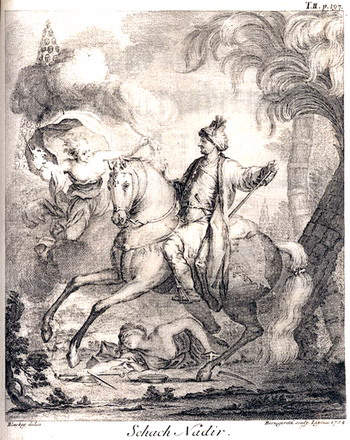
Nadir threatens to attack Russia and captures Herat in Afghanistan
He then attacked the Turks again and drove them completely out of Iran for a second time. He then planned to move against the Russians, but Peter II, the Czar of Russia (1727-30), who heard about his plans, immediately surrendered the Caspian provinces to Iran, in return for peace. Then in 1732 he captured Herat in Afghanistan after laying siege to the city, and impressed by their courage recruited a large number of Heratis to his army, who later formed the backbone of the Afghan regiment in his army.
Nadir deposes young Abbas III and installs himself as Shah of Iran
Nadir was the first Iranian Shah who realized the importance of Iran having its own navy and in 1734 he started building up the navy, which just one year after its creation, had attacked and captured Bahrain and Oman. Having captured new territory and expanded the Iranian Empire, Nadir Shah felt confident of himself, and deposed the young Abbas III and installed himself as the absolute ruler of Iran. He then diverted his attention towards Kandahar, in Afghanistan, a well-defended city, and after 80,000 of his men had laid siege to the city for one year, he captured it in 1738. Subsequently he also captured the cities of Ghazna and Kabul in Afghanistan.
Nadir invades the Mughal Empire in 1739, and carries away an enormous booty, including the original Peacock Thrones of Shah Jahaan and an almost exact duplicate
Around this time the richest kingdom in the area was the Mughal Empire based in Northern India. Nadir Shah was tempted to attack the Moghul Empire to the east, not so much to acquire territory and expand his kingdom, but to acquire the wealth and riches of this kingdom, renowned to be the richest kingdom in the world around this time. In February, 1739, Nadir Shah and his army invaded Northern India, and defeated the Moghul army in battle at Karnal, and took the emperor Muhammad Shah, prisoner. His forces then entered Delhi and Agra, the main seat of power of the Mughal emperors. Nadir's forces ransacked the Moghul treasury in both cities and took into their custody large quantities of treasures which included the "Shah Jahaan's Peacock Throne", several valuable diamonds such as the Koh-i-Noor, the Darya-i-Noor, the Noor-ul-Ain etc. and also hundreds of chests full of diamonds, emeralds, pearls, sapphires etc. Nadir was so impressed with the "Peacock Throne" that he got Emperor Muhammad Shah to produce another identical throne using the same materials and precious stones. Eventually, when Nadir Shah's forces withdrew from Northern India in May 1739, he carried away a booty that was estimated at 700 million rupees, according to standards prevalent at that time. The successful expedition increased the financial situation in Iran, so much so, that Nadir was able to exempt all Iranian people from taxes for the next three years.
Nadir sends gifts of valuable treasures to rulers of neighboring kingdoms including Sultan Mahmud I of the Ottoman Empire
He then attacked and captured the cities of Bukhara and Khiva in Uzbekistan, and captured Armenia from the Turks after a battle and great victory over the Turks, near Yerevan. The vast empire created by Nadir Shah was now almost equal in extent to the ancient Iranian empires. He now settled down to rule his vast empire, and sent gifts of treasures to rulers of neighboring kingdoms such as the Ottoman Empire and the Russian Empire. In May 1747, after the signing of the peace treaty between Iran and Turkey in September 1746, he sent two of his trusted emissaries Mustafa Han and Mohammed Mahdi Han with extremely valuable gifts to the Ottoman Emperor Sultan Mahmud I (1730-1754). Among the gifts sent to the Sultan was the duplicate jewel-studded "Peacock Throne" which Mogul Emperor Muhammad Shah made for him at his request. He also sent gifts to Czarina Elizabeth (1741-62) of Russia, and Abul Faiz Khan, the ruler of Bukhara in Uzbekistan.
Nadir Shah a brilliant soldier but a poor statesman and administrator. Nadir Shah's assassination in 1747.
In the history of Iran, Nadir Shah was one of the most successful rulers who restored the Iranian empire to its former glory. As a soldier he was brilliant and successful, but failed as a statesman and administrator. Towards the end of his rule the country became completely exhausted due to the never ending military campaigns, that killed tens of thousands of his people. He was a harsh and ruthless ruler, who imposed cruel punishment on his people for various offences, which included torture and executions. This resulted in never ending revolts against him in different parts of the country, that finally led to his assassination in his sleep in 1747, by his own Afshar tribesmen - in spite of the fact that he was guarded by a 5,000-strong Afghan bodyguard - during a campaign to suppress an uprising in Khorasan. His sudden assassination led to chaos and civil war in the country, the commanders of the different tribal units in his army trying to capture and carve out territories to be brought under their control. Nadir Shah's vast empire finally crumbled into several independent and self governing territories.
Sultan Mahmud I
Birth and education
Sultan Mahmud I (1730-54) who was son of Sultan Mustapha II (1695-1703) and the elder brother of Sultan Osman III (1754-57), was born in Istanbul on August 2, 1696. He was the nephew of Sultan Ahmed III (1703-1730) whom he succeeded in 1730. He had his education in the palace under the tutelage of specially selected teachers. Young Mahmud took a keen interest in history, literature, and poetry and also studied music. He wrote poetry in Arabic, and even as Sultan continued writing poetry, while his trusted viziers were in charge of governing the empire.
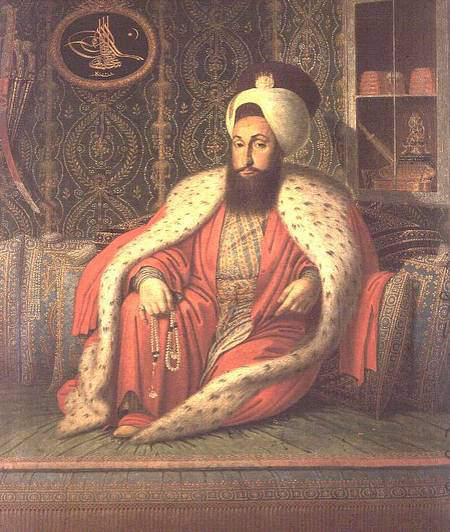
Janissaries instal Mahmud I as Sultan after ousting his predecessor
Sultan Mahmud was put on the throne of the Ottoman Empire in 1730, by the kingmakers of the time, the powerful Janissaries, who engineered a palace coup against his predecessor Sultan Ahmed III. The Janissaries were an elite corps in the service of the Ottoman Empire, that consisted of war captives and Christian youths from the Balkan Provinces, who were converted to Islam, on being drafted into the Ottoman service, and trained under the strictest discipline, including celibacy. The corps was first organized under Sultan Murad I. The Janissaries were highly respected for their military prowess in the 15th and 16th centuries, and eventually became a powerful political force within the Ottoman State, to the extent that they were able to make or unmake sultans as they pleased. It was this power of the Janissaries that led to the overthrow of Sultan Ahmed III in 1730, and the installation of his nephew, Mahmud I, as the new sultan.
Causes of Patrona Halil's uprising
The actual cause of this palace coup engineered by the Janissaries, was said to be jealousy caused by a new breed of aristocrats created by Sultan Ahmed III, by favoring the rise of the Greek Phanariots to high offices. The Phanariots were privileged Greek families, that lived in the Greek quarter of Constantinople, known as the Phanar. They held influential positions in the government, until the Greek war of independence that began in 1821. Another reason given for the deposing of Sultan Ahmed III, was the defeat of Turkey by the Persian forces led by the mighty conqueror Nadir Shah. The uprising of the Janissaries was led by Patrona Halil (Khalil), who rode with the new Sultan to the mosque of Ayub, where the traditional ceremony of girding Mahmud I with the sword of Othman was performed. Patrona Halil served in the ranks of the Janissaries as a common soldier. He forced Sultan Mahmud I, to retire many officers in the Janissary Corps, and appoint nominees recommended by him as successors.
The downfall of Patrona Halil
Patrona Halil and his supporters then tried to force the Sultan to declare war against the Russians. He also wanted the Sultan to appoint him as the commander of the Yeniceri Corps. The demands of the rebel chiefs on the Sultan became unbearable, and some officers loyal to the Sultan, formed an alliance to eliminate Patrona Hill and his supporters. The Khan of the Crimea, the Grand Vizier, the Mufti and the Aga (commander) of the Janissaries drew up a plan that enlisted the support of other sections of the army. Patrona Hill and his 7,000 followers were massacred in front of the Sultan, after they had a meeting with him in his palace. Thus came to an end the rebellion of the Janissaries that put Sultan Mahmud I on the throne.
Sultan Mahmud I, a benevolent ruler
Sultan Mahmud I, was a benevolent ruler who worked for the welfare of his people. The great qualities exhibited by him as a ruler, such as the strength of his character and determination, tempered by mercy and tolerance and coupled with patience and forbearance, were qualities acquired by his sound education. Sultan Mahmud was also responsible for reforming the Ottoman army, with the help of Humbaraci Ahmed Pasha, a French nobleman converted to Islam. While reorganizing the artillery and bombardier corps, Ahmed Pasha also initiated the army engineering corps, and embarked on a program of education and training for the officers of the Ottoman army.
Successful military campaigns conducted against Russia and Iran and signing of peace treaties with both countries
After the reorganization of the army, successful military campaigns were conducted by Ahmed Pasha against both the Iranians and the Russians. The campaign against Iran led to the re-capture of some territories lost prior to 1731, such as Kermensah and Tabriz, and resulted in the signing of the Ahmed Shah treaty in 1732, according to which the Caucasus was left to the Ottoman Empire, and Western Iran and Azerbaijan to Iran. In spite of the Ahmed Shah treaty fighting between the two nations continued until 1746, the Ottomans capturing Baghdad in 1733, and Nadir Shah attacking the Iraqi territory and besieging Mosul and Kars in 1743. A new treaty signed in September 1746 brought peace between the two countries.
Nadir Shah of Iran and Sultan Mahmud I of Turkey send embassies to each others countries and exchange valuable gifts
After signing of the peace treaty of September 1746, Nadir Shah of Iran, sent two of his trusted men, Mustapha Han and Mohammed Mehdi Han as goodwill ambassadors, carrying extremely valuable gifts to the Ottoman Padishah, Sultan Mahmud I, which included the second Peacock Throne brought from Delhi in India. Sultan Mahmud I, who was intimated about the arrival of the embassy, reciprocated the kind gesture of Nadir Shah, and sent an embassy of his own on May 11, 1747, led by Kesriyeli Ahmed Pasha and carrying valuable gifts in return, which included the outstanding dagger, whose handle and sheath were encrusted with emeralds and diamonds, and is the subject of this web article. The ambassadors of the two sides met somewhere near Baghdad, and displayed their treasures to one another. Then after a few days the Iranian embassy left for Baghdad and the Turkish embassy for Hamadan.
Nadir Shah is assassinated before the exchange of gifts could take place and the Turkish embassy returns to Istanbul
At the crucial moment as both embassies were on their way to each others capitals, Nadir Shah was assassinated by his own troops at Fathebad in Khorasan on May 19, 1747. The shocking news of the assassination reached the Turkish embassy as they crossed the Turkish-Iranian border into Iran. With the main objective of their mission, viz. handing over Sultan Mahmud's gifts to Nadir Shah, being thwarted, the head of the embassy, Ahmed Pasha, decided to return immediately to Istanbul, to report the developments to Sultan Mahmud and prevent the gifts from being plundered. Their return journey was not without any incidents, but the embassy managed to enter Ottoman lands with all the gifts intact. Having reached Istanbul, Ahmed Pasha, returned the gifts including the emerald dagger to the treasury and reported about the unexpected developments to Sultan Mahmud I. The Iranian embassy meanwhile reached Baghdad, and on hearing of developments back home requested political asylum which was readily granted. The embassy then reached Istanbul, and handed over Nadir Shah's gifts including the "Peacock Throne" to Sultan Mahmud I, which were then transferred to the treasury. Thus the "Topkapi Emerald Dagger" and Nadir Shah's "Peacock Throne" the most prominent and renowned exhibits in the Topkapi Palace Museum today, have a fascinating history dating back to the mid-18th centuries, and were the products of a historic diplomatic exchange between Turkey and its neighbor Iran, two great nations of the region with a history dating back to several millennia.
Other daggers exhibited at the Topkapi Palace Museum
Besides the "Emerald Dagger" several other daggers are also on display at the treasury of the Topkapi Palace Museum. One such dagger is the emerald dagger that belonged to Sultan Mehmet IV. The dagger is a masterpiece of the 17th century Turkish craftsmanship. The dagger which is 31 cm in length has an emerald encrusted handle and a jewel encrusted golden sheath. The dagger was presented to Sultan Mehmet IV, on the occasion of the dedication of the Yeni Mosque.
Another dagger with a crystal handle was said to be the property of Sultan Selim the Grim. Yet another dagger whose owner is unknown, has a handle consisting of a single emerald and a gold sheath encrusted with diamonds. Each one of these daggers has a unique artistic and historic value, representing the great traditions of jewelry designing and manufacture for which the artisans of the Ottoman Empire were renowned for. However the most well known of all daggers in the Topkapi Palace Museum, is undoubtedly the "Topkapi Emerald Dagger" which has earned an international reputation, particularly after it became the subject of a popular Hollywood heist film in 1964. The film was responsible for giving a major boost not only to the popularity of the "Emerald Dagger" but also the Topkapi Palace Museum, where the dagger is exhibited. Hundreds of thousands of foreign tourists who come to Istanbul annually, and visit the Topkapi Palace Museum, without fail line up before the glass case enclosing the "Emerald Dagger" that was featured in the film, and replicas of the "Emerald Dagger" are sold everywhere in Istanbul for the benefit of tourists who would like purchase them as mementos of their visit.
The Hollywood heist film "Topkapi"
"Topkapi" a crime comedy film, whose theme was the theft of an artifact, from the renowned Topkapi Museum in Istanbul, was produced and directed by the American film director Jules Dassin, based on the novel " The Light of Day" by Eric Ambler, and was released for screening in the year 1964. The film that became popular the world over, for its plot and how it was executed, with full of suspense at the crucial moment of the theft, had a cast that included Melina Mercouri (Elisabeth Lipp), Peter Ustinov (Arthur Simpson), Maximilian Schell (Walter Harper), Robert Morley (Cedric Page), Akim Tamiroff (Geven), Gilles Segal (Giulio) and Jess Hahn (Fischer).
Jewel thieves Elizabeth Lipp and her lover Walter Harper, draw up a plan to steal Sultan Mahmud I's emerald dagger from its glass display case in Istanbul's Topkapi Palace Museum. The duo recruit three others to carry out their ambitious plan; Fischer, a strongman; Giulio a mute athlete; and Cedric Page, an eccentric British inventor. The gang reaches Athens, where at the airport they hire conman Arthur Simpson to drive his American limousine alone across the border, and meet them in Istanbul. As Simpson attempts to drive across the border, he is arrested by the Turkish Police, who found weapons hidden in the trunk. Simpson is interrogated by one of the policeman Major Tufan, and allowed to proceed on condition that he spies on the gang. The Turkish police suspected the "tourists" to be revolutionaries planning a coup d'etat.
Simpson meets the "tourists" in Istanbul as agreed. The gang that hired a villa in Istanbul, plan the details of the robbery, according to which, Fischer, the strongman is to lower Giulio, the athlete, on a rope from a window near the museum's ceiling. Guilio is to attach rubber suckers to the glass chamber which encloses the "Emerald Dagger" and the chamber was to be hauled up by another rope, while Guilio dangling in the air on the first rope carefully retrieves the dagger from its display stand, and replaces it with a duplicate emerald dagger. The glass chamber was to be lowered after this and then placed in its original position. Guilio was to be hauled up by Fischer, after successfully executing the assignment. The suspense in this whole drama arises from the fact that the floor of the museum was sensitively wired, to the extent that even the slightest weight placed on it would have triggered off an alarm in the security office. Hence the need for the dangling operation from above, and the spine-chilling moment of suspense when Guilio nearly dropped one of the tools he had been using in the operation.
Geven, the drunken cook at the villa, believed that the men were Russian spies, and passes the information to Simpson, who in turn informs Major Tufan. Then by a sudden and unexpected turn of events, Fischer's hands are injured accidentally by being smashed by a door, and Simpson is recruited to take Fischer's place, in spite of the fact he revealed his link to the police. The gang successfully elude Major Tufan who was on their trail, and execute the robbery as planned. The dagger is then given to a gypsy, who smuggles it out of Turkey.
Elated and proud about the success of their operation, the gang members go to meet Major Tufan, and complain about weapons being discovered in their car. While they were in the Major's office, a bird flies through the opened window in the museum used for the operation, and lands on the floor, triggering the alarm. Following this incident the entire gang was arrested on suspicion, apparently for an unknown crime, and later released. Elizabeth Lipp one of the masterminds of the operation, then outlines her plans for their next job - the theft of the Romanov jewels from the Kremlin Diamond Fund.
The film was shot at Boulogne-Billancourt Studios in Paris, and also on location in Istanbul, Turkey. Peter Ustinov won the 1964 Academy Award for the Best Supporting Actor for the role he played in the film as Arthur Simpson.
The film gives a major international boost to the Topkapi Emerald Dagger and the Topkapi Museum
After the release of the film in 1964, it became an instant box office hit attracting large crowds all over the world. The Emerald Dagger and the Topkapi Museum where the dagger is displayed became internationally renowned, and a tremendous boost was given to the tourist industry of Turkey. Foreign tourists arriving in Turkey were always eager to see the Emerald Dagger displayed in the treasury of the Topkapi Palace Museum. Tourism promoters and travel agencies around the world printed large posters depicting the "Topkapi Emerald Dagger" that was exhibited in their offices all over the world. Picture postcards and replicas of the dagger were also produced and became much sought after tourist souvenirs in Istanbul.
The Topkapi Palace Museum
Topkapi the largest and oldest palace in the world to survive to this day
Topkapi Sarayi which in the Turkish Language means "The Gate of Cannons Palace" derives its name from the huge cannons displayed outside the gates of the palace which were once used by the forces of Sultan Mehmet II in conquering the city of Constantinople, which subsequently came to be known as Istanbul. The palace is perhaps the largest and oldest palace in the world to survive to this day, thanks to the restoration and maintenance activities undertaken by the Government of Turkey, after the country became a republic in 1924. The palace which stands on the site of the ancient Acropolis, the first settlement of the Byzantine period, overlooks the Bosphorus, the Sea of Marmara and the Golden Horn, providing a panoramic view of the area. The entire palace is an enormous complex occupying an area of 700,000 sq. meters and surrounded by more than 5 km of walls.
Topkapi Palace built by Sultan Mehmet II between 1465 and 1479
The Topkapi Palace was the palace and the main administrative center of the Ottoman empire for 400 years from the 15th to the 19th centuries. After the conquest of Constantinople in 1453, Sultan Mehmet II shifted the capital of his empire from Edirne to this city, which came to be known as Istanbul. Sultan Mehmet II at first built his palace at a site which is now occupied by the University of Istanbul. Subsequently in the year 1465, he ordered the construction of a new palace at point Seraglio, overlooking the Golden Horn, the Bosphorus and the Sea of Marmara, the site of the ancient Acropolis of the Byzantine empire. The palace was completed in 1479, and occupied by Sultan Mehmet II in the same year, and was referred to as the "New Palace," the palace which he earlier occupied being known as the "Old Palace."
The Topkapi Palace served a dual function both as the residence of the Sultan and the main administrative center of the Ottoman empire
The "New Palace" which was one of the most magnificent palaces ever built, eventually came to be known as the "Topkapi Palace" after the installation of the huge cannons outside the main gate of the palace. Unlike other palaces in the western monarchies, the "Topkapi Palace" served not only as the residence of the Ottoman Sultans and their families, but also as the center of Government of the Ottoman empire where the cabinet of ministers met. Besides the palace also housed the various ministries of the government, the imperial treasury, the imperial mint, the imperial archives, and advanced educational institutions of the government that trained civil servants, managers and accounting officers for different government institutions. Civil servants who graduated from this school were posted to the far flung corners of the vast empire where they served the Sultan and his empire faithfully and helped in the administration of the vast domain. Most of the viziers and grand viziers were graduates of this administrative school.
In other words the Topkapi Palace was the vital nerve center of the highly centralized administrative structure of the vast Ottoman empire, one of the most powerful and sophisticated empires in the world, which at its height ruled the entire Balkans, Hungary, Crimea, the Arab East, North Africa, and at times parts of Italy, Poland and Ukraine. The Turks in their long and ancient history founded 16 empires, but the Ottoman empire was the largest, most successful and long lasting of all, that existed for 622 years, exercising its benevolent governance on peoples of European, Asian and African lands in the neighborhood of the Mediterranean and Black seas. The empire was governed by 36 sultans during its existence, and beginning from the early 16th century the sultans also became the spiritual heads of the Islamic world as caliphs. During this period the Topkapi Palace and its neighborhood, and the City of Istanbul became a cosmopolitan environment, where people of different ethnic groups, speaking different languages and professing different religions, from the far corners of the empire, lived and worked together in peace, creating a culturally dynamic society, that was responsible for the creation of the architectural and artistic marvels of this period, which attained a very high state of refinement.
The Topkapi Palace, a lasting monument to the typical Turkish palace architecture
The Topkapi Palace is a typical example of Turkish palace architecture. The most distinctive feature of this architecture is a series of tree-shaded open courtyards, each meant for a particular purpose, and interconnected by large and impressive gates. The periphery of the courtyards are occupied by buildings that perform various functions of government. Ever since the palace was built in the 15th century, it has undergone constant development and expansion, as each sultan, depending on his tastes, made his own alterations and additions. The "Harem" consisting of about 400 rooms was constructed only a century later during the reign of Sultan Murad III. Keeping pace with the expansion of the palace, the number of residents in the palace also dramatically increased. Initially the number of residents in the palace were about 700 to 800, which rose to about 5,000 towards the latter period of the empire, rising to nearly 10,000 during periods of festival. The Janissaries, the elite corps in the service of the Ottoman empire, constituted the largest part of the palace population, and were based within the first courtyard of the palace. Thus the Topkapi Palace with a total area of 700,000 meter square and surrounded by a wall of 5 km became the largest palace in the world.
Abandoning of the Topkapi Palace in 1853. Restoration of the Topkapi Palace and its conversion to a national museum
In 1853, after the construction of the new Dolmabache (filled up garden) palace by Sultan Abdul Megid, Topkapi's importance as the official royal residence diminished, and the palace was almost abandoned. Deterioration set in and parts of the enormous palace began to crumble. Finally after the demise of the Ottoman empire following its defeat in World War I, Turkey was proclaimed a republic on October 29, 1923, and Mustafa Kemal Ataturk became its founder president. President Ataturk realizing the importance of preserving the national heritage of Turkey, ordered the preservation and restoration of all sites of historical and archaeological importance. Under this plan the restoration of the Topkapi palace was given pride of place, and Ataturk ordered that the ancient palace be converted into a national museum. After almost five decades of restoration work, the Topkapi palace has now been restored to its former pristine glory, and houses one of the world's largest collection of artworks and artifacts, which include ceramic, glass and silver ware, imperial costumes, arms and armor, miniatures and manuscripts, clocks, gold and silver jewelry set with precious stones, jewel encrusted objects like daggers, jewel encrusted thrones, rough emeralds and other gemstones etc.
The First Courtyard of the Topkapi palace
The Imperial Gate or Bab-i-Humayun
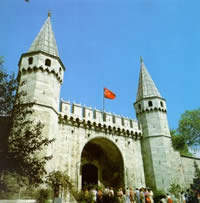
The main entrance to the first and outermost courtyard, known as the "Courtyard of the Regiments" is through the Imperial gate known as Bab-i-Humayun. The portal of Bab-i-Humayun is flanked by two towers built during the time of Sultan Mehmet II. In the past the severed heads of traitors were displayed at the gate. The portal was guarded by a special regiment of palace guards. However, the general public could have access through this gate as the first courtyard was open to the public.
Fountain of Sultan Ahmed III
The fountain just outside the gate is the fountain of Sultan Ahmed III, which is the most striking example of 18th century "Meydan" fountains.
The service buildings, the tiled pavilion, the archaeological museum, Haghia Eirene church
Around the periphery of the first courtyard were the service buildings, which included a hospital, bakery, mint, accommodation for palace servants and guards and the firewood depots. There was an area in the first courtyard that was reserved for cultivating vegetables, which were supplied to the palace. A building of significance in this courtyard was the Cinili Kosk (the tiled lodge or pavilion), the first building constructed in the Topkapi palace complex, and which is now a ceramics museum, exhibiting Turkish ceramics from the 12th century to the present day. Next to the tiled pavilion is the Archaeological museum which houses one of the most outstanding collections in the world, and consists of archeological exhibits dating from ancient Byzantine period. Another building of historical importance is the Haghia Eirene, a 6th century Byzantine church which was converted into a military museum, and later restored and used as a concert hall because of its excellent acoustics. An ancient Gothic Column from the Byzantine period erected in the 3rd century A.D. is also preserved in the first courtyard.
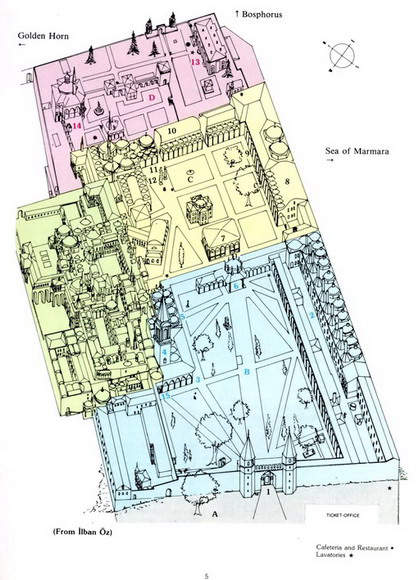
Layout of the Topkapi Palace Museum
A The first court
B The second court
C The third court
D The fourth court
1 The middle gate (gate of greeting)
2 The kitchens (Chinese and Japanese Porcelain - Silverware)
3 The hall of Divan
4 The tower of justice
5 The armoury
6 The gate of Felicity
7 The Throne room
8 The costumes
9 The treasury
10 The Miniature painting collection
11 The clocks
12 The Pavilion of the Blessed Mantle
13 Mecidiye Pavillon
14 Iftariye (breakfast) and Baghdad Pavilion
15 The Harem
The Second Courtyard
Babus-selam or the "Gate of Salutation"
From the first courtyard, entry to the second courtyard is gained through the gate known as the Orta Kapi or Babusselam which may mean "the gate of greeting" or the "peace gate." This gate is also flanked by two towers on either side, and today this gate is the formal entrance to the Topkapi museum.
Divan Odasi or the Chamber of State buildings
The administrative center of the state and the government, the "Divan Odasi" or the "Chamber of State" are situated in this courtyard, on the left as one enters through the Babusselam. The "Council of State" met four days in a week under the chairmanship of the Grand Vizier. Other participants at the meetings were the Viziers and their secretaries. The Sultan normally did not participate in the meetings, but had the privilege of listening to the deliberations if he so wished from a high window masked by curtains, in one of the walls separating the council chamber from the Harem. The hall of the "Council of State" was also the venue for the occasional feasts given in honor of visiting foreign missions. The "Tower of Justice" the only tower in the palace grounds, is also situated among the "Council of State" buildings. The tower was so named because justice in the name of the state was dispensed from the buildings surrounding this tower.
The state treasury buildings, a display house for old weapons
The large eight-domed building adjoining the "Council of State" buildings, with broad eaves was the state treasury. Today this building houses an exhibition of a rich collection of old weapons. Armor and weapons on display include those used by the Sultans, the palace guard, the national army, and weapons captured from foreign armies in battle.
Venue for state ceremonies and receptions
The second courtyard was the venue for state ceremonies as well as for receptions for foreign emissaries. The large extent of the second courtyard which had an area of 22 acres, sometimes enabled a crowd of up to 10,000 people to attend these ceremonies. Whenever the Sultan participated in such events the imperial throne was placed at the opposite end of the courtyard, just in front of the "Gate of Felicity". Perfect silence prevailed during such ceremonies, and as a show of respect the crowds assembled stood up with their hands clasped in front, before the ceremonies started. On normal working days of the week, citizens who had official business to attend to, were allowed access into this courtyard, and so were the representatives of the Janissary Corps on paydays.
The palace kitchens, display area for the world's largest collection of porcelain ware
On the right periphery of the second courtyard is the row of palace kitchens, with twenty chimneys. It is said that during the period of rule of the Sultans, the palace kitchens employed over a thousand cooks and assistants who cooked and served meals to the different sections of the palace. Today the restored palace kitchens have been converted to an exhibition hall that displays a representative collection of about 2,500 pieces out of a total of 12,000 pieces, the largest collection of porcelain ware , glassware and silverware in the world. The porcelain ware are classified according to their country of origin. One section displays porcelain ware and glassware produced in Istanbul. A second section displays porcelain ware and silver ware originating from Europe. Another section is allocated to the Chinese porcelain collection, which included the unique Chinese celadons, which were said to change color when the food was poisoned. Sections are also allocated to the Japanese porcelain collection and the blue and white, mono and polychrome porcelain objects. The last section of this display was allocated to everyday kitchen utensils, coffee sets and gold-plated copper ware.
The Harem
Harem which in Arabic means forbidden, refers to a restricted area in the palace which is the living quarters of the sultan and his family, which includes his mother, brothers, sons and daughters, his female consorts and their woman servants. Other residents of this restricted area were an elite corps of male guardians who were castrated black slaves from Ethiopia, commonly referred to as eunuchs who acted as servants and administrators of the harem. The sultan's mother was the sole ruler of the harem, and there was no title in the empire as the "Empress" normally found in western monarchies.
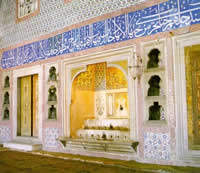
Photo from Istanbul Government Website
The harem consists of long narrow hallways, with about 400 rooms scattered around small courtyards. The part of the harem which was allocated to the mother of the sultan consisted of 40 rooms. Besides the rooms, spacious domed halls, Turkish baths, fireplaces and hearths, pools and fountains and other special halls and rooms are also found in the harem. Over the years the harem had undergone alterations and extensions. A large hall that dates to the reign of Murad III, has a pool filled by fountains and decorated with beautiful 16th century tiles. This hall leads to a small library and the "fruit room" decorated with paintings of fruits and flowers. Two rooms constructed in the 16th century with rich wall decorations and matching stained glass windows, were allocated to the Crown Prince, who according to the laws of succession of the Ottoman empire was the eldest member of the dynasty, instead of the eldest son of the reigning sultan. This gave a sense of security to the children of the sultan, who could live without any fear of assassination. The total floor area covered by the harem is as big as the area covered by the 3rd or 4th courtyards. The harem which is on the left side of the palace, is situated partly to the left side of the rear of the second courtyard and partly to the left of the front side of the third courtyard. The present access to the harem is through the second courtyard via the Divan Odasi or the Chamber of State buildings.
The concubines serving the sultan and his family were selected from the most attractive and healthy young maidens belonging to different races or ethnic groups, some of whom were sent to the sultan as gifts. The girls usually entered the harem at an early age and were brought up by elderly ladies of the harem in a strict disciplinary environment. The girls were taught everything about the rules, customs and traditions of the palace and the rules of protocol in the palace. When the girls had matured into beautiful maidens and were conversant with all the rules of the palace, they were allowed to serve the sultan. Some of these maidens who were able to attract the attention of the sultan and earn his favors eventually end up as his wives. Being human, the wives of the sultan had their jealousies, hatred and rivalries, and vying with each other and being part of intrigues to get closer to the sultan were part of the daily life in the palace. But being matured, intelligent and benevolent individuals the Sultans always adopted an impartial attitude towards their wives, and peace and tranquility usually prevailed in the harem.
The Third Courtyard
Entry to the third courtyard from the second is through the "Babus-sade" or the "Gate of Felicity," which was guarded by the white eunuchs. The third courtyard was the private domain of the sultan and therefore entry was restricted to the sultan, who normally passed through "Babus-sade" on horseback, and only a favored handful of statesmen and trusted intimates. Important buildings in this courtyard were the throne room, the sultan's treasury, the sacred relics chambers, the imperial university and the library of Ahmet III.
The Throne Room or the Audience Chamber
The throne room or the audience chamber which was situated very close to the "Babus-sade" was the place where the sultan met high government officials and received foreign ambassadors. The Grand Vizier and members of the Divan came to the audience chamber to present their resolutions to the sultan for ratification. It is said that for security reasons the lower grades of workers in the audience chamber were recruited from deaf and mute persons.
The Library of Ahmet III
Just after the audience chamber almost at the center of the courtyard is the library built by Ahmed III in the early 18th century. This building is a typical example of a structure that blends harmoniously the baroque and Turkish architectural styles.
The Imperial University
The buildings on the right side of the audience room were the classrooms and lecture halls of the Imperial University, which was a training school for producing civil servants, who after graduation were posted to positions of responsibility in the government, such as administrators, accounting officers etc. in different regions of the vast empire. The Viziers and Grand Viziers of the government were graduates of this school. The managers of the Imperial school were military officers, who also served the sultan at the same time in various other capacities.
The Imperial Costume Collection
Today the same buildings that served as the Imperial school, houses the Imperial costume section of the Topkapi Palace. These imperial costumes were made of fabric that were woven in the palace looms, and embroidered with silk. gold and silver thread. There are a total of 2,500 of these handmade costumes, that had been preserved carefully in special chests since the 15th century. Truly, the unique collection of the sultan's wardrobes, is undoubtedly an outstanding collection of its kind in the whole world. Apart from garments other items displayed in this section include silk carpets and prayer rugs used by the sultans.
The Treasury
The former treasury of the sultan has been converted today to the treasury of the Topkapi Museum, which houses in its four rooms the most valuable collection in the museum, which include jewels and jewelry, jewel-encrusted thrones, jewel-encrusted daggers and other objects, enameled objects etc. This collection is undoubtedly one of the richest collections of its kind in the world. Besides masterpieces of the Turkish art of jewelry manufacture belonging to different periods, exquisite jewelry creations from Europe, India and the far east are also found in this collection. In each one of the four rooms or salons where the collection is exhibited an Imperial throne of a different era is also included.
Room I
Important exhibits in the first room of the treasury include the following:-
1) The complete battle armor of Sultan Mustafa III, made up of iron mail that afforded full protection to the wearer from head to toe, and also included his sword and shield and foot gear for his mount. The battle dress was encrusted with gold and precious stones.
2) Qura'n covers decorated with pearls, including a black velvet cover decorated with pearls and a diamond in the center, with three pearl tassels.
3) The ebony throne of Sultan Murad IV, inlaid with ivory and mother-of-pearls and covered with 17th century Turkish hand-woven fabric.
4) The diamond-studded walking stick of Abdulhamid II, that was gifted by Kaiser Wilhelm of Germany.
5) An ornate Indian music box.
6) Turkish and Iranian pots, vases, jugs, sherbet set in gold,
7) Gold candelabras, gold water pipes,
8) Solid jade vases and ports.
Room II - Emerald Room
1) Emerald praying beads and arrow quivers encrusted with gold and with flower motifs of diamonds and emeralds.
2) An emerald pendant belonging to Sultan Andulhamid I, with three large emeralds set in a triangle, surrounded by leaf patterns on a gold framework, and 48 strings of pearls forming the tassel.
3) A six-sided pendant set with emeralds, pearls, diamonds and sapphires, on a gold framework, Commissioned by Sultan Ahmet I in 1617.
4) An aigrette with a heavy gold pin encrusted with two 5 cm long emeralds and a garnet, with diamond-encrusted gold leaves and loops of pearls attached.
5) Emerald dagger gifted to Sultan Mehmet IV at the time of dedication of Yeni Mosque. The dagger is 31 cm long with an emerald encrusted handle and a jewel-encrusted gold sheath.
6) Uncut emeralds some weighing up to several kilograms each.
7) The 35 cm long "Topkapi Emerald Dagger" the subject of this web article, a gift to the Persian emperor Nadir Shah by Sultan Mahmud I, but never delivered, as Nadir Shah was assassinated before the embassy carrying the gift reached him.
9) The throne of Sultan Ahmet I, a rare and unique masterpiece of 17th century woodwork executed in walnut and inlaid with mother-of-pearl, tortoise shell and other precious stones.
10) Hand carved works of jade.
11) The golden cradle in which newborn prospective sultans were presented to their fathers, the reigning Sultans. The cradle decorated with flower motifs and encrusted with diamonds and emeralds has dimensions of 103 X 54 cm. A jewel-encrusted pendant overhangs the cradle.
Room III
1) More Qur'an covers decorated with precious stones.
2) A jewel-encrusted gold dessert-set belonging to sultan Abdul Hamid.
3) A pendant carrying the seal of Sultan Mahmud II, encrusted with diamonds, on a blue and pink enamel background.
4) A collection of very famous cut diamonds.
5) Brooches, rings and other jewelry items.
6) A gold tray and gold incense burner.
7) The 86-carat "Spoonmaker's Diamond" one of the most famous diamonds in the world, set in silver and surrounded by 49 smaller diamonds, which is the most prominent exhibit in this room. Please click here for separate web article on "Spoonmaker's Diamond."
8) The twin solid gold candelabras, each weighing 48 kg and decorated with 6,666 diamonds. The set was commissioned by Sultan Abdulhamid.
9) Several medals and decorations, which were gifts from heads of state from around the world.
10) The magnificent Holiday Throne of the Ottoman Sultans, made of gold and encrusted with jewels, used during coronations and religious holidays. The throne that weighs 350 kg was a gift to Sultan Murat III, by the Egyptian Governor Ibrahim Pasha in 1585.
Room IV
1) The most prominent exhibit in this room is the throne of Sultan Mahmud I, a gift by the Persian King Nadir Shah in 1747, just before he was assassinated. The throne with a green and red background encrusted with emeralds and pearls, is a masterpiece of Indian craftsmanship. The throne is also known as the "Peacock Throne" as it has some resemblance to the original "Peacock Throne" of Shah Jahaan, said to be the most splendorous throne ever made in the history of mankind, that was carried away as war booty by Nadir Shah when he invaded Mughul India in 1739. Before leaving India, Nadir Shah also got his unwilling host, the Mughal Emperor Muhammad Shah, to commission a replica of the "Peacock Throne" using his court artisans, which too he carried away to Iran. It is believed that the "Peacock Throne" in the Topkapi museum treasury, is actually the replica of the original "Peacock Throne" made by Emperor Muhammad Shah at Nadir Shah's insistence. The original "Peacock Throne" of Shah Jahaan was stolen and dismantled after the death of Nadir Shah, during the period of anarchy that prevailed in the immediate aftermath of his assassination.
2) Swords, rifles, spoons and prayer beads, all extravagantly decorated.
3) The chest in which the mantle of the Holy Prophet Muhammad was once kept.
Portrait and Miniature Exhibit Hall
This hall is located in the building with a colonnade that stands between the Treasury and the Sacreds Relics Chamber, on the opposite end of the courtyard from the Audience Chamber or Throne Room. The museum offices are also located in this building, and a large exhibition hall where temporary exhibitions are organized from time to time.
This section has a rich collection of miniatures, manuscripts, books and writing tools, and some of the rare items have been put out on display. Oil portraits of the Sultans of the Ottoman Empire adorn the walls of the galleries of the hall. The ground floor of the hall displays artwork from the Islamic World from the 13th to 20th centuries.
The Clock Collection
On the same side as the Portrait and Miniature Exhibit Hall, and just adjacent to it, is the hall exhibiting the clock collection. The collection of clocks in this section is perhaps the richest collection of clocks in the world originating from the 16th to 19th centuries. They consist of wall and table clocks and watches of a variety of makes, manufactured in different countries and presented as gifts to the palace. There are also clocks made by Turkish masters. Some of the watches carry the portrait of Abdulmejid and Abdulaziz. A bird cage hanging from the dome displays an enameled clock from its underside. The largest clock in the room, which is of English origin, has a height of 3.5 m and a width of 1.0 m, and contains an organ.
The Sacred Relics Chamber
The Sacred Relics Chamber is located in the domed hall which was previously used as the throne room, before the construction of the new throne room next to the Babus-sade. It is situated directly opposite the treasury on the other side of the courtyard. The walls of the hall are covered with 16 th century Iznik tiles.
The building houses the sacred relics of Islam, brought to Turkey after the conquest of Egypt in the 1517 by Yavuz Sultan Selim I. Among the most important items in this sacred collection are one of the first manuscripts of the Qur'an written on deer skin, authenticated by the Othman the 3rd Caliph of Islam., the keys of the Ka'aba in Mecca, and some personal items and weapons used by the Prophet and his Caliphs. Among the weapons are the swords and the bow of the Prophet Muhammad and his Caliphs. Among the personal items used by the Prophet is a mantle or cloak used by the Prophet. Other items include the seal of the prophet, a letter written by the Prophet, and some relics from his body such as hairs from his beard, some of his extracted teeth, his footprint and soil from his graveyard. The sterling silver chest that held the sacred relics for centuries is also kept in this chamber.
The Fourth Courtyard
Access from the 3rd to the 4th courtyard is by a passage. The 4th court yard is the rear most section of the Topkapi palace, within which are located several pavilions surrounded by gardens. One pavilion in this courtyard is the "Revan Pavilion" which is the only wooden pavilion in the palace complex, and built by architect Koca Kasim in 1635. The "Baghdad Pavilion" also built by Koca Kasim in 1639 is an octagonal-shaped pavilion much bigger than the "Revan Pavilion." Between the "Revan pavilion" and the "Baghdad Pavilion" is the circumcision room and the place where the Sultans normally broke their daily fasting at sunset during the month of fasting (Ramazan).
The Mecidiye Pavilion at the right extreme corner of the courtyard was the last addition to the palace.
You are welcome to discuss this post/related topics with Dr Shihaan and other experts from around the world in our FORUMS (forums.internetstones.com)
Related :-
Swords Daggers and Sheilds of the Iranian Crown Jewels
References
1.The Columbia Encyclopedia, Sixth Edition - 2008
2.Ottoman Web Site - www. osmanli700.gen
3.Mahmud I - from Wikipedia, the free encyclopedia
4.The Turkish Journal of Collectable Art - May 1985, Issue 2.
5.Topkapi (film) - From Wikipedia, the free encyclopedia.
6.Overview of Topkapi (1964) - website of Turner Classic Movies.
7.Topkapi Palace Museum - www.ee.bilkent.edu
8.Topkapi Palace - website of the Government of Istanbul

 Home
Security & Guarantee
How it Works
Technology Partners
Updated Tables
Famous Diamonds
More Famous Diamonds
Famous Pearls
Famous Gemstones
Contact Dr Shihaan Larif
Contact Senior Editor
Famous Jewelry
Reference Database
Forums
Learning Center
Gemstone Gallery
e-mail Notifications
Advertise
Press Release
About Us
Privacy Policy
Contact Us
FAQ'S
Site Map
Staff Mail Login
Staff Documents
Birthstones
History
Minerals
Shows
Live Metal Prices
Jewellery Gallery
News
Marketplace
Marketplace Support
Open Store
Online Auctions
Join Us & Contribute
Directory
Classifieds
List your products
Wholesale Trading
Post Buy Request
Go Green Policy
Site Updates
Upcoming-ToDo List
Latest News
Latest Articles
Latest Blog Updates
Chat Rooms
Job Board
User Gallery
Videos
New Newsletter Archive
Old Newsletter Archive
Jewelry & Mineral Blog
User Blogs & Social Network
Search
Answers (Q & A)
Valuation
Help me find a diamond/jewelry
pin.internetstones.com- Social Pinboard- Sart yours & connect with millions
Invite Friends From Yahoo, Gmail etc-One Click
Home
Security & Guarantee
How it Works
Technology Partners
Updated Tables
Famous Diamonds
More Famous Diamonds
Famous Pearls
Famous Gemstones
Contact Dr Shihaan Larif
Contact Senior Editor
Famous Jewelry
Reference Database
Forums
Learning Center
Gemstone Gallery
e-mail Notifications
Advertise
Press Release
About Us
Privacy Policy
Contact Us
FAQ'S
Site Map
Staff Mail Login
Staff Documents
Birthstones
History
Minerals
Shows
Live Metal Prices
Jewellery Gallery
News
Marketplace
Marketplace Support
Open Store
Online Auctions
Join Us & Contribute
Directory
Classifieds
List your products
Wholesale Trading
Post Buy Request
Go Green Policy
Site Updates
Upcoming-ToDo List
Latest News
Latest Articles
Latest Blog Updates
Chat Rooms
Job Board
User Gallery
Videos
New Newsletter Archive
Old Newsletter Archive
Jewelry & Mineral Blog
User Blogs & Social Network
Search
Answers (Q & A)
Valuation
Help me find a diamond/jewelry
pin.internetstones.com- Social Pinboard- Sart yours & connect with millions
Invite Friends From Yahoo, Gmail etc-One Click




Our Global Jewelry Industry Job Network


Buy & Sell in our Marketplace

Subscribe to our Newsletter

List in our Classifieds

List in our Directory

User Uploaded Gallery

Powered by Ultra Secure
Amazon (USA) Cloud Network

Founder Internet Stones.COM
Register in our Forums

| Featured In
|
|
|
|
|
|
|
|







Blog & Education Feed
Articles Feed
 |
 |
 |

Copyright © .Internet Stones.COM. All rights reserved.