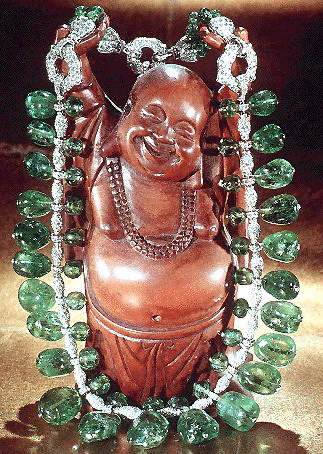
Tumbled Emerald Necklace on Wooden Laughing Buddha
Open FREE Unlimited Store Join Our Newsletter
The Tumbled Emerald Necklace - a popular exhibit in the NMNH of the Smithsonian Institution
The tumbled emerald necklace hanging from the raised hands of the statute of a laughing Buddha in the standing posture, is a popular exhibit among the gem and mineral collection of the National Museum of Natural History of the Smithsonian Institution, displayed in the Janet Annenberg Hooker Hall of Geology, Gems and Minerals.

Description of the necklace
The necklace consists of two rows of tumbled emeralds strung together by a silver or platinum wire passing through rings connecting pairs of outer large and inner small emeralds together. There are twenty three such pairs connected by rings, and the wire passing through the rings connect all twenty three pairs together forming the necklace. The outer large emeralds appear to be somewhat like pear-shaped stones, but being tumbled stones do not have a uniform shape. Stones at the bottom of the necklace appear to be somewhat irregular, but well polished. Other stones are oval or pear-shaped, and are of various sizes. but all stones are well polished. The inner row of small tumbled emeralds appear to be rounded in shape.
©Smithsonian Institution
The emeralds have very good clarity and transparency, two characteristics of high quality emeralds. The color of the emeralds also appear to be herbal green, the color characteristic of Muzo emeralds from Colombia. The color, clarity and transparency of the emeralds seem to conform with the characteristics of Muzo emeralds, which have less inclusions and have a herbal green color. The total carat weight of the emeralds in the necklace is not known, but given the high quality of the emeralds, the necklace is indeed a valuable piece in the National Gem Collection.
It is not known how the necklace came into the possession of the NMNH of the Smithsonian Institution, but if the necklace has a historical provenance its value and significance is tremendously increased. Readers who may have more information about this necklace are kindly requested to provide same as comments to this webpage.
Tumbling of gemstones
Tumbling of rough gemstones is a cutting and polishing technique that does not require the skill and expertise of a gemstone facetor. It is a technique that follows nature's method of wearing irregular rocks and stones by rolling them over and over in streams and rivers, which causes the sharp edges to be worn away until a smooth surface is left. Oval and spherical shapes with smooth rounded edges are formed by this method in nature, a slow process that sometimes takes hundreds or perhaps thousands of years. The abrasives used in nature for the process are sand, gravel, larger stones and other rocks, against which the stones abrade as they tumble downstream.
Tumbling of rough gemstones using a rotatory or vibratory tumbler is actually an acceleration of the process taking place in nature. The rough gemstones are loaded into the barrel of the rotatory tumbler, and after adding abrasives, such as silicon carbide and water, the barrel is rotated at low speed for extended periods, from several days to weeks depending on the hardness of the stone. Tumbling is started with coarse grades of abrasives, and progressively changed to finer and finer grades of abrasives, which results in the gradual smoothing and polishing of the stones into attractive shapes. The tumbling barrels are designed as hexagonal shaped barrels, in order to enhance the stirring action of barrel rotation. In vibratory tumblers the barrel containing the rough stones, abrasives and water, undergo vibration instead of rotation. The progress of the smoothing and polishing is more easily examined in a vibratory tumbler, which does not require the machine to be halted. But, in the case of the rotatory tumblers the machine has to be halted before checking the progress of the stones. Tumbling is also used to polish large quantities of metal jewelry.
The Laughing Buddha
Laughing Buddha statutes depict a stout, smiling or laughing, bald-headed man, half naked with exposed pot belly stomach, symbolizing happiness, good luck and plentitude. Some of the sculptures of the laughing Buddha show small children at his feet, or a begging bowl representing his Buddhist nature. According to legend, rubbing the pot belly of the laughing Buddha may bring forth wealth, good luck and prosperity. The laughing Buddha is the patron saint of fortune tellers, restaurateurs and bartenders, being a deity of contentment and abundance. When people over eat or drink, their over indulgence is jokingly attributed to the influence of the laughing Buddha.
The laughing Buddha known as Budai in Chinese or Hotei in Japanese, is said to be based on an eccentric Chinese Zen Buddhist monk, who lived over a thousand years ago during the time of the Liang dynasty, and has been incorporated into the Buddhist, Taoist and Shinto cultures of the far-eastern countries such as China, Taiwan, Japan and Thailand. His image not only graces the Buddhist temples in these countries, but also hotels, restaurants, businesses and private homes, and is also worn as amulets by the people believing that it brings good luck and prosperity to them. Budai who was a native of Fenghua, was a man of good and loving character, and a benevolent monk, always ready to help his people. Hence he came to be regarded as a Maithriya Bodhisattva - a merciful Buddha - by his people.
You are welcome to discuss this post/related topics with Dr Shihaan and other experts from around the world in our FORUMS (forums.internetstones.com)
Related :-
Madeleine H Murdock's Emerald Necklace
Ashok Kumar Sanchetis Carved Emerald Smithsonian Institution
References
1.Budai - From Wikipedia, the free encyclopedia.
2.How are gems cut and polished ? tradeshop.com
3.Website of the Smithsonian Institution.
 Home
Security & Guarantee
How it Works
Technology Partners
Updated Tables
Famous Diamonds
More Famous Diamonds
Famous Pearls
Famous Gemstones
Contact Dr Shihaan Larif
Contact Senior Editor
Famous Jewelry
Reference Database
Forums
Learning Center
Gemstone Gallery
e-mail Notifications
Advertise
Press Release
About Us
Privacy Policy
Contact Us
FAQ'S
Site Map
Staff Mail Login
Staff Documents
Birthstones
History
Minerals
Shows
Live Metal Prices
Jewellery Gallery
News
Marketplace
Marketplace Support
Open Store
Online Auctions
Join Us & Contribute
Directory
Classifieds
List your products
Wholesale Trading
Post Buy Request
Go Green Policy
Site Updates
Upcoming-ToDo List
Latest News
Latest Articles
Latest Blog Updates
Chat Rooms
Job Board
User Gallery
Videos
New Newsletter Archive
Old Newsletter Archive
Jewelry & Mineral Blog
User Blogs & Social Network
Search
Answers (Q & A)
Valuation
Help me find a diamond/jewelry
pin.internetstones.com- Social Pinboard- Sart yours & connect with millions
Invite Friends From Yahoo, Gmail etc-One Click
Home
Security & Guarantee
How it Works
Technology Partners
Updated Tables
Famous Diamonds
More Famous Diamonds
Famous Pearls
Famous Gemstones
Contact Dr Shihaan Larif
Contact Senior Editor
Famous Jewelry
Reference Database
Forums
Learning Center
Gemstone Gallery
e-mail Notifications
Advertise
Press Release
About Us
Privacy Policy
Contact Us
FAQ'S
Site Map
Staff Mail Login
Staff Documents
Birthstones
History
Minerals
Shows
Live Metal Prices
Jewellery Gallery
News
Marketplace
Marketplace Support
Open Store
Online Auctions
Join Us & Contribute
Directory
Classifieds
List your products
Wholesale Trading
Post Buy Request
Go Green Policy
Site Updates
Upcoming-ToDo List
Latest News
Latest Articles
Latest Blog Updates
Chat Rooms
Job Board
User Gallery
Videos
New Newsletter Archive
Old Newsletter Archive
Jewelry & Mineral Blog
User Blogs & Social Network
Search
Answers (Q & A)
Valuation
Help me find a diamond/jewelry
pin.internetstones.com- Social Pinboard- Sart yours & connect with millions
Invite Friends From Yahoo, Gmail etc-One Click




Our Global Jewelry Industry Job Network


Buy & Sell in our Marketplace

Subscribe to our Newsletter

List in our Classifieds

List in our Directory

User Uploaded Gallery

Powered by Ultra Secure
Amazon (USA) Cloud Network

Founder Internet Stones.COM
Register in our Forums

| Featured In
|
|
|
|
|
|
|
|







Blog & Education Feed
Articles Feed
 |
 |
 |

Copyright © .Internet Stones.COM. All rights reserved.