Umm Kulthum's Pearl Necklace
Open FREE Unlimited Store Join Our Newsletter
Origin of Name :-
The name refers to a 19th-century nine-stranded elaborate festoon pearl necklace, designed in the best Indian traditions of jewelry crafting, similar in style to the famed Satlada necklaces of India, that once belonged to Umm Kulthum (pronounced-Kulsum), the greatest Arab female singer of the 20th-century, of Egyptian nationality, who was fondly referred to as "Kawkab-el-Sharq," meaning, the "shining star of the Middle East."

The necklace that has attained international fame because of its historic provenance, particularly its ownership by the legendary singer of international repute, was actually a gift by one of her most ardent and devoted fans, who was none other than His Royal Highness, the Late Sheik Zayed bin Sultan al-Nahyan, the former ruler of the United Arab Emirates. The necklace was presented to Umm Kulthum by Sheik Zayed, somewhere between 1967 and 1971, in appreciation of her long singing career that mesmerized the Arab world for nearly five decades.
Characteristics of the pearl necklace
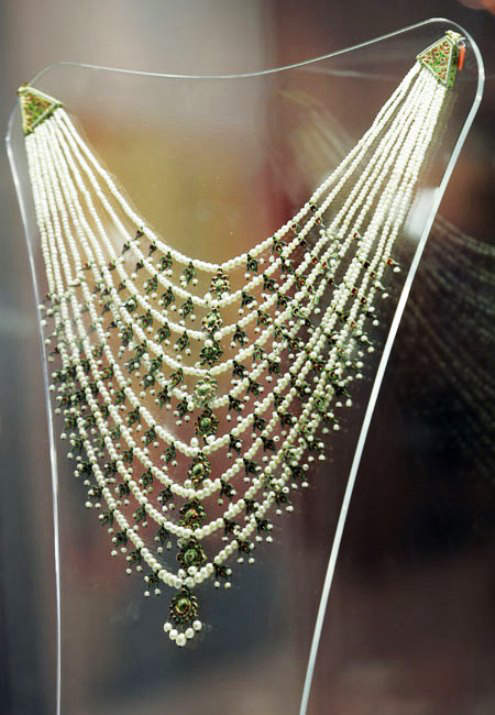
© Christie's
The "Satlada type" nine-stranded festoon pearl necklace was designed in India around 1880, and consists of approximately 1,888 pearls. Each of the nine strands in the necklace, is composed of white spherical natural pearls, with the larger pearls occupying the curvature of the festoons, and the size of the pearls progressively decreasing towards the ends of the strands. In keeping with the design of antique necklaces, there is no clasp joining the strands together as modern necklaces. Instead, the ends of the nine strands converge on either side towards a triangular-shaped cap-like device made of enameled gold or silver, to which the ends of the pearl strands are attached. A tough silk rope arising from each of these cap-like devices, facilitates the necklace to be secured around the neck. This arrangement is advantageous in a way compared to modern necklaces with clasps, as all pearls in the necklace are displayed on the chest in front, and no pearls are hidden behind the neck.
Another special feature of this festoon necklace is that each of the strands are interspersed at regular intervals of four pearls with enameled pendants carrying three pearls each, except for the main pendant at the curvature of the festoon in the longest strand which carries five large pearls. All nine strands have a main pendant at the curvature of the festoon, and all these pendants lie along a perfect vertical line, which is also the median line of the necklace. For description purposes of this article let us number the strands serially from top to bottom, the shortest strand at the top becoming strand no. 1 and the longest strand at the bottom, strand no. 9. In strand no. 9, which is the lowest and main strand in the necklace, there are 13 smaller pendants on either side of the main pendant. Moving upwards from the lowest strand, in strand no. 8, there are 11 smaller pendants on either side of the main pendant. Following this pattern we see that in strand nos. 7, 6, 5, 4, 3, 2 and 1, there are respectively, 10, 9, 8, 7, 6, 5, and 4 smaller pendants on either side of the main pendants. In other words the number of smaller pendants progressively decrease as we go up from the lower strand to the upper strand.
We are now in a position to compute the number of pendants in each of the strands in the necklace. The lowest strand, which is strand no. 9, has (13 x 2) + 1 = 27 pendants. Repeating the calculation for the other strands, there are 23, 21, 19, 17, 15, 13, 11 and 9 pendants respectively in strand nos. 8, 7, 6, 5, 4, 3, 2 and 1. Thus altogether there are 155 pendants in the nine-stranded necklace of which nine are main pendants and the remaining 146 are smaller pendants. The presence of the smaller pendants between the strands each carrying three pearls, has a spectacular and dramatic effect on the necklace, that cannot be achieved if the necklace was composed of pearl strands only. Overall the features incorporated in this unique necklace is a living testimony to the extraordinary skills of the Indian jewelry craftsmen who designed this necklace in the late 19th century.
History of the pearl necklace
The source of the pearls in the necklace
The Umm Kulthum's pearl necklace is believed to have been designed around the year 1880 in Bombay (Mumbai), India, the main center of the pearl trade in Asia at that time. The hub of the international pearl industry at that time was still the Persian Gulf, the Red Sea and the Gulf of Mannar, and was based mainly on the pearl oyster species Pinctada radiata. The pearls produced were mainly medium, small, and the smallest sizes known as seed pearls, and appeared in several colors such as white, cream, yellow and golden. The pearls in the Umm Kulthum's pearl necklace are medium and small sized, and may well have originated from the Pinctada radiata oysters. During this period, pearls produced in the Persian Gulf, the Red Sea and the Gulf of Mannar, mainly reached the Bombay pearl markets, where the dealers got better prices for the pearls, than elsewhere in the world, such as London. This was because the Maharajahs of the princely states of India, were prepared to pay better prices for such pearls and jewelry made out of these pearls. This resulted in the establishment in Bombay of a jewelry manufacturing industry based on pearls. Most of the pearls were graded according to quality, color and sizes, and then beaded ad strung into necklaces, bracelets, and other types of jewelry, for which the Maharajahs paid attractive prices. The Nizams of Hyderabad and the maharajahs of Baroda were some of the more prominent customers of the Bombay pearl markets. The pearl carpet of Baroda, the most extravagant carpet ever made in the history of mankind, incorporates over a million seed pearls originating from the Persian Gulf, the Red Sea and the Gulf of Mannar, purchased at Bombay by the agents of Gaekwar Khande Rao of Baroda, who commissioned the carpet in 1860, with a view of fulfilling a vow to cover the tomb of the Holy Prophet of Islam, Prophet Muhammad, at the Holy City of Medina.
Some of the middle eastern rulers were also customers of the pearl jewelry produced in Bombay at that time, even though oil had not been discovered in the middle east, and these kingdoms did not possess the riches that they own today. Thus, the Umm Kulthum's pearl necklace appears to have been executed by the jewelry craftsmen of Bombay, on a special order placed by one of the royal families based in the Gulf region, and perhaps the royal family might have also supplied the pearls necessary for the execution of this order.
The original owners of the pearl necklace - the ruling family of the sheikdom of Abu Dhabi
The Umm Khultum Pearl Necklace was designed during the period of rule of Sheik Zayed bin Khalifa al-Nahyan from 1855 to 1909
The nine-stranded Umm Kulthum festoon pearl necklace was originally part of the crown jewels of the ruling family of the sheikdom of Abu Dhabi, the largest of the seven "Trucial Sheikdoms" which together with Bahrain and Qatar became British Protectorates by the treaty of 1892, and remained so until the expiry of the treaty on December 1, 1971. At the time the Umm Khultum Pearl Necklace was designed in 1880 in Bombay, probably at the request of the ruling family of Abu Dhabi, the sheikdom was ruled by Sheik Zayed bin Khalifa al-Nahyan, whose reign extended from 1855 to 1909. Sheik Zayed bin Khalifa al-Nahyan was the grandfather of Sheik Zayed bin Sultan al-Nahyan, the ruler of Abu Dhabi from 1966 and the architect and first president of the United Arab Emirates from 1971 to 2004.
The pearling industry, fishing and agriculture were the mainstay of the economy of Abu Dhabi and other Trucial States before the discovery of oil
Prior to discovery of oil in the Trucial States, and the sheikdoms becoming oil exporters beginning from the early 1960s, the mainstay of their economy was agriculture, fishing and the pearling industry. All countries bordering the Arab side of the Persian Gulf such as Kuwait, Saudi Arabia, Bahrain, Qatar, United Arab Emirates and Oman, were engaged in the pearling industry from time immemorial. The pearl banks in the Persian Gulf were mainly found on the Arab side of the Gulf, stretching from Kuwait and the Island of Bahrain in the west to Oman on the tip of the Arabian peninsula, including the strait of Hormuz, and extending up to the Kish Island on the Persian side of the Gulf. The banks were situated from a few hundred meters to around 96 km from the shore, at depths ranging from 2 to 18 fathoms ( 3.6 to 32.4 meters). Bahrain was the center of the pearl industry in the Gulf since ancient times, as most of the pearl oyster reefs were concentrated around this island. Other important pearling areas were found off the coast of Kuwait, the island of Dalmah off Abu Dhabi, Abu Musa, Hormuz and the Lavan-Kish island group on the Persian side.
Regular supplies of pearls from the pearl producing countries such as Abu Dhabi reached the Bombay pearl markets during the 19th and early 20th centuries.
The pearling industry thrived in the nineteenth and early twentieth centuries, providing both income and employment to the people of the Persian Gulf, including the sheikdom of Abu Dhabi. Pearls from the Persian Gulf mainly reached the Bombay markets, because of the attractive prices paid for them. Pearls produced around the island of Dalmah off Abu Dhabi also went to the Bombay markets. During the reign of Sheik Zayed bin Khalifa al-Nahyan from 1855 to 1909, regular supplies of pearls were dispatched to the pearl markets of Bombay. It was during this period in 1880, that Sheik Zayed bin Khalifa al-Nahyan most probably placed the order for the celebrated nine-stranded pearl necklace from the jewelry craftsmen of Bombay.
The decline of the pearl industry after the first world war
The outbreak of World War I in 1914 had a serious impact on the pearl fishery in the Persian Gulf, due to decrease in demand. The war was followed by the Great Depression of the late 1920s and the early 1930s, which had a more devastating effect on the pearl industry. The final death blow was given by Kokichi Mikimoto of Japan, who perfected the technique of producing cultured pearls in 1916, and large quantities of cultured pearls flooded the pearl markets in the 1930s. The industry however survived into the 1940s, as cultured pearls were not universally accepted at the beginning, and eventually in the late 1940s, after the newly independent Indian government imposed heavy taxation on pearls imported from Arab States of the Persian Gulf, the pearling industry finally suffered a natural death, never to raise its head again in the Persian Gulf. The death of the industry caused untold hardship and misery to thousands of people who were dependant on the industry for their livelihood, such a pearl divers, boat owners, pearl dealers and merchants etc. The countries also lost a valuable source of foreign exchange. However, fortunately oil exploratory activities had begun in the 1930s, in the Trucial States including Abu Dhabi, with the help of British investment and technology. Oil was struck in several of the Trucial States, and in 1962 Abu Dhabi exported its first consignment of crude oil.
A short biography of Sheik Zayed bin Sultan al-Nahyan
His early life and education
Sheik Zayed who was born in 1918 in Al Ain, Abu Dhabi was the youngest of the four sons of Sheik Sultan bin Zayed bin Khalifa al-Nahyan, who was the ruler of Abu Dhabi from 1922 to 1926. He was named after his famous grandfather, Sheik Zayed bin Khalifa al-Nahyan, whose rule was the longest in the history of the Emirates, lasting for 54 years from 1855 to 1909. Sheik Zayed bin Khalifa al-Nahyan was known as "Zayed the Great" and was the leader of the Bani Yas tribe, who played a significant role in forging unity between the various tribes of the trucial kingdoms and Oman. Zayed's father Sheik Sultan bin Zayed al-Nahyan was succeeded by his uncle Sheik Saqr bin Zayed al-Nahyan in 1926 for a short time, after which in 1928, his eldest brother Sheik Shakbut bin Sultan al-Nahyan became the ruler of Abu Dhabi. After his father died in 1927, Zayed who was only nine years old at the time, was sent to Al-Ain, about 160 km east of Abu Dhabi, where he spent the rest of his youth and also received his education, which was based on traditional Islamic values, that included the study of the Holy Qur'an, and other associated subjects such as Islamic history and literature, Islamic law and jurisprudence, the traditions (sunnah) of the Holy prophet, etc.
His appointment as Governor of Al Ain in 1946, and his travels abroad with his brother Sheik Shakbut bin Sultan al-Nahyan, that convinced him of the urgent need to develop Abu Dhabi
During this period Abu Dhabi was a British protectorate and was part of the seven Trucial States. The country was poor and undeveloped, and the country's economy was based mainly on fishing, pearl diving and agriculture. In the 1930s the country's economy suffered when cultured pearls from Japan flooded the international pearl markets. In order to help the country look for alternative economic resources, the British Government sent teams of experts to carry out geological surveys in Abu Dhabi. Zayed who was still very young at that time was appointed by his brother Sheik Shakbut bin Sultan al-Nahyan, as guide for the British Geological Survey teams, to help them move around the desert. In 1946, when Zayed was 28 years old, Sheik Shakbut appointed him as the governor of Al Ain. After the expiry of his term of office in 1953, Zayed was again reappointed to the same post. Both Sheik Shakbut and his brother Zayed traveled to Europe to appear at a legal hearing on an oil dispute. They also traveled to other western countries, such as the United States and Switzerland, other Arab States such as Egypt, Syria, Iraq and Lebanon and Asian States such as Pakistan and India. On their return to Abu Dhabi, Sheik Shakbut and Zayed were convinced, that there was an urgent need to develop Abu Dhabi and her neighbors, in order to keep up with development and modernization in the rest of the world.
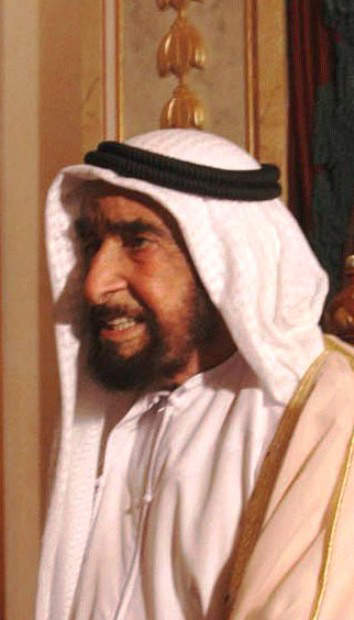
Sheik Zayd bin Sultan al-Nahyan
Photo credit:
https://www.agenciabrasil.gov.br/imagens
Sheik Zayed bin Sultan al-Nahyan takes control of Abu Dhabi in 1966, opening the way to implement the type of development he witnessed in foreign nations
Oil was first discovered in Abu Dhabi in 1958, but the first commercial production started in 1962, from the off shore Umm Shaif field, and later from on shore at Bab. Thus the first cargo of crude oil was exported from Abu Dhabi in 1962, and the oil revenues realized gave a boost to the economy of the country. In 1966, a change of baton took place in the leadership of Abu Dhabi. Sheik Shakbut bin Sultan al-Nahyan who had ruled the country for 38 years, handed over control to his youngest brother, Sheik Zayed bin Sultan al-Nahyan on August 9, 1966. The change in leadership has been variously referred to as a "palace coup" by some authorities and "bloodless coup" by others. Yet, there is no denying of the fact, that this change was the most significant in the history of Abu Dhabi and the Emirates, that saw the emergence of the country from a poor agriculture based economy to an oil-rich economy, that elevated the standard of living of its people and transformed Abu Dhabi and the Emirates to one of the most modern states in the world.
Sheik Zayed bin Sultan al-Nahyan embarks on an ambitious modernization program for his country. Housing and education receives top priority.
After assuming the stewardship of the country, and as the country's oil revenues piled up, Sheik Zayed embarked upon an ambitious modernization program for his previously impoverished country. He identified the priorities for his nation, that included housing, education, health care, development of infrastructure, communications, and the building of an international airport and seaport. Massive housing projects were undertaken to provide basic housing facilities for his people. Next came education. Realizing that the future of his nation depended on a literate and educated population, he invested heavily on the building of new schools and universities, and encouraged both boys and girls to pursue education which was provided free for all citizens. After the founding of the United Arab Emirates, the benefits of education was extended to all other emirates. Today, the U.A.E. is among the most educationally advanced countries in the region. The U.A.E. University in Al Ain had on its roll around 17,000 students in the year 2004. In 1989, a network of technical vocational colleges, known as the Higher Colleges of Technology were opened in each emirate, with separate men's and women's campuses. In 1998, the Zayed University for women opened, with campuses in Abu Dhabi and Dubai. With the expansion of educational opportunities, several foreign countries also opened universities in the Emirates, that included the American University Sharjah with a student population of 4,500 in 2007, and the campuses of universities from the U.S., U.K., and Australia.
Provision of healthcare facilities and infrastructure development also received priority
To provide healthcare for his people, Sheik Zayed built several hospitals, employing highly qualified medical consultants from western and Asian countries, which provided healthcare facilities free of charge. He further decreed that the state would bear the cost of foreign healthcare if required, for those families unable to afford it. Infrastructure development received high priority during the reign of Sheik Zayed bin Sultan al-Nahyan. He built a modern network of roads within Abu Dhabi and highways connecting the different emirates. Bridges were also constructed, including the bridge linking Abu Dhabi to the mainland. The other major projects he undertook was the construction of the Abu Dhabi International Airport, with its unique mushroom-shaped terminal building, and the Abu Dhabi seaport.
Sheik Zayed bin Sultan al-Nahyan's contribution to the environment and conservation
Sheik Zayed brought up in the harsh conditions of the Al Ain desert, was well aware of environmental issues, and the impact a program of afforestation would have on the environment of his country. He allocated funds for the planting of more then 150 million trees, and transformed Abu Dhabi into a green city. He also supervised a program to breed 80 endangered animal species, and created a zoo in Al Ain in 1967. His contribution to the environment and conservation was recognized by the Worldwide Fund for Nature, which awarded him its highest environmental prize, the Golden Panda Award in 1997.
Britain announces the termination of the 1892 treaty. Sheik Zayed's contribution in forming a federation of seven emirates, known as the United Arab Emirates
In January, 1968, Britain announced its decision to terminate its treaty obligations to the seven Trucial States, which together with Qatar and Bahrain were governed as British Protectorates, after the treaty which was first signed in 1892, expired in December 1971. This effectively meant that Britain would withdraw its military presence in the Gulf, which held the prospect of future political instability in the region. Sheik Zayed bin Sultan al-Nahyan had the necessary political acumen to foresee what the future held in store after a British withdrawal, and realized that the best option would be for the nine British Protectorates to join hands to form a single political union, that would be a force to reckon with in the Gulf region in the future. He was the first leader to call for a closer political union between the nine protectorates after the British withdrawal.
Sheik Zayed immediately swung into action, and on February 19, 1968, he met with the ruler of Dubai, Sheik Rashid bin Saeed al-Maktoom at Samih, and had discussions about forming a union between the nine emirates after the withdrawal of Britain. The discussions that were successful led to the signing of an agreement on February 27, 1968, that envisaged the formation of a federation of the nine emirates - Abu Dhabi, Dubai, Fujairah, Sharjah, Ajman, Umm al-Quwain, Ras al-Khaimah, Bahrain and Qatar. During the following three years, Sheik Zayed worked hard to realize his dream of a united federation of the nine states, and had repeated discussions with the leaders of all the emirates, to forge in the unity which was his cherished desire. Unfortunately the leaders of Bahrain and Qatar could not be convinced, and they decided to go in for full independence. Ras al-Khaimah was also reluctant to join initially. Thus on December 2, 1971, six of the nine emirates - Abu Dhabi, Dubai, Fujairah, Sharjah, Ajman and Umm al-Quwain - formed a federation known as the United Arab Emirates (U.A.E.), Sheik Zayed, the architect of the federation, was unanimously elected the president of the new federation and Sheik Rashid of Dubai the vice-president. Just two months afterwards, on February 11, 1972, Ras al-Khaimah also decided to join the federation, increasing the number of emirates to seven.
Sheik Zayed's benevolence benefits not only the people of the UAE but also the people of other countries. The philosophy behind his system of government.
After becoming the president of the United Arab Emirates, Sheik Zayed used the oil revenues of Abu Dhabi to fund projects not only in Abu Dhabi, but throughout the United Arab Emirates. His magnanimity was not confined to the UAE alone. He established the Abu Dhabi Fund for Arab Economic Development, through which he channeled funds for development projects to around 40 less fortunate Islamic nations in Africa and Asia. His other charitable acts involved the adoption of hundreds of orphans and the building of hospitals abroad in Europe, Africa and Asia. Thus he has gone down in history as a great leader and humanist, whose benevolence had not only benefited his own people but also unfortunate people of other countries in the world. Among his other acts of benevolence include the distribution of land free to the poor and landless families, and his tolerance towards people of other religious persuasions, such as Christians and Hindus, among the expatriate workers in his country, who were allowed to have their own places of worship.
The philosophy of his benevolent reign was clearly explained by him when he made the following comments, when asked by the New York Times in April 1997, why there was no elected parliamentary democracy in the United Arab Emirates :-"Why should we abandon a system that satisfies our people in order to introduce a system that seems to engender dissent and confrontation ? Our system of government is based upon our religion, and that is what our people want. Should they seek alternatives, we are prepared to listen to them. We have always said that our people should voice their demands openly. We are all in the same boat, and they are both the captain and the crew. Our doors are open for any opinion to be expressed, and this is well known by all our citizens. It is our deep conviction that Allah has created people free, and has prescribed that each individual must enjoy freedom of choice. No one should act as if they own others. Those in the position of leadership should deal with their subjects with compassion and understanding, because this is the duty enjoined upon them by Allah, who enjoins upon us to treat all living creatures with dignity. Our system of government does not derive its authority from man, but is enshrined in our religion and is based on Allah's book, the Qur'an. What need have we of what others have conjured up ? Its teachings are eternal and complete, while the systems conjured up by man are transitory and incomplete."
Sheik Zayed re-elected as president at five-year intervals until his death in 2004
Sheik Zayed's immense popularity among his subjects in the UAE, led to his re-election again and again at five-year intervals, by members of the Supreme Council, constituted of members from the ruling families of the seven emirates, until his death in 2004. Likewise the ruler of Dubai, Sheik Rashid bin Saeed al-Maktoom was re-elected as vice-president, until his death in 1990, when he was succeeded by his son, Sheik Maktoum.
Sheik Zayed also played a major role in the setting up of the Gulf Co-operation Council, a trade bloc with many economic and social objectives, involving six Arab states of the Persian Gulf, Saudi Arabia, United Arab Emirates, Oman. Kuwait, Qatar and Bahrain. The agreement setting up the council was signed in Riyadh, Saudi Arabia, on November 11, 1981.
His final years, death and succession
In the 1990s, Sheik Zayed's health began to deteriorate, and he used to travel from time to time for medical checkups and treatment to the United States and London. In 1996, he traveled to the United States for a spinal surgery, from which he recovered successfully. In the year 1999, while he was admitted in hospital for some medical tests, the people of the UAE wrote him a personal thank-you letter, with 1.5 million signatures, that represented one-third of the population of the United Arab Emirates. Sheik Zayed was touched by this extraordinary gesture of his beloved citizens. In the year 2000, he underwent a kidney transplant surgery, at the Cleveland Clinic, in the United States, from which he recovered successfully. In the 1990s while his health had been deteriorating, his eldest son, Sheik Khalifa bin Zayed al-Nahyan, who was the Crown Prince and the Deputy Supreme Commander of the UAE armed forces, played an increasing role in the day to day governance of the country. Sheik Zayed, who was 86 years old and had been ailing for sometime and undergoing treatment in London, died on November 2, 2004, which was the 19th day of Ramadan, 1425 A.H. in the Islamic calendar. He was buried in the courtyard of the new Sheik Zayed bin Sultan al-Nahyan Mosque, also popularly known as the Grand Mosque, in Abu Dhabi, whose construction was initiated by the late president himself. Sheik Zayed was succeeded by his eldest son, Sheik Khalifa bin Zayed al-Nahyan, who was unanimously elected as President of the United Arab Emirates, by the rulers of the other emirates in the Supreme Council.
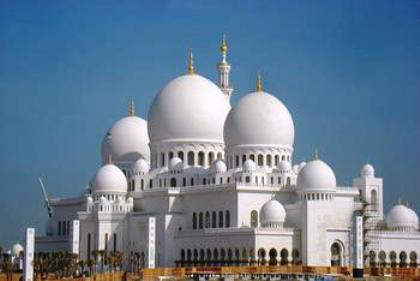
Sheik Zayed bin Sultan al-Nahyan Mosque, Abu Dhabi
The Umm Kulthum Pearl Necklace is inherited by Sheik Zayed bin Sultan al-Nahyan, who presents it Umm Kulthum.
The Umm Kulthum Pearl Necklace which was commissioned in 1880, by Sheik Zayed bin Khalifa al-Nahyan, who was also known as "Zayed the Great," remained with the al-Nahyan royal family as part of its crown jewels, until it was inherited by Sheik Zayed bin Sultan al-Nahyan on August 9, 1966, from his predecessor and eldest brother Sheik Shakbut bin Sultan al-Nahyan, who ruled from 1928 to 1966. It remained with the royal family until somewhere between 1967 and 1971, when the legendary "Kawkab-el-Sharq" the "Shining Star of the Middle East," Umm Kulthum, visited Abu Dhabi for one of her performances, and was received with full state honors by the Emir, Sheik Zayed bin Sultan al-Nahyan, who was an ardent and devoted fan of the reputed singer. It was on this occasion that Sheik Zayed bin Sultan al-Nahyan, presented the historic necklace, an heirloom of the family to Umm Kulthum, in appreciation of her long singing career that had enchanted the Arab World for nearly five decades. The famed singer accepted the gift in all humility and thanked the Emir for his kind gesture.
Umm Kulthum - A short biography
Her early life and discovery of her talents by her father al-Sheik Ibrahim
Umm Kulthum, the most celebrated Arab singer of the modern era, and fondly referred to as the "Voice of Egypt" and the "Shining Star of the Middle East" (Kawkab-el-Sharq), was born on May 4, 1904, to a poor family in a rural village by the name of Tammay al-Zahayrah near the city of al-Sinbillawayn, in the Delta Province of Daqahliyah, Egypt. She was born into a family of singers, and her father, al-Sheik Ibrahim and brother sang religious songs at weddings and other private functions, to supplement his income as the imam of the local mosque. As was the tradition in the village, Umm Kulthum was sent to the local Quranic school, where she memorized the Holy Qur'an, and perhaps picked up the basic skills of reading and writing. She exhibited her singing talents at a very early age, by memorizing the songs her father taught her brother, who use to accompany him for his singing engagements. Al-Sheik Ibrahim was genuinely surprised to discover what the little girl had picked up, just by overhearing her brother's lessons, and was particularly impressed by the strength of her voice. He then encouraged the girl to join the singing lessons, and like her brother she too started performing at village functions. Thus, without any doubt the credit for discovering Umm Kulthum's singing talents, that subsequently mesmerized the entire Arab world, should go to her father al-Sheik Ibrahim. Her exceptionally strong and vibrant voice, made her the star performer of the group, whose popularity increased, throwing open more and more opportunities to the family.
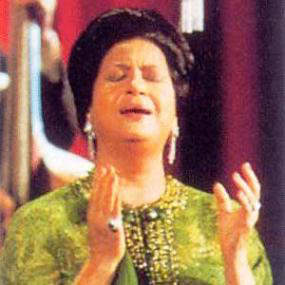
Umm Kulthum
Her migration to Cairo from the village, and the opportunities thrown open to her in her singing career
Well wishers of the family encouraged al-Sheik Ibrahim to take his young daughter to Cairo, in order to further her career in the entertainment business. But, being brought up in the village with their simple life styles, the family was reluctant to move to the busy Cairo metropolis with its fast moving life style, particularly because they had no close relatives in Cairo. Eventually, the breakthrough came when Umm Kulthum, who was now 16 years of age, was noticed by a famous singer in Cairo, Abu al-Aila Muhammad, and the famous oudist Zakariyya Ahmed, who invited the family to Cairo. The family finally moved to Cairo around 1923, and Abu al-Aila Muhammad as promised helped the young girl to meet theatrical agents and find performing opportunities. Being a composer and a singer, Abu al-Aila Muhammad also became her principal teacher, but later Amin Beh Al Mahdy also taught her to play the oud. She became a close friend of Amin Beh's daughter Rawyeha. Amin Beh later introduced her to the cultural circles in Cairo. Abu al-Aila then introduced her to the poet Ahmad Rami, who taught her poetry and improved her command of literary Arabic. Rami later wrote 137 songs for her, and contributed to her phenomenal success. Umm Kulthum who started her singing career in Cairo with the repertory of religious songs composed by her father and sung by her while living in the Delta, changed over to new and modern love songs composed especially for her and written by Rami and others. Her new repertory, elegant personal style and trained voice, elevated her to the top ranks of Cairo's professional singers by the year 1928.
Her life-long involvement with the mass media begins with the inauguration of the Egyptian National Radio, that soars her popularity throughout the Middle East.
She was then introduced to the composer Mohamed-el-Qasabgi, who introduced her to the Arabic Theatre Palace, where she experiences her first real public success. Her fame having soared, in 1932, she embarked on her first Middle Eastern tour, that included cities like Damascus, Baghdad, Beirut and Tripoli. She began making commercial recordings in the 1930s that gave her a stable income and comfortable life. Her life-long involvement with the mass media began in 1934, with the inauguration of the Egyptian National Radio. She used radio broadcasting effectively to cultivate a devoted listenership of hundreds of thousands of Egyptians and Arabs in the Middle East, most of whom had never seen her, sitting in their homes and coffee shops near a radio. She took part in regular broadcast interviews that helped establish a rapport with her remote radio audience. She also granted interviews to the print media, but only to selected journalists, who would protect her image and not misrepresent her.
Her involvement with films that further boosted her popularity.
In 1934, in parallel to her singing career she entered films, pursuing an acting career, and eventually starred in six films, some of which were her own productions. However, she subsequently gave up acting, partly due to lack of personal and emotional contact with the audience, and partly due to the damage caused to her eyes by the bright lights used in shooting films, which required her to wear dark glasses on stage when exposed to bright lights.
The "Golden Age" of Umm Kulthum
From the modernistic romantic songs of the 1930s, dealing with the themes of love, longing and loss, Umm Kulthum adopted a mature performing style in the 1940s and 1950s, based on songs composed by Zakariya Ahmed and poet Bayram-al-Tunisi in indigenous Egyptian styles, that had a lasting appeal for the Egyptian audience. This period is known as the "Golden Age" of Umm Kulthum. In the latter part of this period, she engaged the services of a young composer Riyad-al-Sunbati to set a number of traditional Qasa'id by Ahmed Shawqi. These neo-classical works based on historically Arab poetic and musical practices, were well received by the Egyptian audience.
Sharif Sabri Pasha, the uncle of King Farouk, proposes to marry Umm Kulthum, but the marriage is barred by the royal family
Her songs mesmerized people of all strata of society, including the elite of Egyptian society as well as the royal family. She frequently sang at the court of King Farouk of Egypt. Her celebrity status elevated her standing in society, causing her to socialize freely with members of the Egyptian elite including the royal family. It was then that she first met Sharif Sabri Pasha, one of King Farouk's uncles, in 1946, who fell in love with her and proposed to marry her. She too reciprocated his love and was very keen in marrying him, and settling down to lead a happy married life. Unfortunately, her dreams were shattered as the marriage was not approved by the royal family, and caused a lot of grief and disappointment to the singer. Ironically, she now seemed to be experiencing the "love, longing and loss" that was the favorite themes of her popular romantic songs.
Her marriage to Dr. Hasan al-Hifnawi, a dermatologist and her longtime fan
In the midst of the disappointment of her broken engagement with the king's uncle, she was desperate and agreed to marry a fellow musician, oud player and composer Mahmud Sharif. However, within days the marriage was dissolved, as it was concluded in a haste, and now regarded by both parties as a mistake. Finally in 1954, Umm Kulthum married Dr. Hasan al-Hifnawi, a renowned dermatologist in the Arab world, and a devoted and longtime fan of hers, who was introduced to her by poet Ahmed Rami during one of her concerts. The marriage was successful, as Dr. Hifnawi like Umm Kulthum had similar origins and upbringing in a conservative atmosphere in rural Egypt, and were familiar with its values and behaviors. Both were successful in their own fields, and the marriage was accepted by all her fans. However the couple had no children.
Gamal Abdul Nasser makes use of Umm Kulthum's popularity to further his political agenda
The 1952 revolution that ousted the monarchy in Egypt, did not jeopardize Umm Kulthum's career, even though she had sung at King Farouk's court on many occasions. The new revolutionary government of Egypt was keen in continuing public entertainment including radio broadcasting, and moreover Umm Kulthum's fame had already come to the attention of the Generals of the Revolution, including Gamal Abdul Nasser, who eventually takes control of the country. Nasser made use of Umm Kulthum's popularity to further his own political agenda. One striking instance was the broadcasting of Nasser's speeches and other important government messages, immediately after Umm Kulthum's monthly radio concerts. Her monthly concerts that took place on the first Thursday of every month, were so popular in Egypt and the Middle East, and was also renowned for their ability to clear the streets of some of the world's most populous cities, as people rushed home to tune in.
Umm Kulthum's patriotic efforts on behalf of her motherland Egypt
Umm Kulthum was a dedicated Egyptian patriot, and rose up to the occasion whenever her motherland needed her services. In the immediate aftermath of the disastrous Arab-Israeli war of 1967. she began a series of domestic and international concerts on behalf of her motherland. She traveled throughout Egypt and the Arab World, holding concerts, collecting contributions, and donating the proceeds of her performances to the government of Egypt. Her concerts in all Arab countries were given wide publicity, and her visit to these countries were considered as state visits. She was accorded the honor given to visiting Heads-of-State, and was received and entertained by all Heads-of-State.
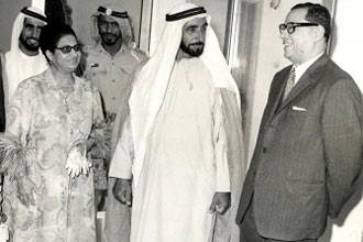
Umm Kulthum with Sheik Zayed in Dubai
© Christie's
Health problems that plagued Umm Kulthum for much of her adult life
Health problems plagued Umm Kulthum every few years for much of her adult life beginning in the 1930s. In the late summer of 1937, when she was 33 years of age, she fell ill and her sickness was diagnosed as some sort of problem with the liver and the gall bladder. Again in the summer of 1946, she had an upper respiratory inflammation, that led to the diagnosis of a thyroid problem. She received treatment at the Bethesda Naval Hospital in the U.S. in 1949. She also sought treatment for the chronic inflammation of her eyes, that was aggravated by the bright lights of the stage and film, that required her to wear dark glasses. Her thyroid problems persisted, and required repeated follow up visits to hospitals in Egypt and abroad.
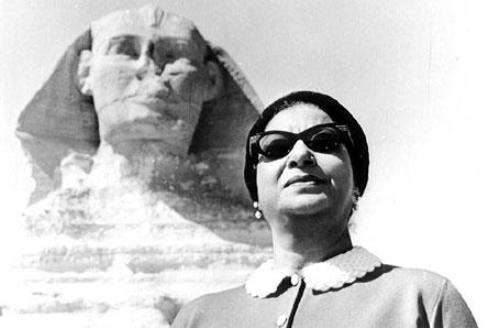
Umm Kulthum standing opposite the Sphinx in Egypt
Photo credit:Arabfilm.com
The aggravation of her health problems with age
The health problems that plagued Umm Kulthum throughout much of her adult life worsened as she grew older. The hypersensitivity of her eyes to light continued into her later years, and she was forced to wear dark glasses constantly. From the year 1971, when she was 67 years old, her health began to decline drastically, with a gall bladder attack in March of that year, that resulted in the postponement of concerts scheduled for March and April. During the following winter, she came down again with a serious kidney infection, that led to the cancellation of two more concerts in February and March of 1972. In December 1972, during the first concert of the new season, she fainted during the program, but continued to sing through the entire concert. However this was her last performance. The continued deterioration of her health caused her to cancel the remainder of the season. From the winter of 1973 through the summer of 1974, she suffered continuously from weak health, and traveled to Europe and the United States to consult kidney specialists. Her last song "Hakam Alaina al-Hawa" was recorded on March 13, 1973. She sang while seated on a chair, as she was too weak to stand up, and the recording took more than 12 hours.
Her last days and the anxiety it caused across the Arab world
On January 21, 1975, she suffered a final kidney attack, but refused to enter hospital, saying that she would die if she goes there. However, her family and close friends eventually decided to admit her to a hospital in Cairo. During her last illness her faithful fans kept vigil earlier at her home in Zamalik and later at the hospital. Reporters from all over the Arab World, thronged the hospital. Many newspapers and radio stations in the Arab world, kept their readers and listeners well informed of her health condition. While the Egyptian newspaper "Al-Ahram" published daily bulletins on her health, the Syrian National Radio Station installed an open telephone line to the hospital to provide its listeners with up-to-the-minute reports on her health condition. Such was the outpouring of concern for the life of Umm Kulthum by the common people of the Arab world, whose lives she touched in many ways, through her strong and vibrant voice, during a singing career that lasted almost five decades. Finally, amidst the prayers of her millions of fans in her beloved country Egypt, and across the Arab world, she passed away peacefully on February 3, 1975. Her death though not unexpected, generated an outpouring of grief across the Arab world, and all nations went into a period of mourning. Most families in the Arab world felt as if a member of their own family had passed away. Such was the love and affection with which she was held by people all over the Middle East.
Arrangements made for her funeral
Soon after her death, arrangements were made by a funeral committee to give her a befitting funeral in keeping with her status as an Arab celebrity, to be held as soon as time permits, in keeping with Islamic traditions. The funeral prayers were to be held at the Umar Makram Mosque in central Cairo, the usual site for funeral prayers for well-known Muslims in the city. After the funeral prayers, the body was to be carried by selected pall-bearers, for a short distance to a vehicle, that would move slowly towards its final resting place. However, before the funeral could take place the committee was informed of the intended arrival of a large number of mourners, that included fans and admirers from across the Arab world. The committee was thus compelled to postpone the funeral for two days, though contrary to Islamic traditions, but not unusual for the funeral of popular leaders, to give foreign admirers a chance to participate in the funeral.
Her funeral attended by over 4 million mourners, one of the largest funeral gatherings in history.
The number of mourners that eventually attended her funeral exceeded over 4 million, one of the largest funeral gatherings in the history of mankind. The number of ordinary Egyptian mourners far exceeded the number anticipated, and the streets of central Cairo was literally packed to capacity. The organizers of the funeral were overwhelmed, and things did not turn out the way the committee had planned. After the funeral prayers at the Umar Makram Mosque in central Cairo, as the coffin was being carried by the selected pall-bearers, pandemonium broke out, and the crowds seized control of the coffin. The crowds took turns and carried the coffin for three hours through the streets of Cairo, eventually taking it to the mosque of al-Sayyid Husayn, believed to be one of Umm Kulthum's favorite mosques. The Sheik of the mosque repeated the funeral prayers over her body, and urged the crowds to carry the body directly to her burial place, reminding them that Umm Kulthum was a pious and religious woman, and would have wanted her remains to be buried quickly in accordance with Islamic rites and practices. The crowd obeyed the instructions of the sheik, and carried the body to the burial place, where she was given a burial according to Islamic rites.
The Umm Kulthum Pearl Necklace is put up for sale at a Christie's auction in Dubai
The descendants of the renowned Egyptian singer Umm Kulthum, put up the historic natural pearl necklace presented to her by Sheik Zayed bin Sultan al-Nahyan, the late President of the United Arab Emirates, for sale, at a Christie's auction of Contemporary Jewels and Watches in Dubai, that was to be held on April 29, 2008, at the Jumeirah Emirates Towers Hotel, Dubai. A pre-sale estimate of $80,000 to $120,000, was placed on the necklace by Christie's.
Prior to the sale, the renowned necklace was put on display at Christie's New York, from April 11 to 14, 2008, and in London on April 18, 2008. On April 27, two days before the sale, the necklace was again put on display at the Jumeirah Emirates Towers Hotel, Dubai, the venue of the auction. Michael Jeha, Managing Director Christie's Middle East, is reported to have made the following comments to "Emirate Business" on the eve of the auction :"The significance of the Umm Kulthum sale centers around her as one of the most famous Arab women in history. Christie's expects a lot of interest in the pearl necklace, conservatively estimated at $80,000 to $120,000. We expect it to exceed its estimate. The provenance of the piece can affect its value; people love to buy provenance; they love to buy into history; It adds to the piece and increases its value."
The Umm Khultum Pearl Necklace fetches a staggering $1.39 million at the April 29, 2008 auction
The Christie's auction of jewels and watches was held at the Godolphin Ballroom at the Jumeirah Emirates Towers Hotel, on April 29, 2008. When the Umm Kulthum Pearl Necklace came up for auction, there was intense bidding for the necklace, which eventually turned out to become a tense battle between two contenders. Finally, the hammer was brought down in favor of one of the unidentified contenders from the Middle East, who paid the staggering amount of 5.1 million Dirhams, equivalent to $1.39 million, for the much-coveted bejeweled necklace, which was 10 times the upper pre-sale estimate of $120,000 placed on the necklace. Thus Michael Jeha's prediction that the necklace would exceed its estimated value, because of its unique provenance, proved to be correct, but the margin of 10 times the estimated value, would have even astounded Mr. Jeha, the Managing Director of Christie's, Middle East.
The same auction saw a 41.5-carat diamond ring sold for $622,000, and an emerald and diamond ring for $712,300.
When was the Umm Kulthum Pearl Necklace given as a gift to Umm Kulthum by Sheik Zayed bin Sultan al-Nahyan?
Sheik Zayed bin Sultan al-Nahyan took control of the destinies of Abu Dhabi on August 9, 1966. The United Arab Emirates, a union of seven of the Gulf Emirates, was inaugurated on December 2, 1971, whose chief architect and first president was Sheik Zayed bin Sultan al-Nahyan. Coincidentally, the year 1971 was also the year Umm Kulthum turned 67 years, and her health began to decline drastically, beginning with a gall bladder inflammation, that resulted in many of her concerts being cancelled. This was followed by her kidney infection in early 1972, that resulted in more cancellations. Her last performance during which she fainted was held in December 1972. In 1973 and 1974 she traveled to Europe and the United States seeking medical treatment for her deteriorating health condition. Her final sickness started in January 1975.
Thus the Umm Kulthum Pearl Necklace was most probably gifted to Umm Kulthum somewhere between 1966, the year Sheik Zayed took control of Abu Dhabi, and 1971, the year the United Arab Emirates was inaugurated. In all probability, the necklace was gifted to her when she visited Abu Dhabi, in the immediate aftermath of the 1967 Arab-Israeli war, as part of an international effort to mobilize support for the Arab cause against Israel, holding a series of domestic and international concerts across the Arab world, collecting contributions and donating the proceeds of her performances to the Government of Egypt. Umm Kulthum took great care of the pearl necklace given to her by Sheik Zayed, and proudly adorned the necklace on several occasions when appearing on stage for her performances, between 1967 and 1971. Thus the historic pearl necklace came to be identified with her image, and was known as the Umm Kulthum Pearl Necklace.
You are welcome to discuss this post/related topics with Dr Shihaan and other experts from around the world in our FORUMS (forums.internetstones.com)
Related :-
External Links :-
Umm Kulthum - Profile by the Egypt State Information Service - www.sis.gov.eg
References :-
1) Zayed bin Sultan al-Nhyan - From Wikipedia, the free encyclopedia
2) Biography of Sheik Zayed bin Sultan al-Nahyan - www.guide.theemiratesnetwork.com
3) History of the United Arab Emirates - From Wikipedia, the free encyclopedia.
4) United Arab Emirates - From Wikipedia, the free encyclopedia.
5) United Arab Emirates -www.infoplease.com
6) United Arab Emirates - The U. S. Department of State. www.state.gov
7) Umm Kulthum's Antique Necklace Fetches $1.3 million -www.elitechoice.org
8) Umm Kulthum necklace is the highlight of Christie's latest UAE jewelry auction - Arabian Watches and Jewellery Business Newsletter. www.mpparabia.com
9) Umm Kulthum : An Outline of her Life - Virginia Louise Danielson, University of Illinois, 1991.
10) Umm Kulthum - From Wikipedia, the free encyclopedia.
 Home
Security & Guarantee
How it Works
Technology Partners
Updated Tables
Famous Diamonds
More Famous Diamonds
Famous Pearls
Famous Gemstones
Contact Dr Shihaan Larif
Contact Senior Editor
Famous Jewelry
Reference Database
Forums
Learning Center
Gemstone Gallery
e-mail Notifications
Advertise
Press Release
About Us
Privacy Policy
Contact Us
FAQ'S
Site Map
Staff Mail Login
Staff Documents
Birthstones
History
Minerals
Shows
Live Metal Prices
Jewellery Gallery
News
Marketplace
Marketplace Support
Open Store
Online Auctions
Join Us & Contribute
Directory
Classifieds
List your products
Wholesale Trading
Post Buy Request
Go Green Policy
Site Updates
Upcoming-ToDo List
Latest News
Latest Articles
Latest Blog Updates
Chat Rooms
Job Board
User Gallery
Videos
New Newsletter Archive
Old Newsletter Archive
Jewelry & Mineral Blog
User Blogs & Social Network
Search
Answers (Q & A)
Valuation
Help me find a diamond/jewelry
pin.internetstones.com- Social Pinboard- Sart yours & connect with millions
Invite Friends From Yahoo, Gmail etc-One Click
Home
Security & Guarantee
How it Works
Technology Partners
Updated Tables
Famous Diamonds
More Famous Diamonds
Famous Pearls
Famous Gemstones
Contact Dr Shihaan Larif
Contact Senior Editor
Famous Jewelry
Reference Database
Forums
Learning Center
Gemstone Gallery
e-mail Notifications
Advertise
Press Release
About Us
Privacy Policy
Contact Us
FAQ'S
Site Map
Staff Mail Login
Staff Documents
Birthstones
History
Minerals
Shows
Live Metal Prices
Jewellery Gallery
News
Marketplace
Marketplace Support
Open Store
Online Auctions
Join Us & Contribute
Directory
Classifieds
List your products
Wholesale Trading
Post Buy Request
Go Green Policy
Site Updates
Upcoming-ToDo List
Latest News
Latest Articles
Latest Blog Updates
Chat Rooms
Job Board
User Gallery
Videos
New Newsletter Archive
Old Newsletter Archive
Jewelry & Mineral Blog
User Blogs & Social Network
Search
Answers (Q & A)
Valuation
Help me find a diamond/jewelry
pin.internetstones.com- Social Pinboard- Sart yours & connect with millions
Invite Friends From Yahoo, Gmail etc-One Click




Our Global Jewelry Industry Job Network


Buy & Sell in our Marketplace

Subscribe to our Newsletter

List in our Classifieds

List in our Directory

User Uploaded Gallery

Powered by Ultra Secure
Amazon (USA) Cloud Network

Founder Internet Stones.COM
Register in our Forums

| Featured In
|
|
|
|
|
|
|
|







Blog & Education Feed
Articles Feed
 |
 |
 |

Copyright © .Internet Stones.COM. All rights reserved.