Uncle Sam Diamond - Famous Diamonds
Open FREE Unlimited Store Join Our Newsletter
Origin of Name
The "Uncle Sam" diamond is the largest diamond ever found in the United States, weighing 40.23 carats and discovered in 1924, by Wesley Oley Basham in the Prairie Creek pipe mine, which later came to be known as the Crater of Diamonds Park, situated in Arkansas. The diamond gets its name from the nick name of the founder W.O. Basham, who was fondly referred to as Uncle Sam by friends and associates. However, some authorities believe the name "Uncle Sam" actually refers to the nickname of the United States, believed to have originated in 1813 from the meat supplier to the United States Army, Samuel Wilson, whose barrels of beef were stamped with the abbreviation U.S. which the soldiers jokingly referred to as coming from "Uncle Sam." Eventually the nickname "Uncle Sam" was given an image by political cartoonist Thomas Nast (1840-1902), who gave Sam a white beard and a stars-and-stripes suit. Thomas Nast is also credited with creating the modern image of Santa Claus. However, the most famous cartoon embodiment of Uncle Sam, and by extension the Government of the United States of America, comes from a World War I recruiting poster by James Montgomery Flagg, in which the cartoon character Uncle Sam was dressed in the patriotic colors of red, white and blue. Since the abbreviation of the name Uncle Sam corresponds with the abbreviation for United States, the cartoon character Uncle Sam became symbolic as a patriotic image of the U.S. As the 40.23-carat rough diamond was the biggest ever found in the United States, the name "Uncle Sam" seems to be the most appropriate for christening this rare diamond, that still retains the coveted title as "the biggest ever diamond found in the United States."

World War I recruiting poster by James Montgomery Flagg depicting the most famous cartoon embodiment of Uncle Sam, and by extension the United States Government

Characteristics of the diamond
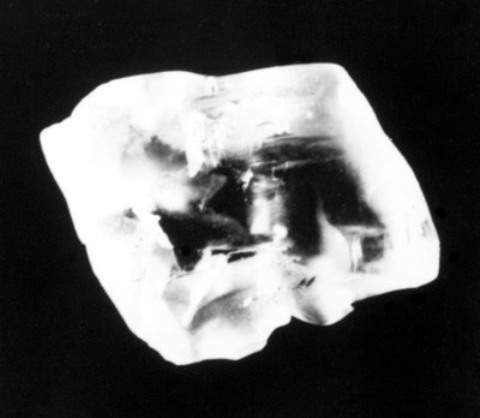
The 40.23-carat Uncle Sam rough diamond crystal before cutting
©The Central Arkansas Library System
Color, clarity, cut and carat weight of the twice-cut "Uncle Sam" diamond
The twice cut and polished "Uncle Sam" diamond is a 12.42-carat, emerald-cut stone with a color grade of "M" equivalent to "Faint Yellow" and a clarity grade of VVS1. The website of the Crater of Diamonds State Park describes the rough "Uncle Sam" diamond as a white diamond with a pink cast weighing 40.23 carats. The clarity of the diamond appears to be exceptional from the photographs of the diamond. The slight pink tone of the diamond that existed in the rough stone was also seen in the cut and polished diamond.
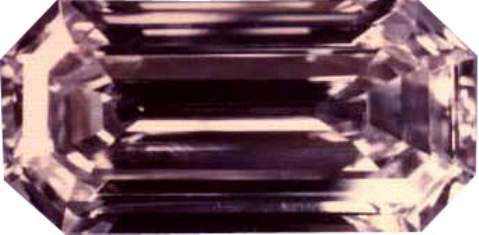
The Uncle Sam Diamond- After cutting
"Uncle Sam" is a Type Ia diamond, yet showing a light pink tone caused by plastic distortion, like the brown Argyle diamonds which are Type Ia, despite the fact the brown color is caused by plastic distortion usually shown by Type IIa diamonds
The slight pink tone of the diamond may be caused by slight plastic distortions in the crystal structure during its formation in the earth's mantle or subsequent violent rise to the earth's surface. The plastically deformed areas of the crystal change the absorption spectrum of the stone imparting the pink color. Hence the "Uncle Sam" diamond can still be categorized as a Type Ia diamond, because of its faint yellow "M" color grade caused by detectable quantities of nitrogen in the diamond, yet giving the slightly pink tone caused by plastic distortion as in Type IIa diamonds. This is similar to Argyle diamonds most of which are classified as Type Ia, because of the presence of detectable quantities of nitrogen, yet brownish in color, due to plastic distortion of the crystal structure.
History
Discovery of the diamond
The rough diamond weighing 40.23 carats was discovered in 1924 in the Prairie Creek Pipe mine at Arkansas, by a workman of the Arkansas Diamond Company, by the name of Wesley Oley Basham, whose nick name was Uncle Sam. The white rough diamond became the largest diamond ever discovered in the United States, and still holds that record.
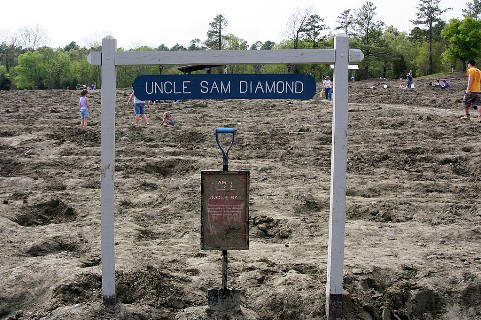
The exact spot in the Crater of Diamonds Park search area where the Uncle Sam diamond was discoverd
Photocredit - Lance and Erin Willett
CC - Some rights reserved
Why the diamond had to be cut twice by the New York based company, Schenck & Van Haelen ?
The rough diamond was said to have been cut twice, by Schenck & Van Haelen of New York, a company that specializes in processing Arkansas diamonds and claims to have handled over 14,000 of these rough diamonds. By experience the company had discovered that Arkansas diamonds are harder than diamonds from other sources, and could be cut successfully only by using diamond powder originating from other Arkansas diamonds. This probably explains why the diamond had to be cut twice. However, the final result of cutting the diamond was a perfect and magnificent emerald-cut diamond, weighing 12.42 carats, a lasting memento for the skill and perfection of the master cutters of the company.
Why an emerald-cut was chosen for the diamond ?
The extraordinary hardnes of the Arkansas diamonds, probably explains why an emerald-cut was chosen for the diamond, instead of the standard brilliant-cut. This was probably because of the lesser number of facets in the emerald-cut (50 facets) when compared to the standard brilliant (57 facets); and the larger rectangular facets in the emerald-cut, which perhaps lessens the difficulty in cutting.
Change in ownership of the diamond
The historic diamond was first owned by Peikin Jewelers of Fifth Avenue, New York. It was Peikin Jewelers that the gave the "Uncle Sam" diamond to the American Museum of Natural History, New York, for display and storage. In 1971, the "Uncle Sam" diamond was acquired by a Boston dealer, Sidney de Young, who subsequently sold it to an anonymous buyer and private collector for $ 150,000. It was Sidney de Young who donated the famous 5.03-carat red diamond known as the "de Young Red" to the National Museum of Natural History of the Smithsonian Institution.
The Crater of Diamonds State Park, the only diamond mine in the world where visitors are free to search for diamonds and keep what they find
The Crater of Diamonds State Park, located on State Highway 301, in Pike Country, southwest Arkansas, near Murfreesboro, is the only diamond mine in the world open to the public, where visitors are free to search for diamonds, and keep what they find. In other words the park is operating a "finders are keepers policy", a unique policy that has never been tried out before in any part of the world. This unique approach had proved to be a tremendous success, attracting over 60,000 visitors to the park every year, among whom the lucky ones discover on an average about 600 diamonds every year. This works out to an average of two diamonds each day.
Geology of the Crater of Diamonds State Park
The Crater of Diamonds mine is actually the eroded surface of a Lamproite pipe
The search area of the Crater of Diamonds State Park is a 36 ½ acre site, which is believed to be the eroded surface of a gem-bearing volcanic pipe known as the Prairie Creek Kimberlite pipe. These diamonds were formed millions or perhaps billions of years ago deep inside the earth's crust about 200 to 300 Km below the surface of the earth. The diamonds were subsequently brought to the surface of the earth by a violent volcanic eruption, estimated to have taken place about 100 million years ago. Test drilling at the crater has shown that the diamond bearing reserve or pipe is shaped like a martini glass, which is consistent with a Lamproite pipe, even though it is commonly referred to as a Kimberlite pipe. The Argyle diamond mine is also believed to be a Lamproite pipe.
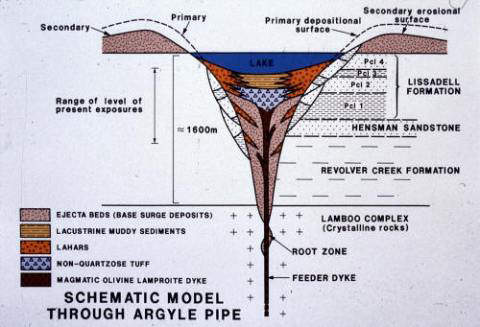
Model of Argyle Lamproite pipe
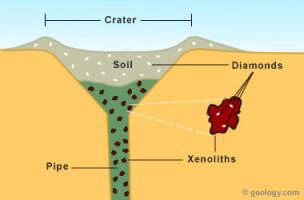
Cross section of a Lamproite pipe. Please note the martini glass shape of the diamond-bearing pipe
© geology.com
The occurrence of Kimberlites and Lamproites in the cratonic areas of the Earth's crust
Kimberlites which are a type of igneous rock are mica Peridotites that are found in pipes. They are rare occurrences in the cratonic (stable) areas of the earth's crust. The stable interiors of South Africa and Siberia have wide spread occurrences, but these pipes are also found in north America, Australia, Brazil and India. Not all Kimberlites contain diamonds. When diamonds do occur they constitute less than one part per million of the rock.
Common characteristics of diamonds found in the "Crater of Diamonds" mine
The diamonds found in the Crater of Diamonds site are generally less than one carat in size. Most of them are about the size of a match head or even smaller. The diamonds exist in different colors, however, the three most common colors found are white, brown and yellow, in that order. Diamonds of significantly larger sizes ranging from 2 to 40 carats have also been discovered, but their occurrence is rare. Diamonds found at the crater are typically smooth well rounded. They have a metallic luster and are generally translucent, i. e. light passes through them but you cannot see the other side.
Other minerals found in the "Crater of Diamonds" site
Besides diamonds a range of other minerals are also found in this site such as quartz, amethyst, garnet, peridot, agate, jasper, calcite, barite. In all about 40 different rocks and minerals have been found in the site of the crater.
History of the discovery of diamonds in the park
John Wesley Huddleston, the owner of a farm on the Prairie Creek site was the first to discover diamonds on the site in 1906
Diamonds were first discovered in the area in 1906, by John Wesley Huddleston who bought a farm on the site. But it is reported that two geologists had studied the site before 1906 with a view of identifying potential diamond-bearing sites, but could not find any diamonds. On August 8, 1906, while Huddleston was spreading rock salt on his hog farm, he observed some shiny specks in the dirt around. His curiosity aroused, Huddleston decided to probe the area that drew his attention, and retrieved two shining pebbles from the dirt. Having refused an offer of 50 cents for the two stones from a local bank cashier, Huddleston dispatched the two stones to a gem expert in New York City, who confirmed that the two stones indeed were diamonds. One stone was a 3.0-carat white diamond, while the other was a 1.5-carat yellow diamond.
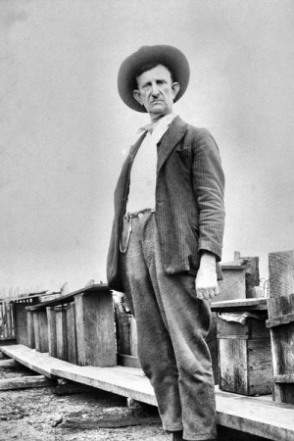
John Wesley Huddleston who first discovered diamonds in the Prairie Creek land
©The Central Arkansas Library System
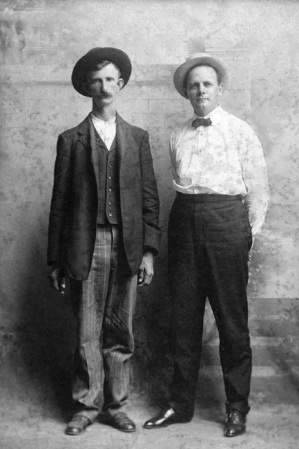
John Huddlestone, the original owner of the Prairie Creek land with Sam Reyburn who acquired the land subsequently
©The Central Arkansas Library System
Huddleston's discovery sparks a diamond rush reminiscent of the South African diamond rush in the late 19th-century
News of the discovery of diamonds by Huddleston sparked a diamond rush in Pike country. The farm next to Huddleston's owned by Millard M. Mauney was also situated in the same gem-bearing crater. Diamond prospectors and fortune hunters rushed to the area, and within a short time the little town of Murfreesboro, assumed a boomtown atmosphere reminiscent of the Kimberley township that developed in the cape region of South Africa during the South African diamond rush in the late 19th century.
Two rival diamond mining companies acquire the land covered by the crater and begin mining operations, that later became sporadic and finally ceased in early 1950s, as operations became uneconomical due to poor yield, mismanagement, lawsuits and sabotage
Huddleston sold his farm to a Diamond Mining Company for $ 36,000, and the public were prohibited from mining in this area. Eventually the entire land covered by the crater became the property of two rival diamond mining companies, the Arkansas Diamond Mining Company and the Ozark Diamond Mines Corporation. It was during this period in 1924, that the largest diamond ever discovered in the United States, was found by a worker of the Arkansas Diamond Mining Company, which was subsequently named the "Uncle Sam" diamond. Over the next four decades the two companies engaged in sporadic mining activity, but operated under severe financial constraints, compounded by poor management, lawsuits and sabotage. Moreover the output of the mine was not sufficient to sustain the operations of the mine and to further expand mining operations. Thus the continued operation of the mine was not economical, and operations ceased at the mine by early 1950s.
Development of the site as a tourist attraction
The two rival companies form a partnership in 1952 to develop the site as a tourist attraction, and introduced the novel concept of opening the mine to the public, to prospect for diamonds for a nominal fee, and allowing them to keep their find
In 1952 the owners of the rival companies formed a partnership, not for further exploration of the mine, which they knew very well was not worthwhile pursuing, but to develop the site as a tourist attraction. They adopted the novel suggestion that the mine area be opened to the public to look for diamonds after paying a nominal fee, and keep what they find. The site was called the "Crater of Diamonds". A museum, gift shop and restaurant were also built and the site was promoted aggressively as a tourist attraction. The project turned out to be a modest success and several diamonds of significant sizes were discovered during this period. They are the 15.33-carat "Star of Arkansas" diamond discovered in 1956, that sparked a second diamond fever. Other diamonds include the 6.42-carat Gary Moore diamond discovered in 1960, and the 34.25-carat "Star of Murfreesboro" discovered in 1964.
In 1972, the State of Arkansas acquire the site, and convert it into the Crater of Diamonds State Park
In 1972 the Crater of Diamonds was purchased by the State of Arkansas, and converted into the Crater of Diamonds State Park. The new state administration of the park continued with the open policy of allowing the public to scout for diamonds for a fee, and keeping the find. Facilities provided for visitors were tremendously improved, and today the park has become one of the leading tourist attractions not only in the state but the entire country. Some of the facilities provided for visitors include camp sites, picnic sites, a cafe, standard pavilion that includes rest rooms, laundry, and gift shops, hiking trails, and interpretive programs for park visitors, and an aquatic play ground called the Diamond Springs. The parks interpretive programs and exhibits explain the site's geology and history and offer tips on recognizing diamonds in the rough. Diamond mining tools are available for rent or purchase. The Diamond Discovery Center provides free identification and certification of diamonds and minerals discovered.
Some important statistics of visitor turnout and production of diamonds
Today the visitor turnout at the park is over 60,000 annually. Over 600 diamonds are discovered annually, which works out to an average of two diamonds per day. Since the discovery of diamonds in the area in 1906, over 70,000 diamonds have been unearthed, and since the establishment of the State owned park in 1972, over 25,000 diamonds have been discovered in the park. The largest diamond discovered since the crater became an Arkansas state park in 1972, was the 16.37-carat white diamond the "Amarillo Starlight" found in 1975 by W. W. Johnson, of Amarillo, Texas. About 15 other diamonds ranging in size from 3 carats to 9 carats, have also been discovered during this period.
Attempts to start commercial mining at the site in the 1990s again abandoned
Preliminary exploratory survey conducted by four mining companies in the early 1990s, to develop the mine as a deep underground mine, was not encouraging and the Crater of Diamonds State Park is destined to remain a public diamond mining park
In early 1990s Governor Bill Clinton of Arkansas signed a bill to authorize a lease for commercial exploration and mining at the park. A consortium of four mining companies undertook a preliminary exploratory survey to look into the possibilities of starting a full-scale deep mining operation. However, by 1994 it was clear that the returns from this exploratory operation were not encouraging, to make a full-scale mining operation viable. Consequently the companies decided to withdraw from the project. Further studies conducted in 1996, confirmed the results of the previous studies, and it appears that the Crater of Diamonds State Park is destined to maintain its status quo as a popular diamond "hunting" ground with all the thrill and adventure associated with it, and may continue to maintain its foremost position as one of the most popular tourist attractions in the country, into the foreseeable future.
You are welcome to discuss this post/related topics with Dr Shihaan and other experts from around the world in our FORUMS (forums.internetstones.com)
Related :-
References :-
1) United States Nicknamed Uncle Sam - September 7, 1813. This Day in History - www.history.com
2) Uncle Sam - From Wikipedia, the free encyclopedia
3) Famous Finds - Crater of Diamonds State Park- www.craterofdiamondsstatepark.com
4) Uncle Sam Diamond Rough - Encyclopedia of Arkansas
5) United States Diamond Mines and Mining -Geology.com
6) Diamond Mining - The Encyclopedia of Arkansas History & Culture. encyclopediaofarkansas.net
 Home
Security & Guarantee
How it Works
Technology Partners
Updated Tables
Famous Diamonds
More Famous Diamonds
Famous Pearls
Famous Gemstones
Contact Dr Shihaan Larif
Contact Senior Editor
Famous Jewelry
Reference Database
Forums
Learning Center
Gemstone Gallery
e-mail Notifications
Advertise
Press Release
About Us
Privacy Policy
Contact Us
FAQ'S
Site Map
Staff Mail Login
Staff Documents
Birthstones
History
Minerals
Shows
Live Metal Prices
Jewellery Gallery
News
Marketplace
Marketplace Support
Open Store
Online Auctions
Join Us & Contribute
Directory
Classifieds
List your products
Wholesale Trading
Post Buy Request
Go Green Policy
Site Updates
Upcoming-ToDo List
Latest News
Latest Articles
Latest Blog Updates
Chat Rooms
Job Board
User Gallery
Videos
New Newsletter Archive
Old Newsletter Archive
Jewelry & Mineral Blog
User Blogs & Social Network
Search
Answers (Q & A)
Valuation
Help me find a diamond/jewelry
pin.internetstones.com- Social Pinboard- Sart yours & connect with millions
Invite Friends From Yahoo, Gmail etc-One Click
Home
Security & Guarantee
How it Works
Technology Partners
Updated Tables
Famous Diamonds
More Famous Diamonds
Famous Pearls
Famous Gemstones
Contact Dr Shihaan Larif
Contact Senior Editor
Famous Jewelry
Reference Database
Forums
Learning Center
Gemstone Gallery
e-mail Notifications
Advertise
Press Release
About Us
Privacy Policy
Contact Us
FAQ'S
Site Map
Staff Mail Login
Staff Documents
Birthstones
History
Minerals
Shows
Live Metal Prices
Jewellery Gallery
News
Marketplace
Marketplace Support
Open Store
Online Auctions
Join Us & Contribute
Directory
Classifieds
List your products
Wholesale Trading
Post Buy Request
Go Green Policy
Site Updates
Upcoming-ToDo List
Latest News
Latest Articles
Latest Blog Updates
Chat Rooms
Job Board
User Gallery
Videos
New Newsletter Archive
Old Newsletter Archive
Jewelry & Mineral Blog
User Blogs & Social Network
Search
Answers (Q & A)
Valuation
Help me find a diamond/jewelry
pin.internetstones.com- Social Pinboard- Sart yours & connect with millions
Invite Friends From Yahoo, Gmail etc-One Click




Our Global Jewelry Industry Job Network


Buy & Sell in our Marketplace

Subscribe to our Newsletter

List in our Classifieds

List in our Directory

User Uploaded Gallery

Powered by Ultra Secure
Amazon (USA) Cloud Network

Founder Internet Stones.COM
Register in our Forums

| Featured In
|
|
|
|
|
|
|
|







Blog & Education Feed
Articles Feed
 |
 |
 |

Copyright © .Internet Stones.COM. All rights reserved.