Lesotho Promise Diamond
Open FREE Unlimited Store Join Our Newsletter
Origin of name
The diamond gets its name from its country of origin, the tiny Kingdom of Lesotho, inside South Africa, where the diamond was discovered at the Letseng diamond mine, high in the mountains of the tiny nation. According to Lesotho's Minister of Natural Resources Mamphono Khaketia, the name "Lesotho Promise" was chosen deliberately to reflect the great promise held out by the previously abandoned diamond mine, for the future. He told reporters while on his visit to Antwerp, Belgium, to attend the sale of the massive diamond, "We promise you more of the same and better in the future."

Characteristics of the stone
The Lesotho Promise is a 603-carat rough diamond discovered at the Letseng diamond mine, in the tiny mountain Kingdom of Lesotho, on August 22nd, 2006. It is the largest diamond to be recovered from this mine, pushing the 601-carat Lesotho Brown, to second place, another large diamond also recovered previously from the same mine. The stone becomes the 15th largest rough diamond to be discovered in the world, and the 10th largest white diamond ever to be found.
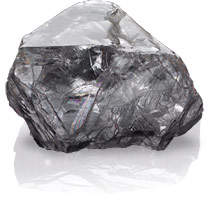
Lesotho Promise rough diamond
© Gem Diamonds
List of largest gem-quality rough diamonds discovered in the world
Name |
Country of discovery | Year of discovery | Carat Weight | Position |
| Cullinan | South Africa | 1905 | 3,106 | 1 |
| Excelsior | South Africa | 1893 | 995 | 2 |
| Star of Sierra Leone | Sierra Leone | 1972 | 969.80 | 3 |
| Incomparable | Zaire | 1984 | 890 | 4 |
| Great Mogul | India | 1650 | 787 | 5 |
| Millennium Star | Zaire | 1990 | 777 | 6 |
| Woyie River | Sierra Leone | 1945 | 770 | 7 |
| Golden Jubilee | South Africa | 1985 | 755 | 8 |
| President Vargas | Brazil | 1938 | 726.60 | 9 |
| Jonker | South Africa | 1934 | 726 | 10 |
| Jubilee-Reitz | South Africa | 1895 | 650.80 | 11 |
| Unnamed | South Africa | 1984 | 620.14 | 12 |
| Sefadu | Sierra Leone | 1970 | 620 | 13 |
| Kimberley Octahedral | South Africa | 616 | 14 | |
| Lesotho Promise | Lesotho | 2006 | 603 | 15 |
| Lesotho Brown | Lesotho | 1967 | 601 | 16 |
| Centenary | South Africa | 1986 | 599 | 17 |
| De Grisogono | Central Africa | 587 | 18 | |
| Lesotho Legacy | Lesotho | 2007 | 493 | 19 |
| Jacob-Victoria | South Africa | 1884 | 457.50 | 20 |
| Zale light of peace | Sierra Leone | 1969 | 435 | 21 |
| De Beers | South Africa | 1888 | 428.50 | 22 |
| Niarchos | South Africa | 1954 | 426.50 | 23 |
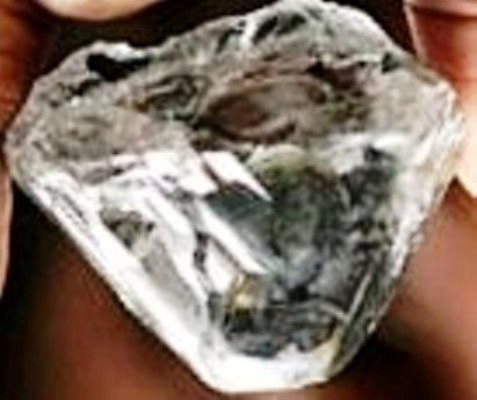
Close-up view of the Lesotho Promise rough diamond
© Graff Diamonds
Another significant fact about the stone is that the Lesotho Promise is the biggest rough diamond to be discovered in the world in 16 years, since the discovery of the 777-carat Millennium Star rough diamond in Mbugi Mayi district of the Democratic Republic of Congo (Zaire) in 1990. The Lesotho Promise also becomes the largest reported find for this century (21st century).
The rough stone is almost pyramidal in shape, which may be appropriate for transformation into a heart-shaped diamond. The stone is exceptionally colorless, with a color rating of D, even in the rough state, the highest color rating for colorless diamonds
History
The Kingdom of Lesotho is an independent Kingdom in Southern Africa, also known as Basutoland, founded around 1820 by Moshoeshoe, subsequently becoming a British colony in 1868 and becoming independent in 1966. The Kingdom is a tiny mountain enclave , within the Republic of South Africa, surrounded by the three provinces of Orange Free State, Kwa Zulu Natal, and Eastern Cape. The Country has an area of 11,720 square miles (30,355 sq. km.). Being surrounded by Southern Africa on all sides, Lesotho is dependent on South Africa for access to the outside world. The lack of resources also make the country economically dependent on South Africa, the country's income coming mainly from textiles, tourism, Angora goats whose coat is used to produce Mohair, and remittances by Basotho mine workers in South Africa.

Clifford Elphick, Chief Executive Officer, Gem Diamonds
Geological surveys of the country had revealed little mineral resources, such as the Uranium deposits near Teyateyaneng, about 30 miles (50 Km) northeast of Maseru, and the Kimberlite pipes in the highlands, producing diamonds. A diamond mine at Letseng-la-Terae (the swamp in the corner) in Mokhotiong, the world's highest diamond mine, discovered in 1957, and mined by De Beers, operated briefly for about five years from 1977-1982. The mine was again re-opened after an agreement was signed in June 1999, between the Lesotho Government and the Gem Diamond Mining Company of Africa Limited. According to this agreement the Company's interests in the mine was limited to 70 %, while the remaining 30 % was owned by the Government.

Roger Davis ,Chairman, Gem Diamonds
© Gem Diamonds
Gem Diamond Mining Company is headed by Clifford Elphick, a former managing director of E. Oppenheimer & Son, the company that runs the investments of the Oppenheimer family, who own a 40% stake in the diamond giant De Beers. The Letseng mine was previously operated by De Beers, from 1977 to 1982. The Gem Diamond Mining Company re-started operations at the mine in the year 2004.
The Lesotho Promise was discovered accidentally by a woman employee of the company, who was just sorting through the rocks at the site of the mine. "She started screaming and the rest of the staff thought she had been electrocuted, and they ran there to see if she was okay. To everyone's surprise they were instead confronted with her accidental discovery-the Lesotho Promise." said Clifford Elphick.
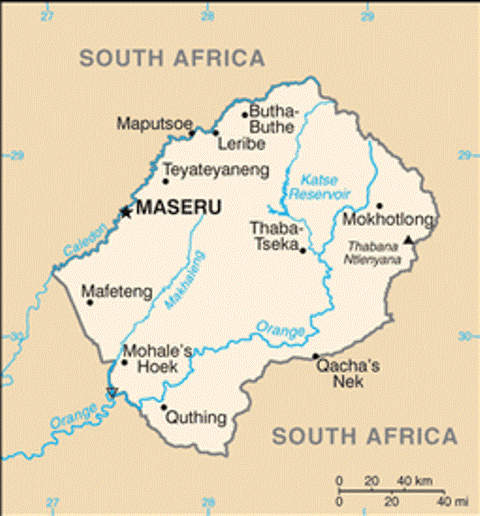
Map of Lesotho - From the CIA World Fact Book
The diamond was dispatched to the Antwerp diamond center in Belgium, where the discovery of the diamond was announced to the world on 4th October 2006, which incidentally happens to be the day the Kingdom of Lesotho gained its independence. Later the diamond was put up for auction on 9th October 2006, but before submitting bids, top diamond cutters and dealers of the world, were given several hours to examine the stone. The auction followed a novel secret bidding procedure in which prospective buyers were requested to submit written bids for the diamond, and the highest bid was selected, provided it satisfied the requirements of the owners. In other words it was similar to a tender competition, and the honor of announcing the results of the tender competition fell on none other than the Honourable Minister of Natural Resources of Lesotho, Mamphono Khaketia, who flew in from Lesotho, specifically for this occasion. The successful bidder for the stone was the South African Diamond Corporation (SAFDICO), a subsidiary and manufacturing arm of the internationally renowned Graff Diamonds, who purchased the stone for $ 12.36 million. Other companies who submitted bids include Antwerp's Rosy Blue Group, Alain Sternberg Bvba and Omega Diamonds.
The uncut diamond which is about a third bigger than a golf ball is expected to be cut into a large heart-shaped diamond and several smaller stones, before being sold.
Johnny Kneller of the South African Diamond Corporation, said, that the stone had to be thoroughly scanned for at least three months before deciding on the best possible diamonds to be cut from it. He also said that giving the exact retail price of the diamond would be difficult, but he hoped that it is going to be over US $ 20 million.
Cutting and Polising of the Lesotho Promise rough diamond
The cutting and polishing of the Lesotho Promise rough diamond was handled by the engineers, gemologists and polishers of SAFDICO's Antwerp manufacturing plant, who worked in consultation with DIAMCAD, a Belgian technology driven polishing company. The engineers and gemologists of both companies subjected the Lesotho Promise rough diamond to an intensive study lasting almost five months, using today's most advanced scanning technology to ensure that all possible cutting and polishing solutions are evaluated.
DIAMCAD - Diamond Computer-Aided Design, is a highly innovative diamond processing company, based in Antwerp, that uses a whole range of high-tech instruments and computer alogrithms to study rough stones and optimize its usage, eliminating all imperfections and inclusions. The scanning technique developed by Diamcad in association with the University of Antwerp, provides the engineers with an accurate 3D model, taking into account the interior as well as the exterior of the stone, helping to analyze the rough diamond and all its imperfections. Having obtained an accurate 3D model of the interior of the stone, the next step involves the simulation of the best combination of stones that would generate the biggest revenue. The state-of-the-art computer algorithm applied, navigates through the inividual constraints of the rough stone and optimizes both the quantity and quality of the simulated outcome. This unique interaction of craftsmanship and science ensured the best possible results obtainable from the rough stone, eliminating most of the imperfections and inclusions. Little wonder then that the final outcome turned out to be all top color (D-color) and internally flawless.
After the thorough scanning process that lasted five months, using high-precision laser machines, the Lesotho Promise rough diamond was initially sawed into eight pieces of different sizes, consisting of three large pieces, one medium-sized piece and four smaller pieces. Each of the eight pieces were again carefully re-subjected to scanning, as if it were a new rough stone, a process that helped to recover more carats and yield more stones.
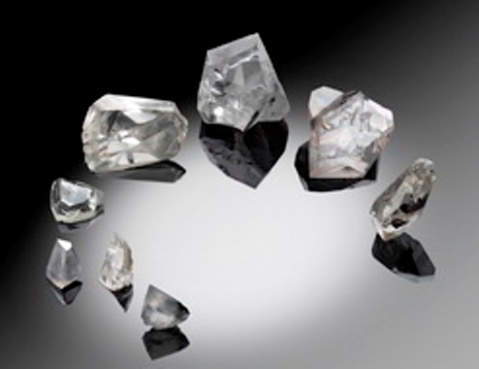
Lesotho Promise after laser sawing
© SAFDICO
Eventually 14 months after Safdico purchased the 603-carat Lesotho Promise, the engineers, gemologists and polishers of Safdico and Diamcad, transformed the enormous stone, the 15th-largest rough diamond ever to be discovered, to 26 astounding diamonds, all D-color flawless, ranging in size from 76.41 carats to 0.55 carats, with a total weight of 223.35 carats. The 76.41-carat, pear-cut, D-flawless diamond came from one of the three larger pieces. A second large piece yielded the 43.12-carat heart-shaped diamond, and the third large piece, a 27.03-carat round brilliant. The 4th largest diamond in the collection, a 20.05-carat emerald-cut, probably came from the medium-sized piece shown above. Out of the remaining 22 diamonds, 6 were pear-shaped, 12 round brilliants, 3 emerald cuts and 1 marquise-cut. The smallest diamond a round brilliant-cut was only 55 points.

Lesotho Promise transformed into 26 D-color flawless diamonds with a total weight of 223.35 carats
© DIAMCAD
Each of the 26 stones is laser inscribed on the girdle with the Graff Logo and its GIA identification number and its own Lesotho Promise number.
The unveiling of the Lesotho Promise Collection by Laurence Graff in December 2007
The finished stones were unveiled by Laurence Graff, Chairman of Graff Diamonds in December 2007 at his London headquarters. Standing before a barrage of cameras, with the ease of a man accustomed to handling millions of pounds worth of diamonds between his thumb and forefinger, Mr. Graff revealed the largest of the 26 diamonds, a 76.41-carat, pear-cut, D-color, flawless diamond. None of the diamonds has been set into jewelry, and Mr. Graff revealed that his intention was to keep the collection intact and sell all 26 stones to just one buyer. He believed that the Lesotho Promise collection was a unique opportunity in the history of the industry, as all the stones had been cut from a single remarkable rough. In a CNBC broadcast in the US, when asked why he is not selling the diamonds separately, Mr. Graff replied, "This is history, and I want to market it as a box of diamonds."
The presentation of the Lesotho Promise collection was of national importance for Lesotho, and the High Commissioner of Lesotho in London, Prince Seeiso Bereng Seeiso, had been invited by Laurence Graff for the unveiling ceremony. The High Commissioner said, "We seem to be having something of a diamond rush. A number of people have been inquiring about the diamonds and although at present only two to three sites are being exploited in our country, more have been identified and we hope that the revenue could be a force for positive change."
Mr. Graff said, "This diamond is one of the most complicated I have ever handled. It was top white color, but we knew it would yield several important stones, rather than one large one. The Lesotho Promise has certainly been one of the highlights of my career, but in our industry you never know what exciting new discovery is waiting to be unearthed. It could be tomorrow or next year - there's always a new gem waiting to be discovered."
The Lesotho Promise Necklace
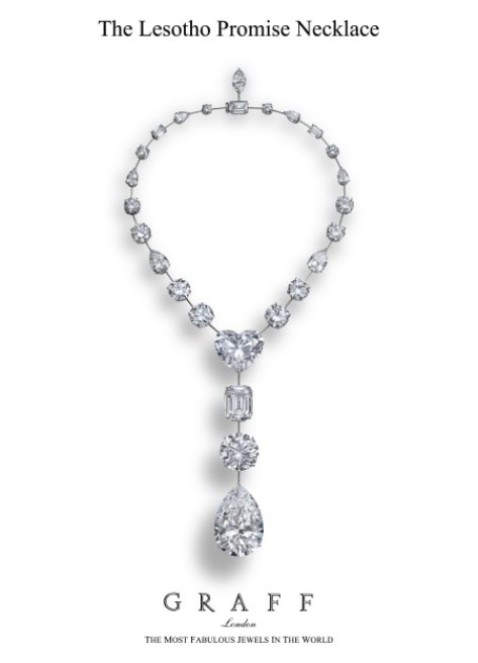
In keeping with Laurence Graff's promise of keeping all the satellite diamonds of Lesotho Promise together and marketing it as a box of diamonds to a single customer, the skilled craftsmen of Graff London under the direction of the veteran jeweller transformed the 26 D-color flawless diamonds into an exquisitely designed white gold Y drop necklace, with three of the largest diamonds incorporated into the pendant part of the necklace. The 43.12-carat heart-shaped diamond is set as the centerpiece of the necklace, from which the pendant and the two arms of the necklace arise. The pendant consists of the 20.05-carat emerald-cut diamond, followed by the 27.03-carat round-brilliant diamond in the middle and the 76.41-carat pear-cut diamond at the tip.
© GRAFF LONDON
The two arms of the necklace are perfectly symmetrical with similar diamonds placed on either side at corresponding points. The sequence of diamonds on one arm of the necklace is as follows :- 2 round brilliants - 1 pear-cut - 2 round brilliants - 1 pear-cut - 1 round brilliant - 1 emerald-cut - 1 pear-cut - 1 round brilliant, making 10 diamonds in each arm. The clasp of the necklace incorporates an emerald cut and marquise cut diamond. Total :- Two arms 20 diamonds + clasp 2 diamonds + centerpiece and pendant 4 diamonds = 26 diamonds.
Laurence Graff unveiled the Lesotho Promise Necklace in early August 2008, at the Salle Empire, Hotel de Paris in Monte Carlo, on the first day of the display of his company's magnificient jewels in Monte Carlo. The necklace was put out on display until August 10, 2008 along with other rare dimonds from Graff's collection, such as "The Flame" a 100-carat pear-shaped D-color internally flawless diamond. Even though no value had been placed on the Lesotho Promise Necklace, it was expected to sell for in excess of US$ 30 million.
Laurence Graff's experience as a jeweler
The purchase of the 603-carat Lesotho Promise rough diamond for the staggering sum of US$ 12.36 million and the transformation of the rough stone, to 26 D-color flawless diamonds worth over US$ 30 million, testifies to the knowledge and experience of Laurence Graff as a gifted and talented jeweler. Recolleting the past, Graff himself says, "When I came across my first diamond I was struck, mesmerized. I felt that I could see right inside the stone and could tell you what it contained. It was an inherent feeling which turned into a lifetime passion."
Laurence Graff and his team spent only four hours in a small room examining the Lesotho Promise rough diamond, with only an eye-glass to help in the examination, but backed by a wealth of experience. After the examination they placed their bid in a sealed envelope, which turned out to be the highest bid of US$ 12.36 million. Graff knew exactly what he was doing. He was confident of the great potential of the rough diamond, and his bid had to be such that no competitor could come anywhere near it, and was still capable of making a profit after cutting and polishing. The fact that the cut and polished stones have a value exceeeding US$ 30 million, more than double the purchase price of the rough diamond, shows that Graff had placed the most appropriate bid, that not only won him the tender, but also gave him a substantial profit from the investment. Only an expert like Graff could place such a bid with confidence. If an ordinary layman had placed such a bid, it would have been characterized as a gamble, as he would not know the outcome of the cutting and polishing of the stone, and there was always the risk of the stone shattering while being cut, a risk that is minimized by modern high-precision laser machines.
You are welcome to discuss this post/related topics with Dr Shihaan and other experts from around the world in our FORUMS (forums.internetstones.com)
Related -
References -
 Home
Security & Guarantee
How it Works
Technology Partners
Updated Tables
Famous Diamonds
More Famous Diamonds
Famous Pearls
Famous Gemstones
Contact Dr Shihaan Larif
Contact Senior Editor
Famous Jewelry
Reference Database
Forums
Learning Center
Gemstone Gallery
e-mail Notifications
Advertise
Press Release
About Us
Privacy Policy
Contact Us
FAQ'S
Site Map
Staff Mail Login
Staff Documents
Birthstones
History
Minerals
Shows
Live Metal Prices
Jewellery Gallery
News
Marketplace
Marketplace Support
Open Store
Online Auctions
Join Us & Contribute
Directory
Classifieds
List your products
Wholesale Trading
Post Buy Request
Go Green Policy
Site Updates
Upcoming-ToDo List
Latest News
Latest Articles
Latest Blog Updates
Chat Rooms
Job Board
User Gallery
Videos
New Newsletter Archive
Old Newsletter Archive
Jewelry & Mineral Blog
User Blogs & Social Network
Search
Answers (Q & A)
Valuation
Help me find a diamond/jewelry
pin.internetstones.com- Social Pinboard- Sart yours & connect with millions
Invite Friends From Yahoo, Gmail etc-One Click
Home
Security & Guarantee
How it Works
Technology Partners
Updated Tables
Famous Diamonds
More Famous Diamonds
Famous Pearls
Famous Gemstones
Contact Dr Shihaan Larif
Contact Senior Editor
Famous Jewelry
Reference Database
Forums
Learning Center
Gemstone Gallery
e-mail Notifications
Advertise
Press Release
About Us
Privacy Policy
Contact Us
FAQ'S
Site Map
Staff Mail Login
Staff Documents
Birthstones
History
Minerals
Shows
Live Metal Prices
Jewellery Gallery
News
Marketplace
Marketplace Support
Open Store
Online Auctions
Join Us & Contribute
Directory
Classifieds
List your products
Wholesale Trading
Post Buy Request
Go Green Policy
Site Updates
Upcoming-ToDo List
Latest News
Latest Articles
Latest Blog Updates
Chat Rooms
Job Board
User Gallery
Videos
New Newsletter Archive
Old Newsletter Archive
Jewelry & Mineral Blog
User Blogs & Social Network
Search
Answers (Q & A)
Valuation
Help me find a diamond/jewelry
pin.internetstones.com- Social Pinboard- Sart yours & connect with millions
Invite Friends From Yahoo, Gmail etc-One Click




Our Global Jewelry Industry Job Network


Buy & Sell in our Marketplace

Subscribe to our Newsletter

List in our Classifieds

List in our Directory

User Uploaded Gallery

Powered by Ultra Secure
Amazon (USA) Cloud Network

Founder Internet Stones.COM
Register in our Forums

| Featured In
|
|
|
|
|
|
|
|







Blog & Education Feed
Articles Feed
 |
 |
 |

Copyright © .Internet Stones.COM. All rights reserved.